


New vehicle sales last month unexpectedly plummeted 12.3 percent from April to about 30,992 units, as COVID-19 lockdowns in Shanghai further disrupted component supply chains and vehicle production, data released by the nation’s motor vehicle offices showed yesterday.
People also became more cautious about buying big-ticket items as rising inflation continues to weigh on the nation’s economic growth, and fear of contracting COVID-19 kept them out of vehicle showrooms.
In the first five months of the year, new vehicle sales tumbled 12 percent year-on-year to 170,520 units.
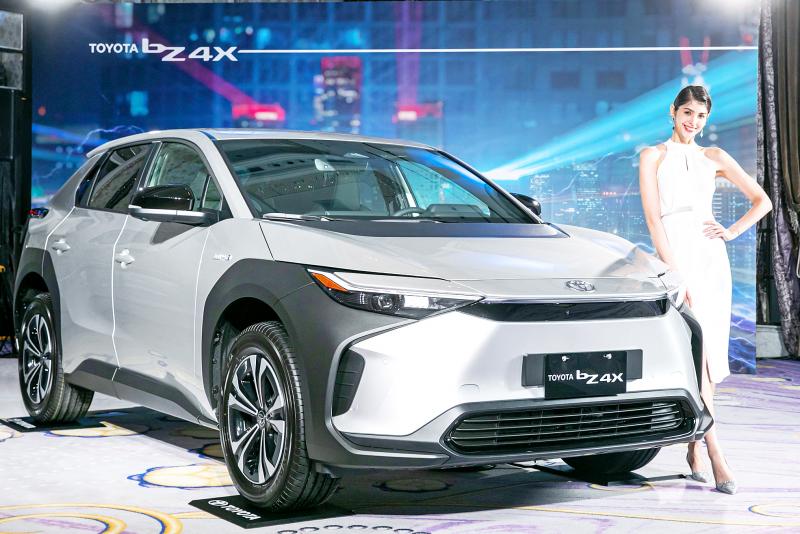
Photo courtesy of Hotai Motor Co
Hotai Motor Co (和泰汽車), which distributes Lexus and Toyota models in Taiwan, said its new vehicle sales last month were similar to April’s 35,000 units, but sales fell about 10 percent from a year earlier.
Sales for this month would likely be flat from last month, the company said.
“The month of May should have been an important sales promotion period for automakers. It is very rare to see such a dismal sales number in May,” market researcher U-Car said in a report yesterday. “As more automakers had a low supply of new cars, some dealers canceled annual sales promotions, or scaled down promotions.”
A vicious cycle of too few components and too few new vehicles led to lower sales in Taiwan, even though the cycle reflected global disruptions, not dampened local demand, the researcher said.
“Only the automakers with better contingency plans and supply chain resiliency will outperform their peers. Tesla Inc sets a good example,” U-Car said.
Tesla saw new vehicle sales last month soar 167.8 percent year-on-year to 1,655 units, raising the automaker’s ranking to No. 6 in terms of sales, close behind Mercedes-Benz Taiwan Ltd’s (台灣賓士) 1,674 units and Ford Lio Ho Motor Co’s (福特六和) 1,689 units.
Mercedes-Benz, ranked No. 5 last month, saw new vehicle sales plunge 38.2 percent from a year earlier, while Ford, ranked No. 4, saw sales fall 21 percent, the companies’ data showed.
Tesla last month took a 5.4 percent market share, the same share as Mercedes-Benz.
China Motor Corp (CMC, 中華汽車) last month edged out Ford to rank No. 3, with new vehicle sales sliding 14.6 percent year-on-year to 1,691 units. CMC and Ford each have a 5.5 percent market share.
Honda Taiwan Co (台灣本田) last month ranked No. 2, with sales falling 10.4 percent annually to 1,778 units. Honda has a 5.7 percent market share.
Hotai ranked No. 1 with a 32.1 percent market share, with Toyota and Lexus sales falling 20.5 percent annually to 9,936 units.

The domestic unit of the Chinese-owned, Dutch-headquartered chipmaker Nexperia BV will soon be able to produce semiconductors locally within China, according to two company sources. Nexperia is at the center of a global tug-of-war over critical semiconductor technology, with a Dutch court in February ordering a probe into alleged mismanagement at the company. The geopolitical tussle has disrupted supply chains, with some carmakers reportedly forced to cut production due to chip shortages. Local production would allow Nexperia’s domestic arm, Nexperia Semiconductors (China) Ltd (安世半導體中國), to bypass restrictions in place since October on the supply of silicon wafers — etched with tiny components to

Singapore-based ride-hailing and delivery giant Grab Holdings Ltd has applied for regulatory approval to acquire the Taiwan operations of Germany-based Delivery Hero SE's Foodpanda in a deal valued at about US$600 million. Grab submitted the filing to the Fair Trade Commission on Friday last week, with the transaction subject to regulatory review and approval, the company said in a statement yesterday. Its independent governance structure would help foster a healthy and competitive market in Taiwan if the deal is approved, Grab said. Grab, which is listed on the NASDAQ, said in the filing that US-based Uber Technologies Inc holds about 13 percent of
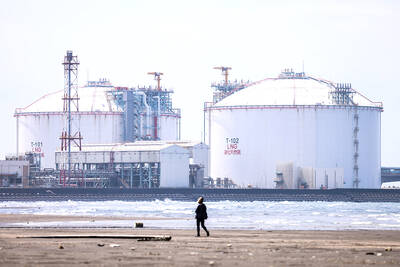
Taiwan is open to joining a global liquefied natural gas (LNG) program if one is created, but on the condition that countries provide delivery even in a scenario where there is a conflict with China, an energy department official said yesterday. While Taiwan’s priority is to have enough LNG at home, the nation is open to exploring potential strategic reserves in other countries such as Japan or South Korea, Energy Administration Deputy Director-General Chen Chung-hsien (陳崇憲) said. While the LNG market does not have a global reserve for emergencies like that of oil, the concept has been raised a few times —

Taiwan Semiconductor Manufacturing Co (TSMC, 台積電) yesterday received government approval to deploy its advanced 3-nanometer (3nm) process at its second fab currently under construction in Japan, the Ministry of Economic Affairs said in a news release. The ministry green-lit the plan for the facility in Kumamoto, which is scheduled to start installing equipment and come online in 2028 with a monthly production capacity of 15,000 12-inch wafers, the ministry said. The Department of Investment Review in June 2024 authorized a US$5.26 billion investment for the facility, slated to manufacture 6- to 12nm chips, significantly less advanced than 3nm process. At a meeting with


 RSS
RSS