


An increase in COVID-19 cases and China’s lockdowns have cast a shadow over business prospects for local manufacturers, and property builders and brokers, the Taiwan Institute of Economic Research (TIER, 台灣經濟研究院) said yesterday.
Service providers, who are taking a hard hit as people avoid nonessential activities, appear less pessimistic based on expectations that things would improve once COVID-19 case numbers stabilize, TIER said in its monthly survey.
The confidence reading for the manufacturing industry declined 4.49 points to 99.1 — its lowest since July 2020 — as sales of machinery equipment, optical devices and plastic products slowed, although foundries held strong, the survey found.
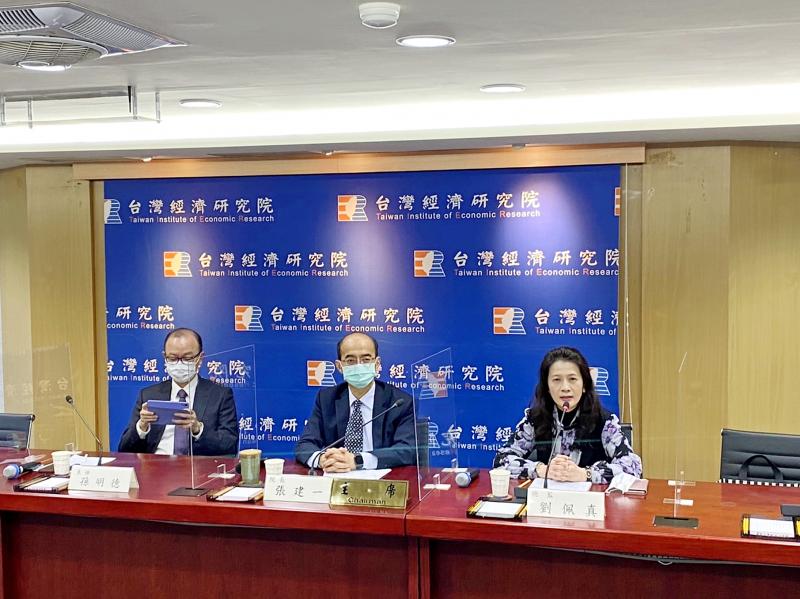
Photo: Allen Wu, Taipei Times
The decline in sentiment had much to do with rising inflationary pressures induced by the Ukraine war, lockdowns in China and surging COVID-19 cases in Taiwan, said Gordon Sun (孫明德), director of the institute’s Economic Forecasting Center.
The number of manufacturers with positive outlooks dropped from 27.9 percent to 25.5 percent, while the number of those with dim outlooks climbed 7.1 points to 14.7 percent, the survey said.
Rising cost burdens prompted customers to become hesitant about placing new orders, explaining why more than 40 percent of machinery equipment suppliers expected the slowdown to persist over the next six months, it said.
Demand for smartphones and laptops lost noticeable momentum, weighing on selling prices for components such as memory chips, camera lenses and flat panels, the survey said, adding that chipmakers fortunately continued to run at full capacity and plan to raise selling prices to reflect cost hikes.
Makers of plastic products also entered a soft patch due to a decline in sales of disease prevention products as countries are choosing to coexist with COVID-19, it said.
The sentiment gauge for the service sector surprisingly rose by 0.21 points to 95.49 as shipping companies and logistics service operators became more optimistic about their business outlook in the next six months because the peak season for shipping consumer goods to the West has begun.
At the same time, travel agencies, hotels and restaurants — although bearing the brunt of the COVID-19 wave at present — are looking forward to Taiwan’s reopening, likely in the second half of this year, it said.
As for property developers and brokers, their confidence score tumbled 7.85 points to 96.1 after housing transactions shrank 11.2 percent in the six special municipalities, the survey said.
More than 40 percent of companies have negative views about the market’s future, citing economic uncertainty, monetary tightening, building material price hikes and labor shortages, it said, adding that spikes in virus cases took a toll on buying interest.
Separately, Samsung Group’s plan to invest US$356 billion in core technologies such as semiconductors is unlikely to displace Taiwan Semiconductor Manufacturing Co (TSMC, 台積電) as the world’s largest contract chipmaker, as the South Korean conglomerate still lags behind TSMC in terms of manufacturing technology and customer relations, said Arisa Liu (劉佩真), a researcher at the Taipei-based institute.
Liu said that while Samsung is second to TSMC in terms of global foundry market share, the gap is huge, with TSMC holding a 52.9 percent share compared with Samsung’s 18.3 percent.
Additional reporting by CNA

NEW IDENTITY: Known for its software, India has expanded into hardware, with its semiconductor industry growing from US$38bn in 2023 to US$45bn to US$50bn India on Saturday inaugurated its first semiconductor assembly and test facility, a milestone in the government’s push to reduce dependence on foreign chipmakers and stake a claim in a sector dominated by China. Indian Prime Minister Narendra Modi opened US firm Micron Technology Inc’s semiconductor assembly, test and packaging unit in his home state of Gujarat, hailing the “dawn of a new era” for India’s technology ambitions. “When young Indians look back in the future, they will see this decade as the turning point in our tech future,” Modi told the event, which was broadcast on his YouTube channel. The plant would convert

Nanya Technology Corp (南亞科技) yesterday said the DRAM supply crunch could extend through 2028, as the artificial intelligence (AI) boom has led the world’s major memory makers to dramatically reduce production of standard DRAM and allocate a significant portion of their capacity for high-bandwidth memory (HBM) chips. The most severe supply constraints would stretch to the first half of next year due to “very limited” increases in new DRAM capacity worldwide, Nanya Technology president Lee Pei-ing (李培瑛) told a news briefing. The company plans to increase monthly 12-inch wafer capacity to 20,000 in the first half of 2028 after a
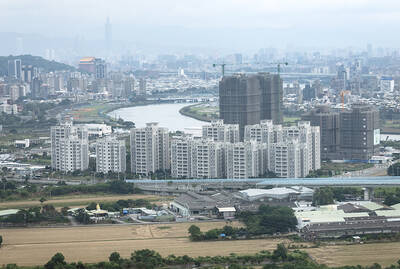
Property transactions in the nation’s six special municipalities plunged last month, as a lengthy Lunar New Year holiday combined with ongoing credit tightening dampened housing market activity, data compiled by local land administration offices released on Monday showed. The six cities recorded a total of 10,480 property transfers last month, down 42.5 percent from January and marking the second-lowest monthly level on record, the data showed. “The sharp drop largely reflected seasonal factors and tighter credit conditions,” Evertrust Rehouse Co (永慶房屋) deputy research manager Chen Chin-ping (陳金萍) said. The nine-day Lunar New Year holiday fell in February this year, reducing
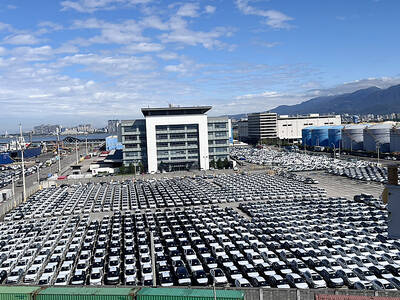
New vehicle sales in Taiwan plunged about 37 percent sequentially last month as the long Lunar New Year holiday and 228 Peace Memorial Day holiday cut short the number of working days, along with the lingering uncertainty over import tax cuts on US vehicles, market researcher U-Car said in a report yesterday. New car sales last month totaled 22,043, slumping from 35,073 units in January and down 19.89 percent from 37,515 in February last year, U-Car data showed. Sales of imported luxury cars, led by Mercedes-Benz, plummeted about 45 percent to 3,109 units last month from 5,663 units in the previous month,


 RSS
RSS