


South Korea’s inflation last month accelerated to the fastest pace since 2008, prompting the central bank to issue a statement as pressure intensifies for it to raise interest rates further at this month’s policy meeting.
Consumer prices advanced 4.8 percent from a year earlier, quickening from 4.1 percent in March and exceeding economists’ estimate of 4.4 percent, data from the statistics office showed yesterday. Transportation costs led the gains, reflecting surging energy prices that have been exacerbated by Russia’s invasion of Ukraine.
Compared with the previous month, consumer prices advanced 0.7 percent, while core inflation accelerated to 3.6 percent from a year earlier, the fastest pace since December 2011.
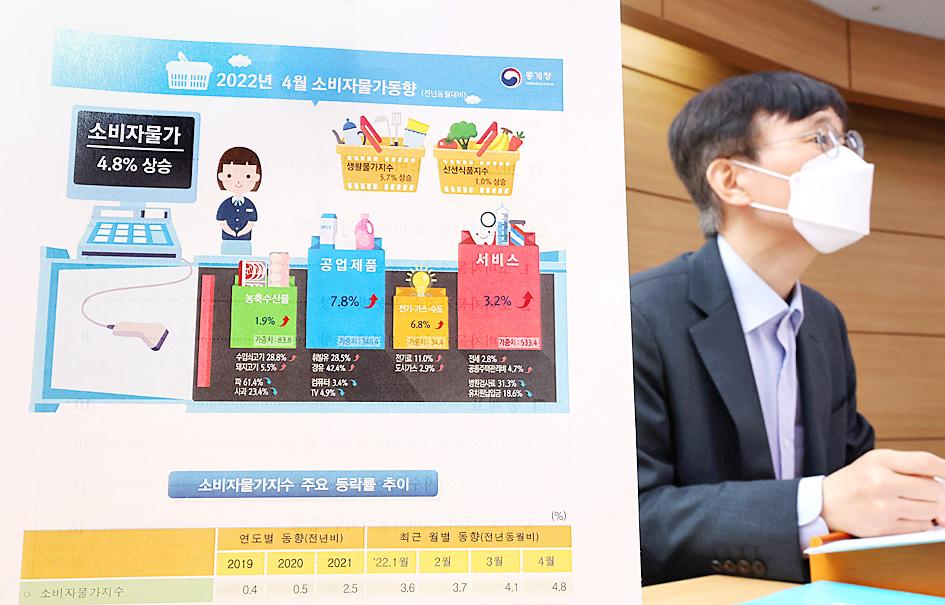
Photo: EPA-EFE
Inflation is forecast to remain in a 4 percent range for the foreseeable future, the Bank of Korea (BOK) said in a statement following the data’s release, a level that is double the central bank’s 2 percent target.
It is “important to stably manage inflation expectations” as pressures rise on items such as gasoline, foods and dining, essential to people’s livelihoods, it said.
Intensifying inflationary pressure is a key factor for the central bank to consider when it meets on May 26 in what would be BOK Governor Rhee Chang-yong’s first rate decision.
The US Federal Reserve is widely expected to raise rates by half a percentage point later this week, as it seeks to rein in consumer prices that jumped in March.
“The number knocked my hat off,” An Young-jin, an economist at SK Securities Co, said of last month’s reading. “The higher-than-consensus figure leads me to believe another rate hike in the BOK meeting in May is inevitable. At this pace, we may even see an inflation number beginning with ‘5.’”
Rhee last week said that inflation remains a bigger concern than threats to the outlook for economic growth. Inflationary pressures that drive up wages to create a vicious circle of price rises is another potential risk facing monetary policy makers.
“Inflation is starting to weigh on the economy,” said Lim Dong-min, a Kyobo Securities researcher. “Policymakers will probably concentrate their firepower in battling inflation this quarter.”
The South Korean Ministry of Finance said in a separate statement earlier that it was quickly implementing various measures, such as fuel tax cuts, to rein in inflationary pressures.
The BOK has already hiked rates four times since August last year, leading the global exit from record monetary stimulus that helped soften the hit from the COVID-19 pandemic, while inflating asset bubbles across the economy.
Potential hurdles in the push toward higher rates are Russia’s war on Ukraine that is weighing on Europe’s economy and COVID-19 lockdowns in China. South Korea’s exports slowed last month as shipments to China fell for the first time since October 2020.
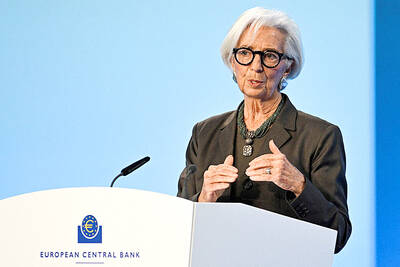
European Central Bank (ECB) President Christine Lagarde is expected to step down from her role before her eight-year term ends in October next year, the Financial Times reported. Lagarde wants to leave before the French presidential election in April next year, which would allow French President Emmanuel Macron and German Chancellor Friedrich Merz to find her replacement together, the report said, citing an unidentified person familiar with her thoughts on the matter. It is not clear yet when she might exit, the report said. “President Lagarde is totally focused on her mission and has not taken any decision regarding the end of
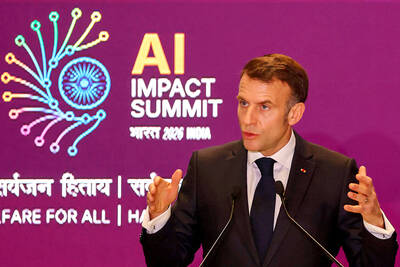
French President Emmanuel Macron told a global artificial intelligence (AI) summit in India yesterday he was determined to ensure safe oversight of the fast-evolving technology. The EU has led the way for global regulation with its Artificial Intelligence Act, which was adopted in 2024 and is coming into force in phases. “We are determined to continue to shape the rules of the game... with our allies such as India,” Macron said in New Delhi. “Europe is not blindly focused on regulation — Europe is a space for innovation and investment, but it is a safe space.” The AI Impact Summit is the fourth
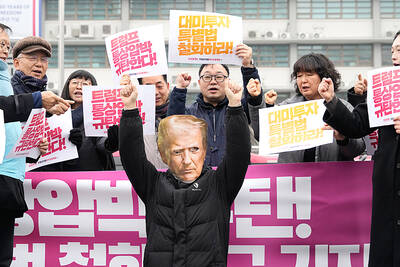
CONFUSION: Taiwan, Japan and other big exporters are cautiously monitoring the situation, while analysts said more Trump responses ate likely after his loss in court US trading partners in Asia started weighing fresh uncertainties yesterday after President Donald Trump vowed to impose a new tariff on imports, hours after the Supreme Court struck down many of the sweeping levies he used to launch a global trade war. The court’s ruling invalidated a number of tariffs that the Trump administration had imposed on Asian export powerhouses from China and South Korea to Japan and Taiwan, the world’s largest chip maker and a key player in tech supply chains. Within hours, Trump said he would impose a new 10 percent duty on US imports from all countries starting on
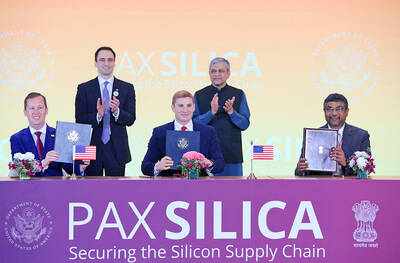
STRATEGIC ALLIANCE: The initiative is aimed at protecting semiconductor supply chain resilience to reduce dependence on China-dominated manufacturing hubs India yesterday joined a US-led initiative to strengthen technology cooperation among strategic allies in a move that underscores the nations’ warming ties after a brief strain over New Delhi’s unabated purchase of discounted Russian oil. The decision aligns India closely with Washington’s efforts to build secure supply chains for semiconductors, advanced manufacturing and critical technologies at a time when geopolitical competition with China is intensifying. It also signals a reset in relations following friction over energy trade and tariffs. Nations that have joined the Pax Silica framework include Japan, South Korea, the UK and Israel. “Pax Silica will be a group of nations


 RSS
RSS