


Oil logged gains for a fifth month after another tumultuous period of trading that saw prices whipsawed by the fallout from Russia’s war in Ukraine and a resurgence of COVID-19 in China.
West Texas Intermediate (WTI) futures climbed 4.4 percent last month, marking the longest monthly winning streak since January 2018.
With the war entering a third month, Germany has signaled that it would not oppose an EU embargo on Russian oil, but expressed skepticism that it is the most effective means of damaging Russian President Vladimir Putin.

Photo: Reuters
China’s outbreak has added another source of volatility. The nation’s leaders pledged to boost economic stimulus to spur growth, but virus lockdowns have swelled oil stockpiles. The world’s top crude importer is on course to register the weakest demand since the early days of the COVID-19 pandemic.
Crude is rallying, with demand concerns perceived to be short-term while supply concerns are persistent, CIBC Private Wealth Management senior energy trader Rebecca Babin said. “Next week will be critical as we will get official selling prices from Saudi as a good litmus test for how much demand is suffering in China.”
WTI crude oil for June delivery on Friday fell US$0.67 to US$104.69 a barrel, up 2.6 percent for the week.
Brent crude for June delivery on Friday rose US$1.75 to US$109.34 a barrel, gaining 2.5 percent weekly.
As the path toward a potential embargo on Russian oil has grown clearer, the oil market’s structure has firmed. On Thursday, WTI was trading in its widest backwardation — a structure that indicates tight supply — in a month.
In earnings news, big oil is among the biggest corporate winners from Russia’s increasing isolation nine weeks into its invasion of Ukraine. Exxon Mobil Corp tripled its share-buyback program to US$30 billion and Chevron Corp said it would repurchase a record US$10 billion of stock before the end of this year.
Meanwhile, diesel futures in New York jumped to a fresh record on Friday in data going back to 1986 ahead of the contract expiration. It has become the world’s most in-demand fuel as buyers compete for supplies from US Gulf Coast refiners that have stepped up to plug the gap left by Russia.
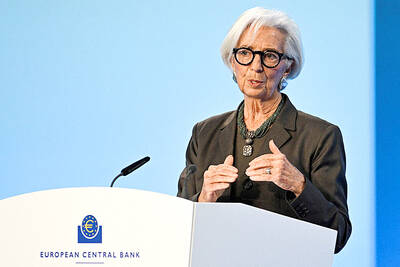
European Central Bank (ECB) President Christine Lagarde is expected to step down from her role before her eight-year term ends in October next year, the Financial Times reported. Lagarde wants to leave before the French presidential election in April next year, which would allow French President Emmanuel Macron and German Chancellor Friedrich Merz to find her replacement together, the report said, citing an unidentified person familiar with her thoughts on the matter. It is not clear yet when she might exit, the report said. “President Lagarde is totally focused on her mission and has not taken any decision regarding the end of
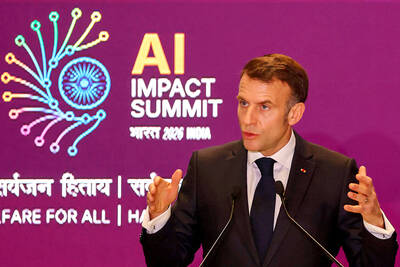
French President Emmanuel Macron told a global artificial intelligence (AI) summit in India yesterday he was determined to ensure safe oversight of the fast-evolving technology. The EU has led the way for global regulation with its Artificial Intelligence Act, which was adopted in 2024 and is coming into force in phases. “We are determined to continue to shape the rules of the game... with our allies such as India,” Macron said in New Delhi. “Europe is not blindly focused on regulation — Europe is a space for innovation and investment, but it is a safe space.” The AI Impact Summit is the fourth
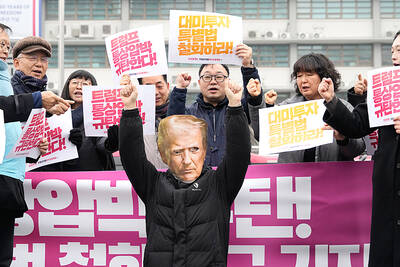
CONFUSION: Taiwan, Japan and other big exporters are cautiously monitoring the situation, while analysts said more Trump responses ate likely after his loss in court US trading partners in Asia started weighing fresh uncertainties yesterday after President Donald Trump vowed to impose a new tariff on imports, hours after the Supreme Court struck down many of the sweeping levies he used to launch a global trade war. The court’s ruling invalidated a number of tariffs that the Trump administration had imposed on Asian export powerhouses from China and South Korea to Japan and Taiwan, the world’s largest chip maker and a key player in tech supply chains. Within hours, Trump said he would impose a new 10 percent duty on US imports from all countries starting on
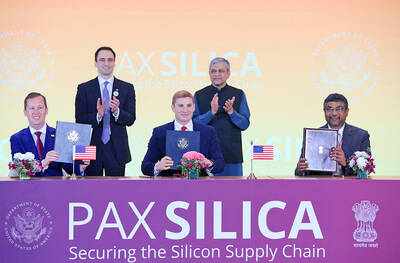
STRATEGIC ALLIANCE: The initiative is aimed at protecting semiconductor supply chain resilience to reduce dependence on China-dominated manufacturing hubs India yesterday joined a US-led initiative to strengthen technology cooperation among strategic allies in a move that underscores the nations’ warming ties after a brief strain over New Delhi’s unabated purchase of discounted Russian oil. The decision aligns India closely with Washington’s efforts to build secure supply chains for semiconductors, advanced manufacturing and critical technologies at a time when geopolitical competition with China is intensifying. It also signals a reset in relations following friction over energy trade and tariffs. Nations that have joined the Pax Silica framework include Japan, South Korea, the UK and Israel. “Pax Silica will be a group of nations


 RSS
RSS