

L’Oreal SA sales climbed as the cosmetics giant benefited from higher demand for its luxury products, weathering COVID-19 restrictions in China.
Sales rose almost 14 percent on a like-for-like basis in the first quarter of this year, the French company said late on Tuesday, beating analyst estimates.
Three of the four main divisions grew by double-digit percentages.
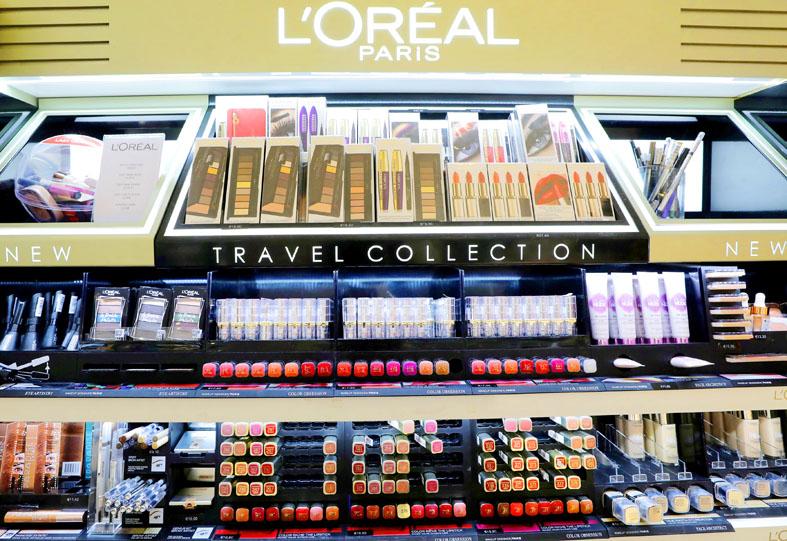
Photo: Reuters
The luxury unit, which includes skincare brands like Helena Rubinstein and Yves Saint Laurent perfume, grew by almost 18 percent. Total sales at the premium unit surpassed the mass-market consumer products business for the first time last year. The latter unit grew 6.9 percent during the quarter.
L’Oreal experienced supply issues that would not be fully solved by the second quarter, chief executive officer Nicolas Hieronimus told analysts in a call.
He forecast that the beauty market would grow 4 and 5 percent this year, with L’Oreal outperforming this growth.
L’Oreal would be able to fully offset the input cost increases of its products, which would affect its gross margin in the first half, chief financial officer Christophe Babule said during the call.
That is despite measures to increase product prices, especially for new launches, as well as a reduction of advertisement and promotional spending as a percentage of total sales, he said.
L’Oreal in China had double-digit percentage growth during the first quarter, outperforming the market in the country thanks to marketing campaigns for the Lunar New Year, Valentine’s Day and Women’s Day, the statement said.
Although current lockdowns are affecting demand, Babule said he is confident that Chinese consumers’ appetite for cosmetics can recover quickly once virus restrictions ease, as happened two years ago.
Hieronimus said the group is still selling essential products in Russia.
“We’re taking all the appropriate measures to offset any reputational risks” related to the company’s presence there, he added. “Should the situation warrant it, we’ll make adjustments.”
Last month, L’Oreal announced that it was temporarily shutting stores as well as its e-commerce site in Russia, even though its plant near Moscow remained open for business. Russia represents about 1.5 percent of total sales for L’Oreal.
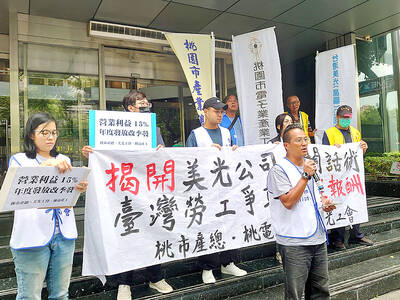
UNION DETERMINATION: Rejecting an offer for a one-time payout as an attempt to influence opinion, the union said a strike at the memory chip manufacturer is possible The Micron Taiwan workers’ union yesterday rejected a one-time payout unveiled by US-based Micron Technology Inc last week, saying it wants a long-term mechanism under which employees would share 15 percent of the company’s operating profits. While the union and the company are still in talks over the dispute, the reward package was proposed unilaterally by the employer without reaching an agreement with the union, union head Jerry Lin (林哲瑞) told reporters. Lin said he suspected the company was seeking to influence public opinion with the move. On Friday last week, Micron announced a reward package under which employees in Taiwan would receive
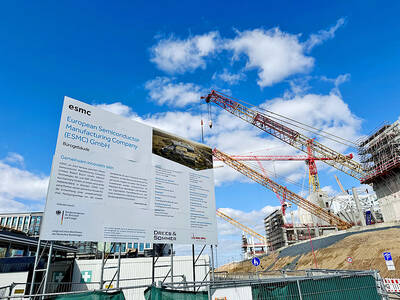
BUILDER’s RITES: The topping out ceremony is held when a project being built has its highest point laid out, a sure sign that TSMC’s European project is making solid progress A “topping out” ceremony was held on Monday at a plant under construction in Germany by Taiwan Semiconductor Manufacturing Co (TSMC, 台積電), indicating that the fab is progressing as planned and within budget, the head of a joint-venture company in charge of the project said. A topping out ceremony is the construction milestone of laying the final beam or structural piece at the highest point of a building, and it honors the construction crew, architects and engineers. European Semiconductor Manufacturing Co (ESMC) president Christian Koitzsch said that about 2,000 workers from 106 countries are working around the clock at the site in

SOME CUSHION: Taiwan’s GDP is forecast to grow more than 11 percent this year, so the economy should be able to absorb the impact of a rate hike, an expert said With domestic inflation topping the 2 percent alert level for a fourth consecutive month last month and several major central banks around the world raising their key interest rates, Taiwan’s central bank is facing growing pressure to raise rates at its quarterly policymaking meeting on Thursday, economists said. At its June meeting, the central bank left interest rates unchanged for the ninth consecutive quarter, with the discount rate at 2 percent. Central Bank Governor Yang Chin-long (楊金龍) had said that the bank maintained a somewhat hawkish stance, with two board directors voicing support for a rate hike at the meeting. Cathay United
APPEAL: Any agreement to produce advanced memory such as HBM or DRAM could run into opposition from Seoul as those technologies are sensitive, sources said South Korea’s SK Hynix Inc is in talks with Intel Corp about a deal that would see it manufacture memory chips on US soil for the first time, three people familiar with the discussions said. Under one potential scenario, SK Hynix would lease part of Intel’s long-planned chipmaking facility in Ohio, they said. Under another scenario, it could form a venture with Intel and major cloud firms that are keen to lock in memory supplies, two of the people said. A deal would relieve pressure on Intel, which has been struggling, and mark a big win for US President Donald


 RSS
RSS