


Export orders last quarter expanded at a faster-than-expected 16.2 percent annually to US$173.13 billion, the best first-quarter performance ever, aided by improving key component supplies and robust demand for chips used in 5G devices, servers and emerging technologies, the Ministry of Economic Affairs said yesterday.
The figure beat the ministry’s estimate of US$168.9 billion to US$170.4 billion, indicating milder seasonal weakness.
Demand for information and communications technology (ICT) and electronics products were much higher than its expectations, and only a fraction of local manufacturers felt the pinch of China’s stringent “zero COVID-19” policy, the ministry said.
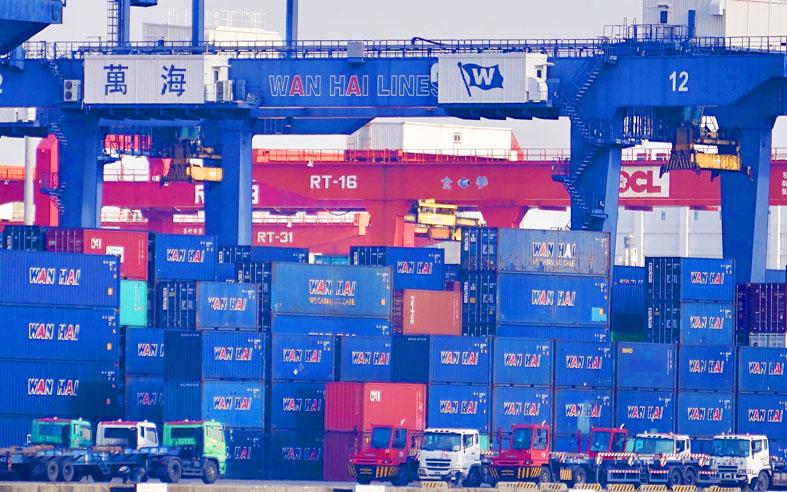
Photo: CNA
That was evident in continued growth in export orders from China, including Hong Kong, which rose 11.4 percent annually to US$43.76 billion, the ministry said.
However, the situation remains dynamic as China imposes lockdowns in more cities and the pace of work resumption at factories remains uneven, it said.
It expects export orders to slide 9.1 to 11.5 percent on a monthly basis to between US$55.5 billion and US$57 billion this month.
That would represent an annual growth rate of 1 to 3.8 percent, the ministry added.
“We are conservative about export orders estimates, due to rising uncertainty. As China is tightening COVID-19-related controls, we are closely monitoring whether April will be a turning point,” Department of Statistics Director Huang Yu-ling (黃于玲) said by telephone yesterday. “Besides, the supply chain bottleneck remains an issue.”
Another unfavorable factor is the Russia-Ukraine war, which has driven commodity prices higher and stoked fears of inflation worldwide, Huang said.
That could result in a global economic slowdown and subsequently depresses demand for goods made by Taiwanese manufacturers, she said.
During the first three months of this year, orders for electronics products — primarily semiconductors — surged 25 percent annually to US$57.77 billion, making the segment the biggest contributor to export orders, ministry data showed.
ICT products came next, with orders swelling 17.9 percent to US$47.76 billion, attributable to an improvement in key component shortages in the laptop and mobile phone sectors.
Orders for optoelectronics products fell 2.4 percent to US$6.97 billion, the only segment that suffered declines, due to falling prices of TV panel displays.
Orders for basic metals, mainly steel, jumped 19.5 percent to US$9.45 billion, thanks to an upward spiral in steel prices driven by commodity price hikes worldwide, the ministry said.
Orders for machine tools advanced 3.8 percent to US$6.7 billion as robust demand for semiconductors offset weakness in demand from China amid a weakening economy.
Orders for plastic products rose 2.7 percent to US$7.4 billion, while those for petrochemical products surged 21.2 percent to US$6.69 billion, buoyed by increases in global crude oil prices.
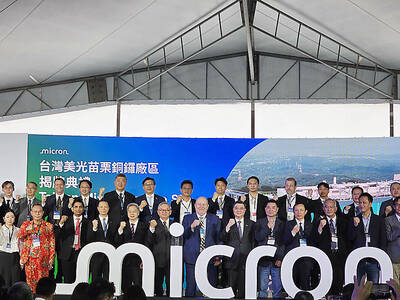
UNPRECEDENTED PACE: Micron Technology has announced plans to expand manufacturing capabilities with the acquisition of a new chip plant in Miaoli Micron Technology Inc unveiled a newly acquired chip plant in Miaoli County yesterday, as the company expands capacity to meet growing demand for advanced DRAM chips, including high-bandwidth memory chips amid the artificial intelligence boom. The plant in Miaoli County’s Tongluo Township (銅鑼), which Micron acquired from Powerchip Semiconductor Manufacturing Corp (力積電) for US$1.8 billion, is expected to make a sizeable capacity contribution to the company from fiscal 2028, the company said in a statement. It would be an extended production site of Micron’s large-scale manufacturing hub in Taichung, the company said. As the global semiconductor industry is racing to reach US$1 trillion

A man walks past real-estate advertisements outside a house in Taipei yesterday. The central bank yesterday said it plans to establish an “Inflation-at-Risk” gauge as a supplementary tool for observing inflation, as policymakers express wish to communicate more effectively with the public when making inflation forecasts.
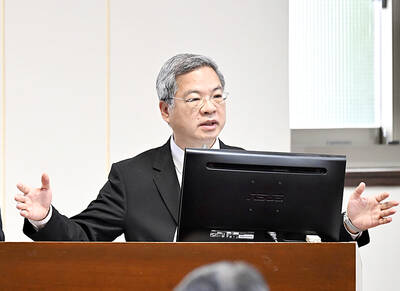
ABOVE LEGAL REQUIREMENT: The Ministry of Economic Affairs is prepared if LNG supply is disrupted, with more than the legal requirement of 11 days of inventory Taiwan has largely secured liquefied natural gas (LNG) supplies through May and arranged about half of June’s supply, Minister of Economic Affairs Kung Ming-hsin (龔明鑫) said yesterday. Since the Middle East conflict began on Feb. 28, Taiwan’s LNG inventories have remained more than 12 days, exceeding the legal requirement of 11 days, indicating no major supply concerns for domestic gas and electricity, Kung said at a meeting of the legislature’s Economics Committee in Taipei. The ministry aims to increase the figure to 14 days by the end of next year, he said. While one or two LNG or crude oil shipments for May

Taiwan’s food delivery market could undergo a major shift if Singapore-based Grab Holdings Ltd completes its planned acquisition of Delivery Hero SE’s Foodpanda business in Taiwan, industry experts said. Grab on Monday last week announced it would acquire Foodpanda’s Taiwan operations for US$600 million. The deal is expected to be finalized in the second half of this year, with Grab aiming to complete user migration to its platform by the first half of next year. A duopoly between Uber Eats and Foodpanda dominates Taiwan’s delivery market, a structure that has remained intact since the Fair Trade Commission (FTC) blocked Uber Technologies Inc’s


 RSS
RSS