


Sri Lankan President Gotabaya Rajapaksa has a fetish for fiasco. The Indian Ocean island is a basket case for several reasons: COVID-19 decimated US dollar earnings from tourism; the resulting increase in social spending ballooned public debt. Then came the war in Ukraine, worsening shortages of food, fuel and foreign currency, but the lion’s share of the blame must go to the president’s quixotic policies.
Rajapaksa has presided over the economy’s undoing: It began with an expensive tax cut soon after taking office in 2019; that was followed by an ill-conceived enthusiasm for organic farming, which destroyed production of rice, the local staple, and tea, a crucial export; and then there is the bizarre embrace of a Chinese-built tax haven as a ticket to growth.
Sri Lanka now has Asia’s fastest inflation rate of almost 19 percent, widespread power outages, and nearly US$5 billion in US dollar-denominated borrowings due this year and next, with just a little more than US$2 billion left in the foreign-exchange kitty.
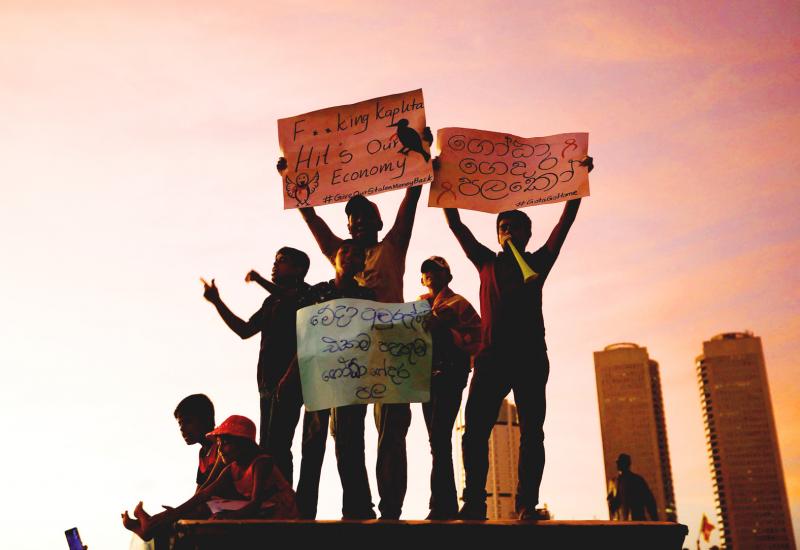
Photo: Reuters
The administration on Tuesday threw in the towel, announcing its intention to default on foreign debt.
Emblematic of this mess is the white elephant Rajapaksa got from China: The Colombo Port City project, envisioned as a playground for the rich who would earn in US dollars and keep all of it. Companies located there could, at the discretion of the commission managing the city, also be exempted from paying taxes and levies.
The 269 hectare patch of reclaimed land is supposed to position the commercial capital of Colombo as the most livable city of South Asia, a tropical paradise version of the Dubai International Financial Center, only twice as large. Never mind the sinking feeling taking hold in other coastal metropolises from Singapore to Jakarta to Manila because of rising sea levels.
The Port City is a costly fantasy, even if it does go on to generate one-sixth of Sri Lanka’s current economic output by 2041, as predicted by an independent study. Although Chinese money is building it, a hub of residential, retail, commercial and financial activity that produces little revenue for the debt-ridden nation cannot possibly be the best use of its coastline or real estate. As the rescuer, the IMF must insist that businesses in the special economic zone pay their share of taxes.
So far, the IMF has been cautious about calling out the Port City for what it is — an outright folly — but it has questioned its overarching purpose.
“The creation of a low-tax jurisdiction is likely to draw attention from the international community given a renewed focus on such matters,” the IMF said recently after a consultation with the Sri Lankan government.
Sri Lanka is swimming against the tide: The tax-free United Arab Emirates is introducing a 9 percent levy on corporate profit from next year and Singapore is exploring a “top-up tax” on multinationals to align its policies with the Organisation for Economic Co-operation and Development’s global rules on base erosion and profit shifting.
The largesse could perhaps be justified if it was an efficient means of attracting investment and boosting living standards.
However, until the zone is functional, its linkages with the broader economy will remain largely restricted to pump-priming construction. Even after 2041, it is unclear exactly how big a draw Port City will be.
“Tax incentives,” as the IMF says, “are often not a critical determinant for attracting investment and the revenue forgone could be better spent on human capital and infrastructure, while improving the doing business environment.”
The project was started in 2014, when Gotabaya’s brother Mahinda, the current prime minister, was president. The family (until recently, there were several more of the Rajapaksa clan in the government) probably thought that Sri Lanka could exploit its strategic naval location to profit from playing China and India, the two large regional powers, against each other.
China Harbor Engineering Co (CHEC, 中國港灣工程), which oversaw the reclamation, was given a 99-year lease on 116 hectares. The Sri Lankan government’s own share of marketable land is only 62 hectares.
India has been extremely critical of a new Chinese enclave in its backyard. Its suspicions about Sri Lanka’s pro-Beijing tilt were aggravated when Rajapaksa booted India and Japan out of a deal to jointly rebuild a partially functional eastern terminal at the Colombo port, next to the China-backed southern terminal, of which China Merchants Port Holdings Co (招商局控股港口) owns 85 percent.
The Sri Lankan government decided to keep ownership of the eastern terminal in local hands, but still gave CHEC a role in construction. To soften up New Delhi, Rajapaksa awarded a 51 percent stake in a new western terminal to India’s Adani Group, without any public tendering process.
Including the Hambantota port, leased to China Merchants Ports by a previous administration to ease its debt burden, and an elevated Colombo highway project handed over to CHEC, the small nation of 22 million seems to have staked most — if not all — of its strategic assets. Yet, all it has to show for its participation in the China-India strategic rivalry is economic misery, broken public finances and a currency in free fall even after the central bank raised interest rates by 7 percentage points in one day to steady the tumbling rupee.
If it was a bad idea for tiny Sri Lanka to get drawn into regional geopolitics, taking sides in the US-China cold war could be worse. Given the project’s Belt and Road connection, Washington would be wary if Port City is as lax about financial regulation as it is generous with letting the rich keep their money. A new Indian Ocean tax haven will raise eyebrows, but a potential hub for beating US sanctions? That simply will not do.
Andy Mukherjee is a Bloomberg Opinion columnist covering industrial companies and financial services. He previously was a columnist for Reuters Breakingviews. He has also worked for the Straits Times, ET Now and Bloomberg News.
This column does not necessarily reflect the opinion of the editorial board or Bloomberg LP and its owners.

The domestic unit of the Chinese-owned, Dutch-headquartered chipmaker Nexperia BV will soon be able to produce semiconductors locally within China, according to two company sources. Nexperia is at the center of a global tug-of-war over critical semiconductor technology, with a Dutch court in February ordering a probe into alleged mismanagement at the company. The geopolitical tussle has disrupted supply chains, with some carmakers reportedly forced to cut production due to chip shortages. Local production would allow Nexperia’s domestic arm, Nexperia Semiconductors (China) Ltd (安世半導體中國), to bypass restrictions in place since October on the supply of silicon wafers — etched with tiny components to

Singapore-based ride-hailing and delivery giant Grab Holdings Ltd has applied for regulatory approval to acquire the Taiwan operations of Germany-based Delivery Hero SE's Foodpanda in a deal valued at about US$600 million. Grab submitted the filing to the Fair Trade Commission on Friday last week, with the transaction subject to regulatory review and approval, the company said in a statement yesterday. Its independent governance structure would help foster a healthy and competitive market in Taiwan if the deal is approved, Grab said. Grab, which is listed on the NASDAQ, said in the filing that US-based Uber Technologies Inc holds about 13 percent of
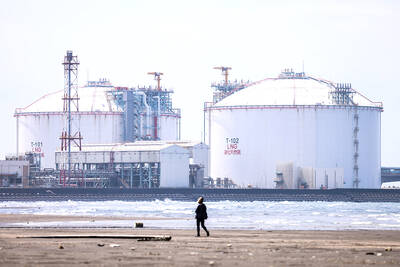
Taiwan is open to joining a global liquefied natural gas (LNG) program if one is created, but on the condition that countries provide delivery even in a scenario where there is a conflict with China, an energy department official said yesterday. While Taiwan’s priority is to have enough LNG at home, the nation is open to exploring potential strategic reserves in other countries such as Japan or South Korea, Energy Administration Deputy Director-General Chen Chung-hsien (陳崇憲) said. While the LNG market does not have a global reserve for emergencies like that of oil, the concept has been raised a few times —

Taiwan Semiconductor Manufacturing Co (TSMC, 台積電) yesterday received government approval to deploy its advanced 3-nanometer (3nm) process at its second fab currently under construction in Japan, the Ministry of Economic Affairs said in a news release. The ministry green-lit the plan for the facility in Kumamoto, which is scheduled to start installing equipment and come online in 2028 with a monthly production capacity of 15,000 12-inch wafers, the ministry said. The Department of Investment Review in June 2024 authorized a US$5.26 billion investment for the facility, slated to manufacture 6- to 12nm chips, significantly less advanced than 3nm process. At a meeting with


 RSS
RSS