


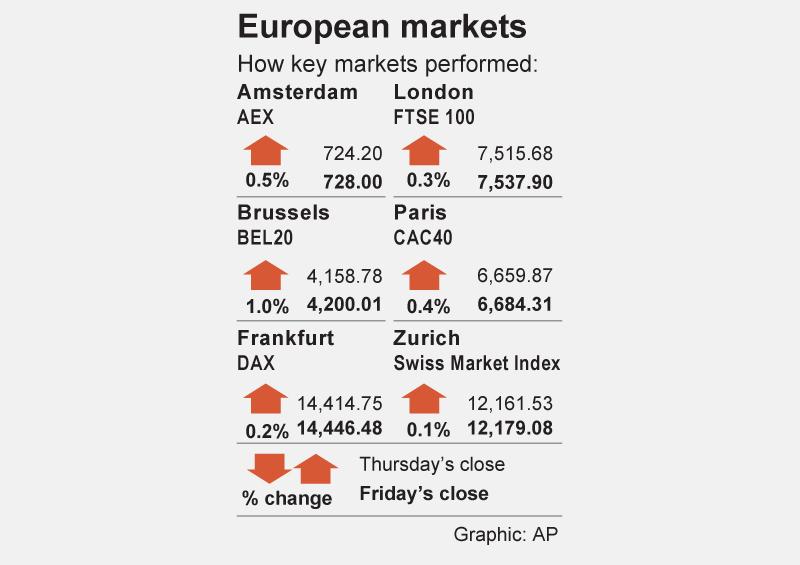
European shares on Friday rose slightly after sluggishness early in the day as a rally in bank stocks helped outweigh worries about economic growth and inflation, with Europe facing a deadline to start paying for Russian gas in rubles.
Russian President Vladimir Putin threatened to cut off gas supplies unless paid in local currency from Friday — a move that could exacerbate an energy crunch in the continent as Russian gas imports account for about 40 percent of Europe’s consumption.
The move comes as a response to Russia’s increasing economic isolation following its invasion on Ukraine.
The Russian government has so far stayed current on its debt obligations. JPMorgan Chase & Co on Thursday processed a nearly US$447 million payment for dollar debt due in 2030.
Another deadline is tomorrow.
Worries about the fallout from the war, compounded by likely central bank tightening to control surging inflation, saw the pan-European STOXX 600 mark its first quarterly loss in two years last month.
The index on Friday rose 0.3 percent. Banks gained 1.1 percent, with Spanish lender Santander firming 3.1 percent after reiterating its profitability target for this year.
Given that not all Russian banks have been sanctioned, markets are calm on hopes that some compromise can be made for gas payments, said Dhaval Joshi, lead strategist at BCA Research.
“If this goes to the worst case where supplies are cut off, it’s not good for Europe, end of story,” Joshi said. “Markets will sell-off.”
Negotiations aimed at ending the five-week war were set to resume even as Ukraine braced for further attacks in the south and east.
Adding to worries were data sets on Friday that pointed to slowing activity in Europe.
“The key question for Q2, maybe even Q3, is when are we going to get the peak inflation,” Joshi said. “Because once we get to a peak in inflation, that will take pressure off long bond yields and one of the headwinds for markets will start to disappear, but that will mean that the nature of the market will change — the long-duration stocks will do better than short duration stocks.”
“Banks, cyclicals and oil stocks which have performed well will reverse,” he said.
Technology stocks were one of the worst performers in the first quarter on inflation worries, down 17 percent.
They led declines on Friday, too, down 0.5 percent.
In France, volatility could also stem from French presidential elections this month.
However, analysts do not expect much of an impact, as French President Emmanuel Macron is widely expected to be re-elected.
Among individual stocks, French catering and food services group Sodexo fell 7.9 percent on narrowing its full-year organic revenue growth forecast, citing uncertainties due to the COVID-19 pandemic and the war in Ukraine.
Eurozone inflation surged by a record 7.5 percent last month.
Analysts said that inflation would put pressure on the European Central Bank (ECB), which has thus far been reluctant to lift interest rates.
“With eurozone inflation rising even further above the ECB’s forecast, and likely to remain very high for the rest of the year, we think it won’t be long before the Bank starts raising interest rates,” said Jack Allen-Reynolds at Capital Economics.
Additional reporting by AFP

UNPRECEDENTED PACE: Micron Technology has announced plans to expand manufacturing capabilities with the acquisition of a new chip plant in Miaoli Micron Technology Inc unveiled a newly acquired chip plant in Miaoli County yesterday, as the company expands capacity to meet growing demand for advanced DRAM chips, including high-bandwidth memory chips amid the artificial intelligence boom. The plant in Miaoli County’s Tongluo Township (銅鑼), which Micron acquired from Powerchip Semiconductor Manufacturing Corp (力積電) for US$1.8 billion, is expected to make a sizeable capacity contribution to the company from fiscal 2028, the company said in a statement. It would be an extended production site of Micron’s large-scale manufacturing hub in Taichung, the company said. As the global semiconductor industry is racing to reach US$1 trillion

Singapore-based ride-hailing and delivery giant Grab Holdings Ltd has applied for regulatory approval to acquire the Taiwan operations of Germany-based Delivery Hero SE's Foodpanda in a deal valued at about US$600 million. Grab submitted the filing to the Fair Trade Commission on Friday last week, with the transaction subject to regulatory review and approval, the company said in a statement yesterday. Its independent governance structure would help foster a healthy and competitive market in Taiwan if the deal is approved, Grab said. Grab, which is listed on the NASDAQ, said in the filing that US-based Uber Technologies Inc holds about 13 percent of

ABOVE LEGAL REQUIREMENT: The Ministry of Economic Affairs is prepared if LNG supply is disrupted, with more than the legal requirement of 11 days of inventory Taiwan has largely secured liquefied natural gas (LNG) supplies through May and arranged about half of June’s supply, Minister of Economic Affairs Kung Ming-hsin (龔明鑫) said yesterday. Since the Middle East conflict began on Feb. 28, Taiwan’s LNG inventories have remained more than 12 days, exceeding the legal requirement of 11 days, indicating no major supply concerns for domestic gas and electricity, Kung said at a meeting of the legislature’s Economics Committee in Taipei. The ministry aims to increase the figure to 14 days by the end of next year, he said. While one or two LNG or crude oil shipments for May

Taiwan’s food delivery market could undergo a major shift if Singapore-based Grab Holdings Ltd completes its planned acquisition of Delivery Hero SE’s Foodpanda business in Taiwan, industry experts said. Grab on Monday last week announced it would acquire Foodpanda’s Taiwan operations for US$600 million. The deal is expected to be finalized in the second half of this year, with Grab aiming to complete user migration to its platform by the first half of next year. A duopoly between Uber Eats and Foodpanda dominates Taiwan’s delivery market, a structure that has remained intact since the Fair Trade Commission (FTC) blocked Uber Technologies Inc’s


 RSS
RSS