


The “snap” of a shutting phone is the nostalgic sound resonating from the giant stands of Samsung Electronics Co, Oppo Mobile Telecommunications Corp (歐珀) and Huawei Technologies Co (華為) at the Mobile World Congress in Barcelona, Spain, this week.
Star of the early 2000s, the flip-phone is making a comeback, with the big names of the industry hoping the high-tech new version — the foldable smartphone — is on the verge of going mainstream.
As production costs start to fall, analysts expect a 10-fold increase in sales by 2026.
Samsung has been the pioneer in the sector, presenting the first foldable smartphone at the Barcelona conference three years ago.
The South Korean firm accounted for 87 percent of foldable phone sales last year, analysts at Display Supply Chain Consultants (DSCC) said.
It vows that its latest models — the Galaxy Fold and Galaxy Z Flip — will give users the sort of experience normally reserved for tablets and laptops.
“We are working with players like Disney+ and YouTube to best integrate their applications into this screen size and make maximum use of all the possibilities of the product,” said Francois Hernandez, vice president and head of IT & Mobility at Samsung France.
However, competition is rising, with companies such as China’s Oppo muscling in.
Its Find N, currently available only in Asia, has seen “really hot” sales in China, said the company’s head of products, Arne Herkelmann.
The foldable phone “is ready for the mass market,” Herkelmann told reporters. “We see that it is becoming more and more mature as a technology, and also reaching more approachable prices, so definitely in the future, you will see more foldable devices.”
It has not just been the technical challenge of creating a bendable screen that has held back the market.
It has also been hard to disrupt the fundamental image — seemingly set in stone with the first iPhone in 2007 — of a smartphone as a large black rectangle with a single touch screen.
They remain a niche segment with a market share of just 0.62 percent last year, said Ritesh Bendre, an analyst at Counterpoint Research.
However, with Huawei — which has its P50 Pocket — Xiaomi Corp (小米), Motorola Mobility LLC and Google working on their own models, that share is expected to reach 3.5 percent by 2025, Bendre said.
A key turning point is expected when Apple Inc joins the fray, which analysts expect to see in about 2025.
“Apple is a hugely influential company,” said Bendre, estimating that foldable sales would surpass 60 million when it gets involved.
“This will add further credibility and help open up the foldable market to iPhone customers,” DSCC cofounder and chief executive officer Ross Young said. “Volumes will depend on whether Apple is aiming for a more expensive or cheaper type of foldable.”
In the upcoming battle of the foldable, Samsung already has the jump on its competitors, especially in the technologies necessary for production.
“Samsung is taking advantage of Apple’s lack of participation and Huawei’s difficulties” linked to US sanctions, Young said. “It sees foldable screens as a way to improve its flagship position against Apple and other brands.”
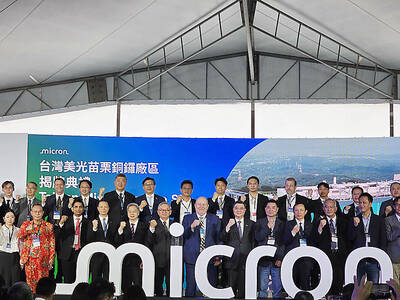
UNPRECEDENTED PACE: Micron Technology has announced plans to expand manufacturing capabilities with the acquisition of a new chip plant in Miaoli Micron Technology Inc unveiled a newly acquired chip plant in Miaoli County yesterday, as the company expands capacity to meet growing demand for advanced DRAM chips, including high-bandwidth memory chips amid the artificial intelligence boom. The plant in Miaoli County’s Tongluo Township (銅鑼), which Micron acquired from Powerchip Semiconductor Manufacturing Corp (力積電) for US$1.8 billion, is expected to make a sizeable capacity contribution to the company from fiscal 2028, the company said in a statement. It would be an extended production site of Micron’s large-scale manufacturing hub in Taichung, the company said. As the global semiconductor industry is racing to reach US$1 trillion

Singapore-based ride-hailing and delivery giant Grab Holdings Ltd has applied for regulatory approval to acquire the Taiwan operations of Germany-based Delivery Hero SE's Foodpanda in a deal valued at about US$600 million. Grab submitted the filing to the Fair Trade Commission on Friday last week, with the transaction subject to regulatory review and approval, the company said in a statement yesterday. Its independent governance structure would help foster a healthy and competitive market in Taiwan if the deal is approved, Grab said. Grab, which is listed on the NASDAQ, said in the filing that US-based Uber Technologies Inc holds about 13 percent of

Taiwan’s food delivery market could undergo a major shift if Singapore-based Grab Holdings Ltd completes its planned acquisition of Delivery Hero SE’s Foodpanda business in Taiwan, industry experts said. Grab on Monday last week announced it would acquire Foodpanda’s Taiwan operations for US$600 million. The deal is expected to be finalized in the second half of this year, with Grab aiming to complete user migration to its platform by the first half of next year. A duopoly between Uber Eats and Foodpanda dominates Taiwan’s delivery market, a structure that has remained intact since the Fair Trade Commission (FTC) blocked Uber Technologies Inc’s

Memory chip stocks extended their losses yesterday after Alphabet Inc’s Google publicized research that could allow more efficient use of the storage needed for artificial intelligence (AI) development. SK Hynix Inc and Samsung Electronics Co, South Korean leaders in the market, fell more than 6 percent and about 5 percent respectively in Seoul. In the US, Micron Technology Inc, Western Digital Corp and Sandisk Corp slid more than 2 percent in pre-market trading, after they all closed lower on Wednesday. Memory companies have been on a tear in recent months as the rapid development of AI infrastructure triggered a spike in chip


 RSS
RSS