


State-run Mega Financial Holding Co (兆豐金控) and First Financial Holding Co (第一金控) yesterday said that they are aiming for stable profit growth this year, despite lingering uncertainties.
Mega Financial said that the operating environment would turn favorable for financial institutions this year after major central banks worldwide disclosed plans to raise interest rates, which would widen interest spreads and profit margins.
The US Federal Reserve last month said that it would raise interest rates by 25 basis points as early as next month and shrink the central bank’s balance sheet to help contain inflation.
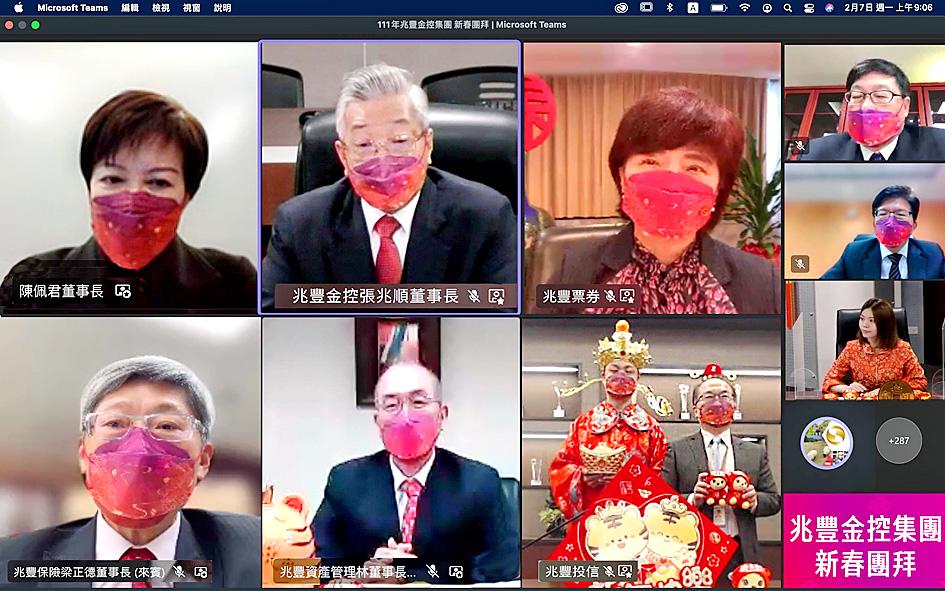
.Photo courtesy of Mega Financial Holding Co
Interest rate hikes would allow Mega Financial to better use its funds and assets and pursue better returns, even though the COVID-19 pandemic and supply chain disruptions would linger, it said.
Mega Financial chairman Michael Chang (張兆順) urged his colleagues to meet the growth challenges by embracing change.
The company’s banking arm, Mega International Commercial Bank (兆豐銀行), has embarked on a transformation process that could take time to bear fruit, Chang said.
Additionally, the bank’s credit card business is now making a profit and its number of cards in circulation has risen above the 1 million mark after three years of effort, he added.
Mega Bank president Robert Tsai (蔡永義) said that the Fed could raise interest rates three to five times this year, which would benefit the Taiwanese lender’s operations.
The bank-focused conglomerate last year posted earnings of NT$1.89 per share, representing a 3 percent increase from a year earlier, although the pace lagged behind its peers, it said.
First Financial Holding said that it is seeking to bolster its operating resiliency and raise profit contributions from non-bank subsidiaries.
First Financial chairwoman Chiou Ye-chin (邱月琴) said that the state-run conglomerate would assign more importance to environmental protection, in line with global efforts to cut carbon emissions.
Its main subsidiary, First Commercial Bank (第一銀行), said that it would deepen relationships with customers and offer wealth management tools that suit their needs.
The lender added that it would make its online banking platform more user-friendly to improve customer service.
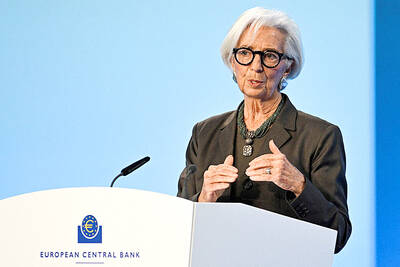
European Central Bank (ECB) President Christine Lagarde is expected to step down from her role before her eight-year term ends in October next year, the Financial Times reported. Lagarde wants to leave before the French presidential election in April next year, which would allow French President Emmanuel Macron and German Chancellor Friedrich Merz to find her replacement together, the report said, citing an unidentified person familiar with her thoughts on the matter. It is not clear yet when she might exit, the report said. “President Lagarde is totally focused on her mission and has not taken any decision regarding the end of
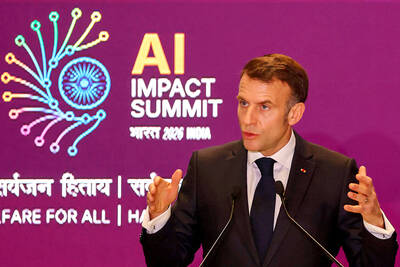
French President Emmanuel Macron told a global artificial intelligence (AI) summit in India yesterday he was determined to ensure safe oversight of the fast-evolving technology. The EU has led the way for global regulation with its Artificial Intelligence Act, which was adopted in 2024 and is coming into force in phases. “We are determined to continue to shape the rules of the game... with our allies such as India,” Macron said in New Delhi. “Europe is not blindly focused on regulation — Europe is a space for innovation and investment, but it is a safe space.” The AI Impact Summit is the fourth
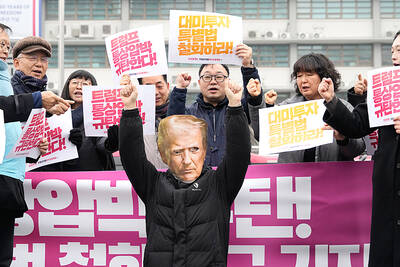
CONFUSION: Taiwan, Japan and other big exporters are cautiously monitoring the situation, while analysts said more Trump responses ate likely after his loss in court US trading partners in Asia started weighing fresh uncertainties yesterday after President Donald Trump vowed to impose a new tariff on imports, hours after the Supreme Court struck down many of the sweeping levies he used to launch a global trade war. The court’s ruling invalidated a number of tariffs that the Trump administration had imposed on Asian export powerhouses from China and South Korea to Japan and Taiwan, the world’s largest chip maker and a key player in tech supply chains. Within hours, Trump said he would impose a new 10 percent duty on US imports from all countries starting on
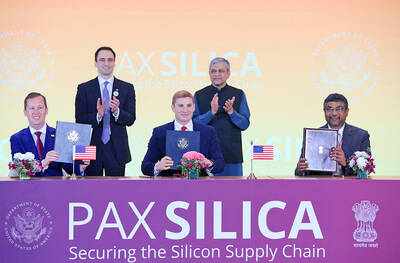
STRATEGIC ALLIANCE: The initiative is aimed at protecting semiconductor supply chain resilience to reduce dependence on China-dominated manufacturing hubs India yesterday joined a US-led initiative to strengthen technology cooperation among strategic allies in a move that underscores the nations’ warming ties after a brief strain over New Delhi’s unabated purchase of discounted Russian oil. The decision aligns India closely with Washington’s efforts to build secure supply chains for semiconductors, advanced manufacturing and critical technologies at a time when geopolitical competition with China is intensifying. It also signals a reset in relations following friction over energy trade and tariffs. Nations that have joined the Pax Silica framework include Japan, South Korea, the UK and Israel. “Pax Silica will be a group of nations


 RSS
RSS