


Shares of Meta Platforms Inc, formerly known as Facebook, on Thursday registered a historic plunge after the social media giant reported a rare profit decline due to a sharp rise in expenses, shaky ad revenue growth, competition from TikTok and fewer daily US users on its flagship platform.
At the same time, it invested more than US$10 billion in CEO Mark Zuckerberg’s ambitious plan to transform Meta Platforms Inc into a virtual reality — or “metaverse-based” — company.
Meta’s shares fell more than 26 percent to US$237.76 in afternoon trading on Thursday, lopping more than US$230 billion off the company’s overall value, or market capitalization. That is the largest single-day decline for a company on record.
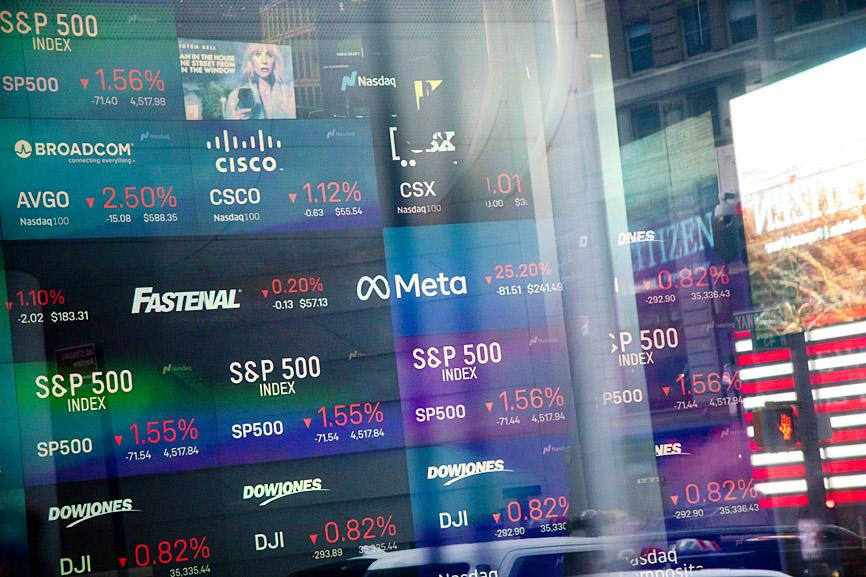
Photo: Bloomberg
“Meta is sacrificing its core business model for its fascination with the metaverse,” said Rachel Jones, an analyst with the research firm GlobalData. “Betting big on the metaverse isn’t a bad thing — the technology is set to be huge and provide a multitude of opportunities — but it will take at least another decade to really get going.”
While tech companies are accustomed to making big bets on futuristic-sounding ideas that sometimes become reality — and come with a huge payoff — Wall Street does not like uncertainty.
There is “continued concern that Facebook’s past challenges will follow Meta into the metaverse,” Forrester Research research director Mike Proulx said. “The company has work to do to convince consumers that Meta’s expression of the metaverse is a good thing.”
Since Meta took on its new name late last year, the company has been shifting resources and hiring engineers — including from competitors such as Apple Inc and Google — who can help Zuckerberg realize his vision.
Despite an enormous backlash to Facebook’s problems ranging from misinformation and privacy mishaps to teen mental health and hate speech, Zuckerberg continues to believe that bold bets to steer the company in new directions have generally paid off.
In a conference call on Wednesday, Zuckerberg said the company’s investments this year would focus on Reels — a TikTok-esque short form video service on Instagram — as well as messaging, ads, commerce, privacy, artificial intelligence “and, of course, the metaverse.”
“Making meaningful progress across all seven of these areas is going to improve the services we offer today and will help power a social, intuitive and entertaining metaverse,” he said.
He acknowledged that “this fully realized vision is still a ways off, and although the direction is clear, our path ahead is not perfectly defined.”
While Wall Street’s metaverse optimism appears to fall well short of Zuckerberg’s, Meta’s rivals are ramping up their own metaverse projects. This includes Apple, Google and Microsoft Corp, which last month bought the video game company Activision Blizzard with the hopes of accelerating its ambitions for the metaverse.
It is not just the big companies. App analytics company SensorTower said that 86 apps added “metaverse” to their title or description from November last year through last month. To date, 552 mobile apps include the term “metaverse” in their title or description.
Stifel analyst Mark Kelley sought to calm investors, saying that Zuckerberg outlined not one, but seven investment priorities for the company this year.
Kelley said he does not think that Meta’s initial goal of reaching 1 billion metaverse users is a stretch — and importantly, he believes only 40 percent would be gamers, signaling its broader appeal.


Taiwanese firms have increased investment in the Philippines in recent years as Manila’s ties with Washington deepen and global supply chains continue to shift away from China, an expert at the Chung-Hua Institution for Economic Research (CIER, 中華經濟研究院) said yesterday. The Philippines had not been among Taiwanese investors’ top choices in Southeast Asia, CIER Taiwan ASEAN Studies Center director Kristy Hsu (徐遵慈) said at a seminar in Taipei. However, Taiwan’s investment in the country has grown significantly since the COVID-19 pandemic, reaching US $257 million last year, a high in recent years, she said. Although Taiwan’s total investment in the Philippines still lags

Intel Corp regards Taiwan Semiconductor Manufacturing Co (TSMC, 台積電) as a longstanding partner, as the US chipmaker would continue outsourcing production of advanced chips to TSMC, Intel chief executive officer Lip-Bu Tan (陳立武) said yesterday. “I don’t look at people as competitors. I look at the collaboration... Nvidia is also, you know, a good friend,” Tan told a news conference following his keynote speech at the Computex trade show in Taipei. “It’s a very trusted partnership for us... We are a big, top customer for them, and we’re going to continue doing that,” he said, referring to TSMC, the world’s largest foundry

Hon Hai Precision Industry Co (鴻海精密) yesterday said it would work with US chipmaker Intel Corp to jointly develop and deploy next-generation artificial intelligence (AI) infrastructure and intelligent computing platforms in a move to capture booming demand for AI computing systems. Hon Hai, also known as Foxconn Technology Group (富士康), said in a statement that the partnership would combine its global manufacturing scale, system integration expertise and AI data center deployment capabilities with Intel’s strengths in processor architecture, silicon technologies and software ecosystem. The companies said they plan to work on equipment used in AI data centers, including server racks powered by

Artificial intelligence (AI) agents would supplant smartphones as the center of people’s digital lives, fundamentally reshaping personal devices and driving a major computing upgrade cycle, Qualcomm Inc CEO Cristiano Amon said yesterday. In his keynote speech for this year’s Computex trade show in Taipei, Amon said that the rise of "agentic AI" — AI systems capable of reasoning, planning and carrying out tasks autonomously — would transform how people interact with technology across phones, PCs, vehicles and wearable devices. Describing the technology as the next major evolution in computing, Amon said that "2026 is the year of agents.” For decades, smartphones have sat


 RSS
RSS