


India turned down a demand of Elon Musk’s Tesla Inc for tax breaks to import electric vehicles (EVs), saying that rules already allow bringing in partially built vehicles and assembling them locally at a lower levy.
“We looked at whether the duties need to be rejigged, but some domestic production is happening and some investments have come in with the current tariff structure,” Indian Central Board of Indirect Taxes and Customs Chairman Vivek Johri said in an interview on Thursday. “So, it is clear that this is not a hindrance.”
Indian Prime Minister Narendra Modi’s administration has encouraged Tesla to produce locally, while Musk wants India to lower taxes — as high as 100 percent on imported EVs — to enable the company to first sell vehicles built elsewhere at competitive prices.
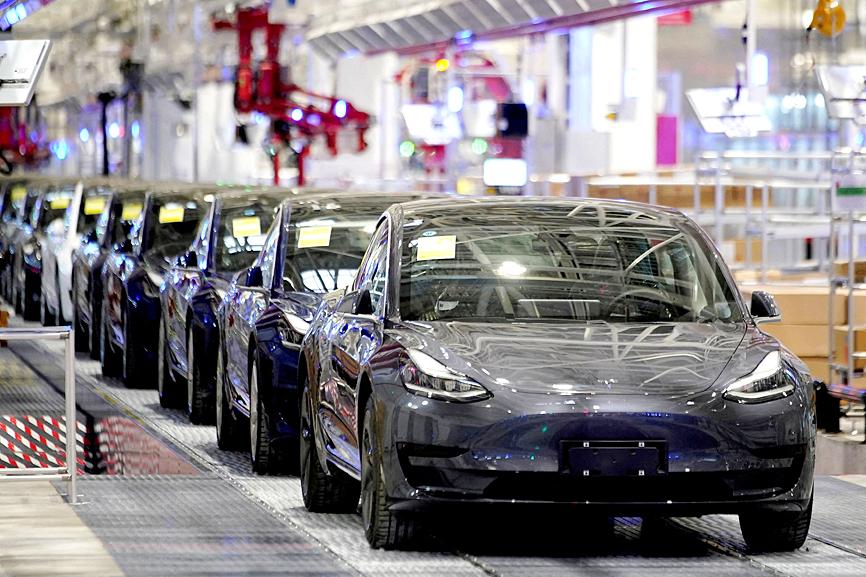
Photo: Reuters
However, it levies import duties of 15 to 30 percent on parts shipped for assembly in the nation.
Tesla has yet to present a plan for local manufacturing and procurement from India, even after the government asked for it, Johri said.
The federal budget earlier this week did not mention any tax breaks for cleaner but imported vehicles, even though the western state of Maharashtra — home to financial capital Mumbai — publicly backed Tesla’s demands.
Politicians from at least five Indian states have invited Tesla to set up shop in their provinces after Musk said last month that the US EV company was still facing challenges with the federal government.
India has asked Tesla to consider importing so-called knocked-down units or partially built vehicles, which attract a lower import levy, instead of fully built units.
Tesla should follow the lead of domestic companies such as Mahindra & Mahindra Ltd and Tata Motors Ltd, which are investing in building local capacity for electric vehicles, Johri said.
“There are others importing completely built units. That route is open,” he said.
Tesla is also up against the likes of Mercedes-Benz, which is to roll out a locally assembled EQS — the electric version of its flagship S-Class sedan — in India by the fourth quarter of this year.
Indian roads are still dominated by cheap, gasoline and diesel-powered vehicles made by the local units of Hyundai Motor Co and Suzuki Motor Corp, with electric vehicles accounting for less than 1 percent of total sales, underscoring a huge opportunity for EV makers in the world’s second-most populous nation.
Tesla first disclosed definite intent of entering India as early as 2019, but Musk said that local rules prohibit him from testing the waters first with imports, as high duties make Tesla vehicles “unaffordable.”
In October last year, an Indian minister said that he had asked Tesla to avoid selling China-made vehicles in the country, and urged the automaker to manufacture, sell and export vehicles from a local factory.
“Some investment has already come in with the current tariff structure. So why can’t others also come in?” Johri said. “There are other foreign brands also which are being sold in the country with the current tariff structure.”
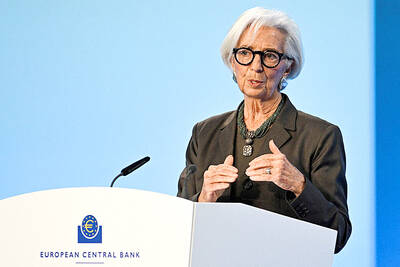
European Central Bank (ECB) President Christine Lagarde is expected to step down from her role before her eight-year term ends in October next year, the Financial Times reported. Lagarde wants to leave before the French presidential election in April next year, which would allow French President Emmanuel Macron and German Chancellor Friedrich Merz to find her replacement together, the report said, citing an unidentified person familiar with her thoughts on the matter. It is not clear yet when she might exit, the report said. “President Lagarde is totally focused on her mission and has not taken any decision regarding the end of
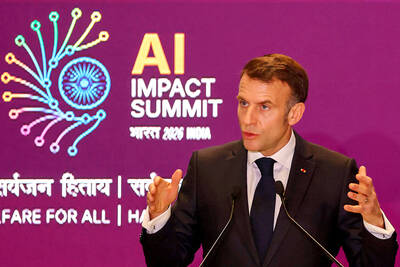
French President Emmanuel Macron told a global artificial intelligence (AI) summit in India yesterday he was determined to ensure safe oversight of the fast-evolving technology. The EU has led the way for global regulation with its Artificial Intelligence Act, which was adopted in 2024 and is coming into force in phases. “We are determined to continue to shape the rules of the game... with our allies such as India,” Macron said in New Delhi. “Europe is not blindly focused on regulation — Europe is a space for innovation and investment, but it is a safe space.” The AI Impact Summit is the fourth
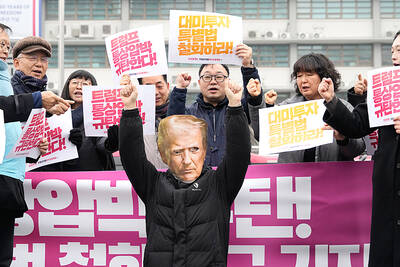
CONFUSION: Taiwan, Japan and other big exporters are cautiously monitoring the situation, while analysts said more Trump responses ate likely after his loss in court US trading partners in Asia started weighing fresh uncertainties yesterday after President Donald Trump vowed to impose a new tariff on imports, hours after the Supreme Court struck down many of the sweeping levies he used to launch a global trade war. The court’s ruling invalidated a number of tariffs that the Trump administration had imposed on Asian export powerhouses from China and South Korea to Japan and Taiwan, the world’s largest chip maker and a key player in tech supply chains. Within hours, Trump said he would impose a new 10 percent duty on US imports from all countries starting on
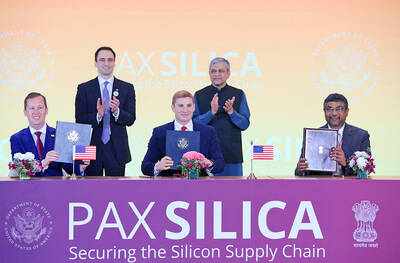
STRATEGIC ALLIANCE: The initiative is aimed at protecting semiconductor supply chain resilience to reduce dependence on China-dominated manufacturing hubs India yesterday joined a US-led initiative to strengthen technology cooperation among strategic allies in a move that underscores the nations’ warming ties after a brief strain over New Delhi’s unabated purchase of discounted Russian oil. The decision aligns India closely with Washington’s efforts to build secure supply chains for semiconductors, advanced manufacturing and critical technologies at a time when geopolitical competition with China is intensifying. It also signals a reset in relations following friction over energy trade and tariffs. Nations that have joined the Pax Silica framework include Japan, South Korea, the UK and Israel. “Pax Silica will be a group of nations


 RSS
RSS