


Advanced Micro Devices Inc (AMD) rallied as much as 12 percent in late trading after giving a surprisingly strong sales forecast, suggesting it is making further gains on archrival Intel Corp in computer processors.
The chipmaker’s first-quarter sales outlook outpaced Wall Street estimates on Tuesday, and AMD is reaching a level of profitability that is nearly identical to Intel’s — something that would have been inconceivable just a few years ago. Fourth-quarter sales and earnings also topped analysts’ predictions.
AMD ended last year with record revenue — up more than threefold from its annual sales five years ago.
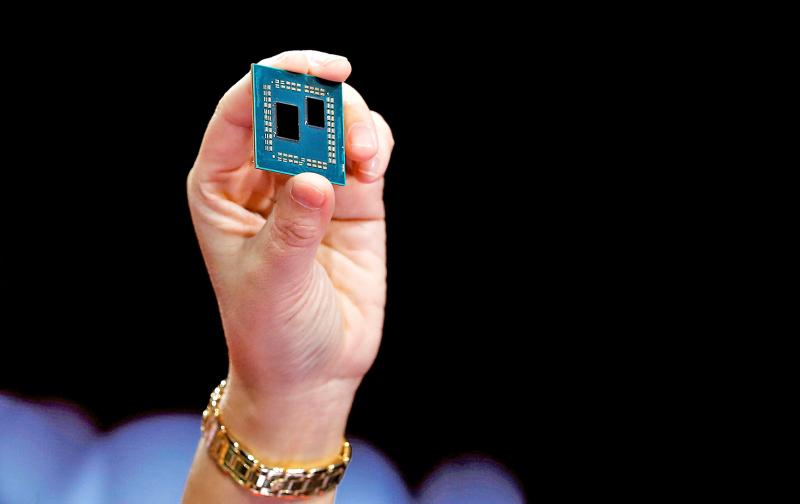
Photo: Reuters
“We still have a very ambitious set of goals in terms of what we believe we can do,” AMD chief executive office Lisa Su (蘇姿丰) said in an interview. “We see secular growth over the next five years because people need more computing.”
First-quarter revenue will be US$5 billion, plus or minus US$100 million, AMD said. That compares with an average analyst estimate of US$4.33 billion.
AMD’s profitability is reaching lofty levels. Its gross margin will be about 51 percent this year. That is nearly on par with Intel’s projection for 51 percent to 53 percent.
AMD shares rose as high as US$130.65 in extended trading after closing at US$116.78 in New York. The stock had fallen 19 percent this year, battered by a broader downturn.
The company’s outlook helped soothe concerns that the chip industry is slowing after a pandemic-fueled boom. AMD predicted a sales gain of about 31 percent to US$21.5 billion this year, compared with an analyst projection of US$19.3 billion.
Under Su, AMD has developed leading-edge components — something her predecessors struggled to do. That has led more chip customers to ditch Intel in favor of AMD. However, Intel CEO Pat Gelsinger, who took the helm last year, is now claiming his company is offering better PC processors than AMD.
“I usually let the numbers speak for themselves and the products speak for themselves,” Su said. “But we’re a very competitive bunch over here.”
AMD data-center sales, including chips used by companies such as Alphabet Inc’s Google and Amazon.com Inc’s AWS, doubled last year compared with 2020. The company said that demand increased from its cloud customers, which are deploying its Epyc server chips in their data centers.
AMD is also the second-largest maker of graphics chips used in add-on cards by PC gamers. It competes in that market with Nvidia Corp and will face fresh opposition from Intel, which has begun offering products for that segment for the first time in years.
AMD, based in Santa Clara, California, reported fourth-quarter net income of US$974 million, or US$0.80 a share, compared with US$1.78 billion, or US$1.45 a share, in the same period a year earlier. Sales rose 49 percent to US$4.83 billion.
Revenue in AMD’s enterprise and semicustom unit, which makes server and gaming console chips, rose 75 percent from a year earlier. Its computing division posted a revenue increase of 32 percent from a year earlier.
AMD also said it expects to close its acquisition of Xilinx Inc in the first quarter. Chinese regulators granted approval for the purchase, which will make AMD one of the largest makers of programmable processors and increase its ability to compete directly with Intel.

The domestic unit of the Chinese-owned, Dutch-headquartered chipmaker Nexperia BV will soon be able to produce semiconductors locally within China, according to two company sources. Nexperia is at the center of a global tug-of-war over critical semiconductor technology, with a Dutch court in February ordering a probe into alleged mismanagement at the company. The geopolitical tussle has disrupted supply chains, with some carmakers reportedly forced to cut production due to chip shortages. Local production would allow Nexperia’s domestic arm, Nexperia Semiconductors (China) Ltd (安世半導體中國), to bypass restrictions in place since October on the supply of silicon wafers — etched with tiny components to

Singapore-based ride-hailing and delivery giant Grab Holdings Ltd has applied for regulatory approval to acquire the Taiwan operations of Germany-based Delivery Hero SE's Foodpanda in a deal valued at about US$600 million. Grab submitted the filing to the Fair Trade Commission on Friday last week, with the transaction subject to regulatory review and approval, the company said in a statement yesterday. Its independent governance structure would help foster a healthy and competitive market in Taiwan if the deal is approved, Grab said. Grab, which is listed on the NASDAQ, said in the filing that US-based Uber Technologies Inc holds about 13 percent of

Taiwan is open to joining a global liquefied natural gas (LNG) program if one is created, but on the condition that countries provide delivery even in a scenario where there is a conflict with China, an energy department official said yesterday. While Taiwan’s priority is to have enough LNG at home, the nation is open to exploring potential strategic reserves in other countries such as Japan or South Korea, Energy Administration Deputy Director-General Chen Chung-hsien (陳崇憲) said. While the LNG market does not have a global reserve for emergencies like that of oil, the concept has been raised a few times —

Taiwan Semiconductor Manufacturing Co (TSMC, 台積電) yesterday received government approval to deploy its advanced 3-nanometer (3nm) process at its second fab currently under construction in Japan, the Ministry of Economic Affairs said in a news release. The ministry green-lit the plan for the facility in Kumamoto, which is scheduled to start installing equipment and come online in 2028 with a monthly production capacity of 15,000 12-inch wafers, the ministry said. The Department of Investment Review in June 2024 authorized a US$5.26 billion investment for the facility, slated to manufacture 6- to 12nm chips, significantly less advanced than 3nm process. At a meeting with


 RSS
RSS