


The Financial Supervisory Commission (FSC) has suspended consideration of IBF Financial Holdings Co’s (國票金控) proposal to fully acquire EnTie Commercial Bank (安泰銀行), as IBF Financial had failed to address four of the commission’s doubts about the deal, Banking Bureau Director-General Sherri Chuang (莊琇媛) said yesterday.
The four doubts regard IBF’s financial strength, its funding resources, the benefits from consolidation and job protection, Chuang said.
IBF Financial can refile its application after it fully addresses these issues, Chuang said.

Photo: CNA
“We noticed that nearly half of the company’s board of directors did not support the merger, and some lawsuits have even been filed amid disputes,” Chuang said. “Under these circumstances, the acquisition of EnTie bank might not be beneficial for IBF Financial’s operation.”
Seven members of IBF Financial’s 13-seat board voted for the acquisition, with six against, she said.
The commission said that IBF Financial should ideally have support from a larger majority of its board members’ and shareholders before reopening the application, she said.
As IBF Financial has invested in the online Rakuten International Commercial Bank Co (樂天國際商銀), and both the online bank and EnTie bank might need capital injection in the future, the FSC questioned whether IBF Financial would have sufficient capital to support both banking units, Chuang said.
IBF Financial plans to acquire EnTie’s shares through a cash-and-share swap. Each EnTie shareholder would receive NT$9.46673 in cash and 0.493344 class A preferred shares, which could be converted to IBF’s common shares after one year for each EnTie share, corporate data showed.
However, the commission is concerned that the swap plan could weaken IBF Financial’s shareholding structure, as the financial service provider did not receive overwhelming support from its board members for the merger, and it might need to seek investors to subscribe to as high as 26 percent of the new shares that are to be issued to fund the merger, Chuang said.
“IBF did not clearly explain who the investors would be. If most of the new shares are to be bought by specific individuals, the buyers could become major shareholders. We would need to review the shareholders’ qualifications,” Chuang said.
IBF Financial said that it would talk with the regulator and make a case for the deal.
EnTie Bank said that its operation would continue unchanged despite the FSC’s rejection of the merger, it said.
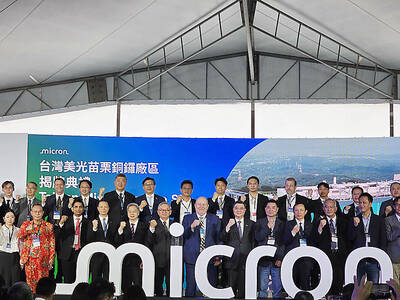
UNPRECEDENTED PACE: Micron Technology has announced plans to expand manufacturing capabilities with the acquisition of a new chip plant in Miaoli Micron Technology Inc unveiled a newly acquired chip plant in Miaoli County yesterday, as the company expands capacity to meet growing demand for advanced DRAM chips, including high-bandwidth memory chips amid the artificial intelligence boom. The plant in Miaoli County’s Tongluo Township (銅鑼), which Micron acquired from Powerchip Semiconductor Manufacturing Corp (力積電) for US$1.8 billion, is expected to make a sizeable capacity contribution to the company from fiscal 2028, the company said in a statement. It would be an extended production site of Micron’s large-scale manufacturing hub in Taichung, the company said. As the global semiconductor industry is racing to reach US$1 trillion

Singapore-based ride-hailing and delivery giant Grab Holdings Ltd has applied for regulatory approval to acquire the Taiwan operations of Germany-based Delivery Hero SE's Foodpanda in a deal valued at about US$600 million. Grab submitted the filing to the Fair Trade Commission on Friday last week, with the transaction subject to regulatory review and approval, the company said in a statement yesterday. Its independent governance structure would help foster a healthy and competitive market in Taiwan if the deal is approved, Grab said. Grab, which is listed on the NASDAQ, said in the filing that US-based Uber Technologies Inc holds about 13 percent of

Taiwan’s food delivery market could undergo a major shift if Singapore-based Grab Holdings Ltd completes its planned acquisition of Delivery Hero SE’s Foodpanda business in Taiwan, industry experts said. Grab on Monday last week announced it would acquire Foodpanda’s Taiwan operations for US$600 million. The deal is expected to be finalized in the second half of this year, with Grab aiming to complete user migration to its platform by the first half of next year. A duopoly between Uber Eats and Foodpanda dominates Taiwan’s delivery market, a structure that has remained intact since the Fair Trade Commission (FTC) blocked Uber Technologies Inc’s

Memory chip stocks extended their losses yesterday after Alphabet Inc’s Google publicized research that could allow more efficient use of the storage needed for artificial intelligence (AI) development. SK Hynix Inc and Samsung Electronics Co, South Korean leaders in the market, fell more than 6 percent and about 5 percent respectively in Seoul. In the US, Micron Technology Inc, Western Digital Corp and Sandisk Corp slid more than 2 percent in pre-market trading, after they all closed lower on Wednesday. Memory companies have been on a tear in recent months as the rapid development of AI infrastructure triggered a spike in chip


 RSS
RSS