


While the Omicron variant of SARS-CoV-2 stirs up pandemic deja vu in the US with swamped hospitals, canceled flights and millions of people quarantined — one trend that dominated earlier COVID-19 waves is on the decline: binge boozing.
It has been widely documented that alcohol consumption surged in the US in 2020 and began to ease up last year. This year has begun with overwhelming participation in Dry January — 19 percent of American adults are abstaining from alcohol (or trying to) this month, according to one survey. What is surging now is the business of non-alcoholic booze.
Yes, mocktails are having their moment. While it is hard to take faux anything seriously, this latest trend is not as trivial as it may sound. Sales of non-alcoholic beverages spiked 33 percent to US$331 million in the past year, NielsenIQ reported last fall.
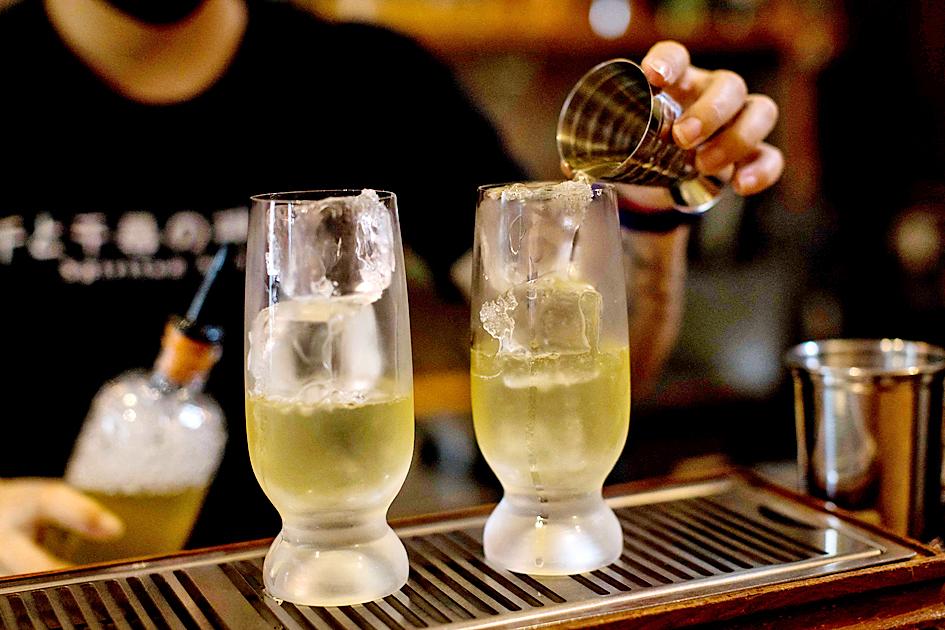
Photo: AFP
Going forward, the growing popularity of near-beers, “clean” wines and zero-proof spirits could follow a trajectory similar to the remarkable boom of faux meats.
Both trends are spearheaded by health-conscious millennials. Both also have important ethical and environmental implications. Just as the fake meat market has been built by brand new start-ups and old industry giants alike — from Impossible Foods and Beyond Meat to Tyson Inc and Cargill Inc — faux alcohol products are being peddled by both scrappy young beverage companies and legacy booze brands.
You might already recognize new brands like Curious Elixirs, Kin Euphorics and Seedlip — the latter having been purchased Diageo PLC, parent company of Smirnoff, Johnnie Walker and Guinness.
These zero-proof liquors and mixers are being marketed as an extension of the bougie craft cocktail movement — and priced accordingly, with costly additives like “adaptogens” that purportedly offer a holistic, hangover-free high.
Major vintners, including Kendall-Jackson, Johannes Leitz and Brancott Estates, have rolled out alcohol-free or low-alcohol wines that range from earthy Pinot Noirs to crisp Rieslings. They are not cheap — some sell for more than US$20 a bottle — but they also do not taste like the grape-juicy knockoffs of yore. Some have even been well-reviewed by wine snobs.
As for near-beer options, well, they are not your grandpa’s O’Doul’s. Heineken has debuted its “O.O” product, which, according to Food & Wine magazine, “certainly isn’t bad,” and to my untrained palate is hard to distinguish from a traditional lager.
Other brewers are adding something extra: Brooklyn Brewery uses a new brewing method for its non-alcoholic beer, dubbed “Special Effects,” retaining the malty flavor while cutting the alcohol. For those who would like to switch up their drug-induced buzz, Two Roots Brewery has introduced a tetrahydrocannabinol-infused tipple they’re calling “cannabiers.”
For now, non-alcoholic beers comprise a tiny share of the industry in the US, but some brewers expect it to grow by double digits in the next few years, alongside other trends in health and wellness.
Industrywide growth projections tend to lump the emerging nonalcoholic market in with soft drinks and bottled teas and coffees, all of which could reach US$1.6 trillion in global sales by 2025.
Much of the boom has taken place online, with a 315 percent increase in non and low-alcoholic beverage sales over the past year, compared with a 26 percent rise in online sales of alcoholic options during that period, Nielsen said.
However, now there is a curious parallel phenomenon of boutique shops known as “dry stores” popping up in major cities selling only high-end booze-free drinks.
Neither the stores nor the products are necessarily catering to people struggling with alcoholism. The taste and ceremony of mocktails could serve as a trigger for some in recovery, raising their chance of a relapse.
However, for many who can afford these products, the potential benefits of having healthy, tasty and socially acceptable alternatives in an alcohol-saturated society can be a good thing. It can help create space for the growing populations motivated by blogs like tiredofthinkingaboutdrinking.com and bestsellers like Sober Curious and Quit Like a Woman, which make the case that sobriety can bring about better sleep, less anxiety, more productivity and personal empowerment.
Celebrity spokespeople have emerged, including Elton John and Chrissy Teigen, and some have debuted their own mocktail lines, including Katy Perry’s De Soi and Blake Lively’s Betty Buzz.
There are also environmental benefits to consider at a time when climate pressures are increasingly bearing down on wine and beer producers. Drought, heat and wildfires scorched the US Pacific Northwest last year, causing costly damage to vineyards, devastating yields and pushing up wine prices.
Barley harvests have also been hit hard — falling 38 percent in Canada last year and 33 percent in the US because of hotter, drier growing conditions. Hops is also becoming increasingly difficult to farm.
Brewing beer is a process that guzzles 7 gallons (26.5 liters) of water for every gallon of beverage produced, making it more difficult to run profitable breweries in water-strapped regions.
The upshot is this: Alcohol producers would need to develop new growing methods for climate adaptation and consumers would need an increasing range of options — including, perhaps, wine and beer alternatives that do not require grapes, hops and barley at all. As millennials and generation Zers age, and as costs continue to rise for traditional beers and wines, nonalcoholic concoctions deserve to become more popular.
Amanda Little is a Bloomberg Opinion columnist. She is a professor of journalism and science writing at Vanderbilt University and the author of The Fate of Food: What We’ll Eat in a Bigger, Hotter, Smarter World.
This column does not necessarily reflect the opinion of the editorial board or Bloomberg LP and its owners.

The domestic unit of the Chinese-owned, Dutch-headquartered chipmaker Nexperia BV will soon be able to produce semiconductors locally within China, according to two company sources. Nexperia is at the center of a global tug-of-war over critical semiconductor technology, with a Dutch court in February ordering a probe into alleged mismanagement at the company. The geopolitical tussle has disrupted supply chains, with some carmakers reportedly forced to cut production due to chip shortages. Local production would allow Nexperia’s domestic arm, Nexperia Semiconductors (China) Ltd (安世半導體中國), to bypass restrictions in place since October on the supply of silicon wafers — etched with tiny components to

Singapore-based ride-hailing and delivery giant Grab Holdings Ltd has applied for regulatory approval to acquire the Taiwan operations of Germany-based Delivery Hero SE's Foodpanda in a deal valued at about US$600 million. Grab submitted the filing to the Fair Trade Commission on Friday last week, with the transaction subject to regulatory review and approval, the company said in a statement yesterday. Its independent governance structure would help foster a healthy and competitive market in Taiwan if the deal is approved, Grab said. Grab, which is listed on the NASDAQ, said in the filing that US-based Uber Technologies Inc holds about 13 percent of

Taiwan Semiconductor Manufacturing Co (TSMC, 台積電) yesterday received government approval to deploy its advanced 3-nanometer (3nm) process at its second fab currently under construction in Japan, the Ministry of Economic Affairs said in a news release. The ministry green-lit the plan for the facility in Kumamoto, which is scheduled to start installing equipment and come online in 2028 with a monthly production capacity of 15,000 12-inch wafers, the ministry said. The Department of Investment Review in June 2024 authorized a US$5.26 billion investment for the facility, slated to manufacture 6- to 12nm chips, significantly less advanced than 3nm process. At a meeting with

Taiwan is open to joining a global liquefied natural gas (LNG) program if one is created, but on the condition that countries provide delivery even in a scenario where there is a conflict with China, an energy department official said yesterday. While Taiwan’s priority is to have enough LNG at home, the nation is open to exploring potential strategic reserves in other countries such as Japan or South Korea, Energy Administration Deputy Director-General Chen Chung-hsien (陳崇憲) said. While the LNG market does not have a global reserve for emergencies like that of oil, the concept has been raised a few times —


 RSS
RSS