


Every day, Aiden Lee joins the hundreds of thousands of people getting around Taipei on two wheels, but when most of his fellow riders head to a gasoline pump to refuel, he takes his e-scooter to one of Taiwan’s increasingly commonplace battery-swapping stations — tech that its creators say could supercharge the shift from fossil fuels.
“Honestly, if it weren’t for battery swapping — which, by the way, is even faster than filling up at a gas station — I wouldn’t use an electric bike,” the marketing executive said. “I don’t think I have the time to wait for the battery to charge.”
Lee has used the rechargeable batteries provided by Gogoro Inc (睿能創意) since 2015, putting him among the 450,000 subscribers who swap an average of 330,000 batteries per day, company data showed.
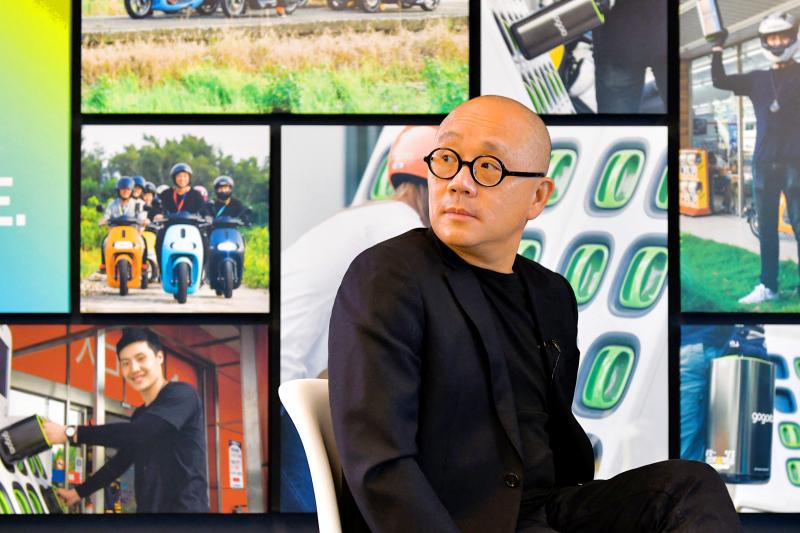
Photo: Sam Yeh, AFP
It costs about 10 percent more than buying gasoline each month, he said.
Now eyeing regional expansion and a New York listing, Gogoro has more than 2,300 stations outside convenience stores or in parking lots across Taiwan, where e-scooter riders stop to exchange depleted batteries for charged cells.
Previous attempts to introduce battery swaps have proved tricky, especially for electric vehicles (EVs), but the tech works better for scooters, said Gogoro founder and chief executive Horace Luke (陸學森), as the batteries and stations do not need to be so large.
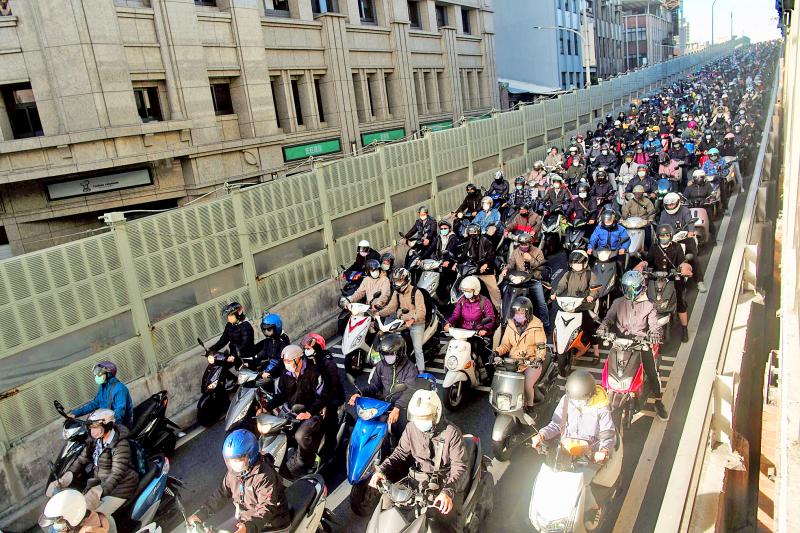
Photo: Sam Yeh, AFP
The facilities outnumber gasoline stations in four major Taiwanese cities, the company said, and Gogoro vice president Alan Pan (潘璟倫) told a news conference last week that the firm’s goal for next year is to “surpass the number of gasoline stations nationwide.”
With more than 240 million battery swaps since 2015, Gogoro said that it has kept about 360,000 tonnes of carbon dioxide out of the atmosphere.
“We are working on solutions that ... create a new industry as the world looks now to sustainability, and how to curb global warming and climate change,” Luke said in an interview.
Government sales figures show that e-scooters make up 21 percent of all scooters in Taiwan, with sales of traditional gasoline models in a double-digit percentage decline annually.
Luke said that, through local partnerships, Gogoro was moving to expand into the world’s largest scooter markets: China, India and Indonesia — all countries with smog-choked cities.
The firm has teamed up with top industry players, including motorcycle maker Hero MotoCorp in India, e-scooter maker Yadea Technology Group Co (雅迪科技集團) in China and Indonesian ride-hailing firm Gojek.
In China, its battery-swapping system was launched in October last year in the city of Hangzhou.
Gogoro plans to list on the NASDAQ this quarter through a merger with a special purpose acquisition company, establishing an entity valued at US$2.35 billion.
Global sales of e-scooters are estimated to have topped 25 million units in 2020, or 35 percent of total sales of two-wheeled vehicles, BloombergNEF said.
Market research firm Guidehouse Insights said that “battery swapping has become a legitimate technology platform solution that is being exported to original equipment manufacturers in foreign markets.”
Countries in Southeast Asia “with strong two-wheeler cultures, high urban density rates, supportive policy frameworks for EVs, and a strong desire to reduce urban air pollution will likely be next in line,” it said in a report.
“I think battery swapping was a real game changer and is a real game changer,” Luke said.
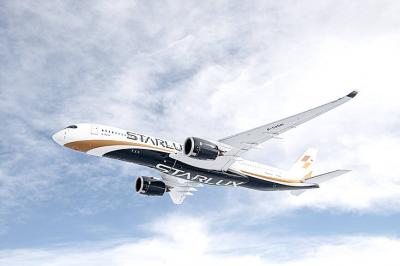
Starlux Airlines Co (星宇航空) today unveiled a long-haul network expansion plan at a shareholders’ meeting in Taipei, including direct flights to Barcelona, Spain, and Zurich, Switzerland, as well as a service connecting Taipei, Sydney and New Zealand. Starlux is to become the first Taiwanese carrier to offer non-stop services to the two European cities, while the inaugural oceanic route is expected to expand transit opportunities within the Australia-New Zealand market, Starlux said. Flight services to Chicago, Dallas, Washington and New York are under evaluation, the airline added. Prior to the shareholders’ meeting, the airline earlier this year announced that it would be

Cairo’s new monorail slices across the city skyline, running above the familiar chaos of blaring horns and aging buses’ exhaust fumes that mark rush hour below. The US$4.5 billion monorail, opened this month, is among Egypt’s most prominent new transport projects, part of a debt-funded infrastructure drive criticized for sapping state finances while bringing limited benefits to most of the country’s 109 million people. “It feels like you’re in a different country,” said Ramy Sayed, a restaurant manager, aboard a driverless Innovia 300 train. “No noise, no traffic, we’re not used to this.” The eastern line runs 56km from the bustling middle-class

Netherlands-based semiconductor equipment supplier ASML Holding NV yesterday said that it is planning to hire an additional 1,000 people in Taiwan this year in response to growing demand from clients. ASML had previously planned to recruit 600 people this year, but that the plan has been adjusted upward, ASML vice president and ASML Taiwan general manager Grace Wang (汪佳慧) told reporters. ASML has a workforce of more than 4,500 in Taiwan, accounting for about 10 percent of its global total, Wang said. This year’s recruitment campaign would focus on adding people in the customer support, manufacturing and supply chain domains to assist ASML
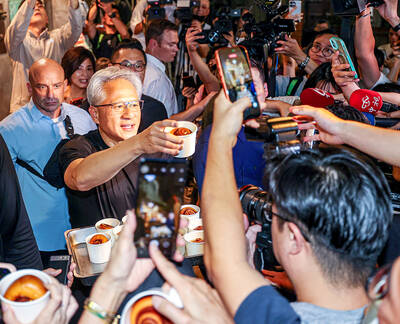
Nvidia Corp yesterday announced that CEO Jensen Huang (黃仁勳) would attend an employee meeting in Taipei tomorrow to celebrate the launch of the company’s Taiwan headquarters project. Huang would attend a gathering at the site of Nvidia’s planned headquarters in Beitou Shilin Technology Park (北投士林科技園區), the company said in a statement. After arriving in Taiwan on Saturday last week, Huang told reporters that he plans to meet with Quanta Computer Inc (廣達) chairman Barry Lam (林百里) and Taiwan Semiconductor Manufacturing Co (TSMC, 台積電) chairman C.C. Wei (魏哲家), and would attend the groundbreaking ceremony for Nvidia’s Taiwan headquarters tomorrow. Nvidia has not yet applied


 RSS
RSS