


The Dow on Friday closed lower dragged down by financial stocks as investors were disappointed by fourth quarter results from big US banks, which cast a shadow over the beginning of the earnings season.
The NASDAQ and the S&P regained lost ground in afternoon trading to close higher.
Consumer discretionary stocks put pressure on the indices throughout the session, after morning data showed a decline in retail sales and a souring of consumer sentiment last month.
JPMorgan Chase & Co tumbled after reporting weaker performance at its trading arm.
The bellwether lender also said that soaring inflation, the looming threat of the Omicron variant of SARS-CoV-2 and trading revenues would challenge industry growth in coming months.
Along with JPMorgan, big decliners putting pressure on the Dow included financial stocks Goldman Sachs Group Inc, American Express Co and home improvement retailer Home Depot Inc.
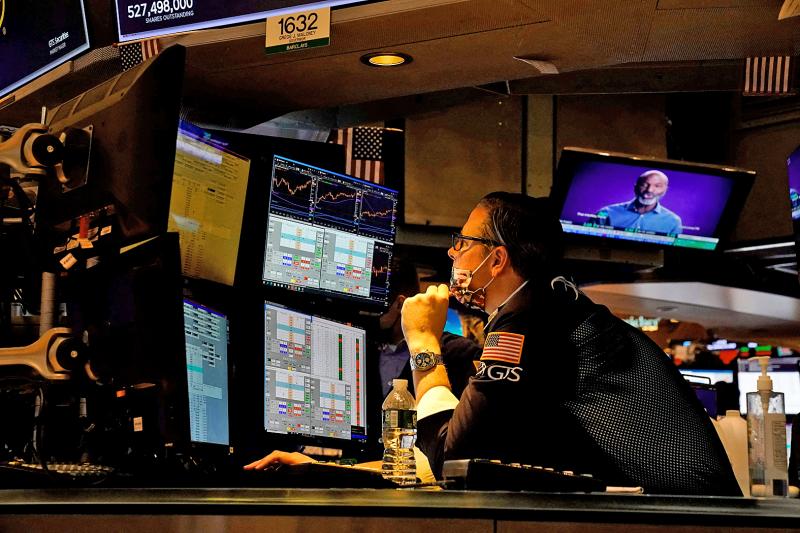
Photo: AFP
Citigroup Inc shares fell after it reported a 26 percent drop in fourth-quarter profit, while asset manager BlackRock Inc fell 2.2 percent after missing quarterly revenue expectations.
The S&P 500 bank subsector, which hit an intraday high in the previous session, closed down 1.7 percent. The sector has recently been outperforming the S&P as investors bet the US Federal Reserve’s expected interest rate hikes would boost bank profits.
“The bar was very high going into [JPMorgan] results. On the surface it was good but, under the hood, not so much,” said Michael James, managing director of equity trading at Wedbush Securities Inc in Los Angeles.
In the interest rate hiking cycle expected this year “positioning was very crowded on the long side” going into the earnings season, he said.
For consumer stock weakness, James pointed to “clearly disappointing” retail sales, which dropped 1.9 percent last month due to shortages of goods and an explosion of COVID-19 infections. Separate data showed that soaring inflation hit US consumer sentiment this month, pushing it to its second-lowest level in a decade.
Retail sales and bank loan growth raised doubts about the economic outlook for this quarter and this year for Keith Buchanan, portfolio manager at Globalt Inc in Atlanta.
“The question is, does the economy have enough strength to get through the risk Omicron brings as fiscal and monetary stimulus is rolling off,” Buchanan said.
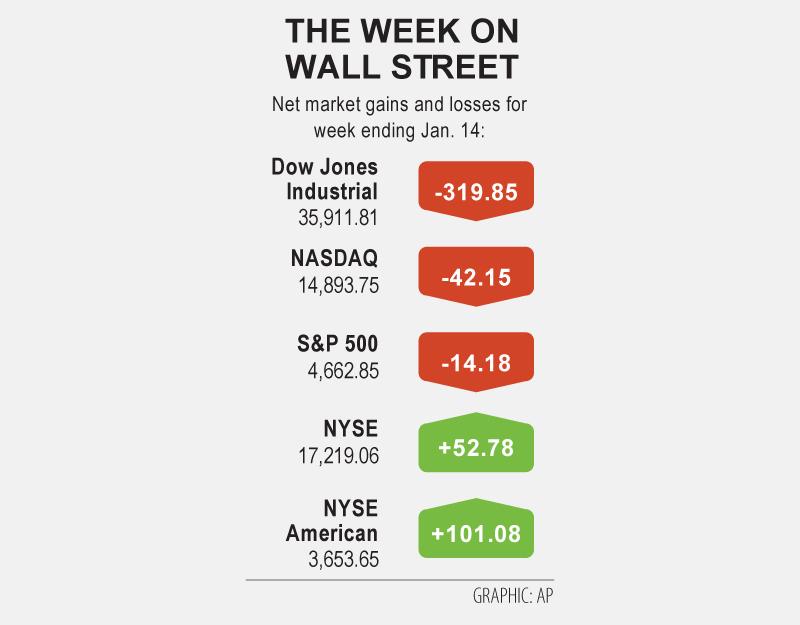
The Dow Jones Industrial Average fell 201.81 points, or 0.56 percent, to 35,911.81, the S&P 500 gained 3.82 points, or 0.08 percent, to 4,662.85 and the NASDAQ Composite added 86.94 points, or 0.59 percent, to 14,893.75.
For the week, the S&P 500 fell 0.3 percent while the Dow fell 0.88 percent and the NASDAQ fell 0.28 percent.
At the end of the session, four out of 11 S&P sectors rose with energy leading gains.
An afternoon rally pushed the NASDAQ and the S&P to closing gains with help from rate-sensitive growth sectors, with technology closing up 0.89 percent and communications services adding 0.53 percent.
“There’s clearly some bargain hunting going on in technology today,” James said.
Analysts see S&P 500 companies earnings rising 23.1 percent in the fourth quarter, Institutional Brokers’ Estimate System data from Refinitiv showed.
However, one bright spot in the bank sector on Friday was Wells Fargo & Co, which rallied after posting a bigger-than-expected rise in fourth-quarter profit.

The domestic unit of the Chinese-owned, Dutch-headquartered chipmaker Nexperia BV will soon be able to produce semiconductors locally within China, according to two company sources. Nexperia is at the center of a global tug-of-war over critical semiconductor technology, with a Dutch court in February ordering a probe into alleged mismanagement at the company. The geopolitical tussle has disrupted supply chains, with some carmakers reportedly forced to cut production due to chip shortages. Local production would allow Nexperia’s domestic arm, Nexperia Semiconductors (China) Ltd (安世半導體中國), to bypass restrictions in place since October on the supply of silicon wafers — etched with tiny components to

Singapore-based ride-hailing and delivery giant Grab Holdings Ltd has applied for regulatory approval to acquire the Taiwan operations of Germany-based Delivery Hero SE's Foodpanda in a deal valued at about US$600 million. Grab submitted the filing to the Fair Trade Commission on Friday last week, with the transaction subject to regulatory review and approval, the company said in a statement yesterday. Its independent governance structure would help foster a healthy and competitive market in Taiwan if the deal is approved, Grab said. Grab, which is listed on the NASDAQ, said in the filing that US-based Uber Technologies Inc holds about 13 percent of

Taiwan Semiconductor Manufacturing Co (TSMC, 台積電) yesterday received government approval to deploy its advanced 3-nanometer (3nm) process at its second fab currently under construction in Japan, the Ministry of Economic Affairs said in a news release. The ministry green-lit the plan for the facility in Kumamoto, which is scheduled to start installing equipment and come online in 2028 with a monthly production capacity of 15,000 12-inch wafers, the ministry said. The Department of Investment Review in June 2024 authorized a US$5.26 billion investment for the facility, slated to manufacture 6- to 12nm chips, significantly less advanced than 3nm process. At a meeting with

Taiwan’s food delivery market could undergo a major shift if Singapore-based Grab Holdings Ltd completes its planned acquisition of Delivery Hero SE’s Foodpanda business in Taiwan, industry experts said. Grab on Monday last week announced it would acquire Foodpanda’s Taiwan operations for US$600 million. The deal is expected to be finalized in the second half of this year, with Grab aiming to complete user migration to its platform by the first half of next year. A duopoly between Uber Eats and Foodpanda dominates Taiwan’s delivery market, a structure that has remained intact since the Fair Trade Commission (FTC) blocked Uber Technologies Inc’s


 RSS
RSS