


Shares of uPI Semiconductor Corp (力智電子) yesterday rose 35.82 percent on their debut on the Taiwan Stock Exchange.
The IC designing arm of Asustek Computer Inc (華碩電腦) became the third company to launch an initial public offering (IPO) on the main board this year.
Founded in 2005, uPI focuses on analogue and mixed-signal power management solutions, the company’s Web site says.
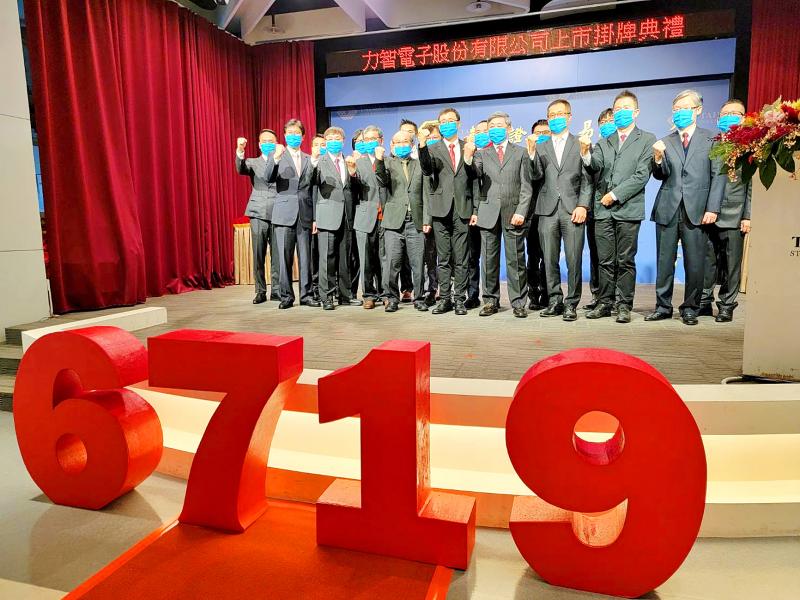
Photo: Vanessa Cho, Taipei Times
Its shares closed at NT$800, after reaching NT$808, far above its IPO price of NT$589, exchange data showed.
The TAIEX rose 0.33 percent yesterday.
Unique Satellite TV quoted uPI chairman S.Y. Hsu (許先越) as saying at a listing ceremony at the local bourse that the semiconductor industry is still facing a shortage of raw materials, which stems from structural imbalances between long-term demand and short-term supply amid the COVID-19 pandemic.
“While the shortage is expected to ease in the second half of this year, certain raw materials would continue to see supply constraints until next year,” Hsu was quoted as saying.
Headquartered in Hsinchu County’s Jhubei City (竹北), uPI counts power management ICs as its main source of revenue, accounting for 70 percent, with the remainder coming from metal-oxide semiconductor field-effect transistors and smart power stage IC solutions.
The company reported record revenue of NT$5.95 billion (US$215.21 million) for last year, up 41.71 percent from NT$4.2 billion in 2020.
Net profit in the first three quarters of last year rose 147.49 percent to NT$805.97 million, from NT$325.66 million a year earlier, with gross margin of 41.76 percent and an operating margin of 22.55 percent, uPI said.
Earnings per share were NT$11.4, compared with NT$4.67 a year earlier, it said.
As of September last year, Asustek held a 33.8 percent stake in uPI, while United Microelectronics Corp (聯電) held 8.54 percent and Powerchip Semiconductor Manufacturing Corp (力積電) owned 2.42 percent.

Singapore-based ride-hailing and delivery giant Grab Holdings Ltd has applied for regulatory approval to acquire the Taiwan operations of Germany-based Delivery Hero SE's Foodpanda in a deal valued at about US$600 million. Grab submitted the filing to the Fair Trade Commission on Friday last week, with the transaction subject to regulatory review and approval, the company said in a statement yesterday. Its independent governance structure would help foster a healthy and competitive market in Taiwan if the deal is approved, Grab said. Grab, which is listed on the NASDAQ, said in the filing that US-based Uber Technologies Inc holds about 13 percent of

The domestic unit of the Chinese-owned, Dutch-headquartered chipmaker Nexperia BV will soon be able to produce semiconductors locally within China, according to two company sources. Nexperia is at the center of a global tug-of-war over critical semiconductor technology, with a Dutch court in February ordering a probe into alleged mismanagement at the company. The geopolitical tussle has disrupted supply chains, with some carmakers reportedly forced to cut production due to chip shortages. Local production would allow Nexperia’s domestic arm, Nexperia Semiconductors (China) Ltd (安世半導體中國), to bypass restrictions in place since October on the supply of silicon wafers — etched with tiny components to

Taiwan Semiconductor Manufacturing Co (TSMC, 台積電) yesterday received government approval to deploy its advanced 3-nanometer (3nm) process at its second fab currently under construction in Japan, the Ministry of Economic Affairs said in a news release. The ministry green-lit the plan for the facility in Kumamoto, which is scheduled to start installing equipment and come online in 2028 with a monthly production capacity of 15,000 12-inch wafers, the ministry said. The Department of Investment Review in June 2024 authorized a US$5.26 billion investment for the facility, slated to manufacture 6- to 12nm chips, significantly less advanced than 3nm process. At a meeting with

Taiwan’s food delivery market could undergo a major shift if Singapore-based Grab Holdings Ltd completes its planned acquisition of Delivery Hero SE’s Foodpanda business in Taiwan, industry experts said. Grab on Monday last week announced it would acquire Foodpanda’s Taiwan operations for US$600 million. The deal is expected to be finalized in the second half of this year, with Grab aiming to complete user migration to its platform by the first half of next year. A duopoly between Uber Eats and Foodpanda dominates Taiwan’s delivery market, a structure that has remained intact since the Fair Trade Commission (FTC) blocked Uber Technologies Inc’s


 RSS
RSS