


With personal health a rising priority around the world, the auto industry is on the hunt for new gadgets and accessories to make the vehicle cockpit feel safer for the driver and passengers.
Items on display at last week’s CES, formerly known as the Consumer Electronics Show, include air purifiers, vehicle seat alarms and intelligent sun visors.
The objective is to transform vehicles “into a sort of health cocoon,” Valeo SA chief executive officer Christophe Perillat told a news conference at the Las Vegas trade show.
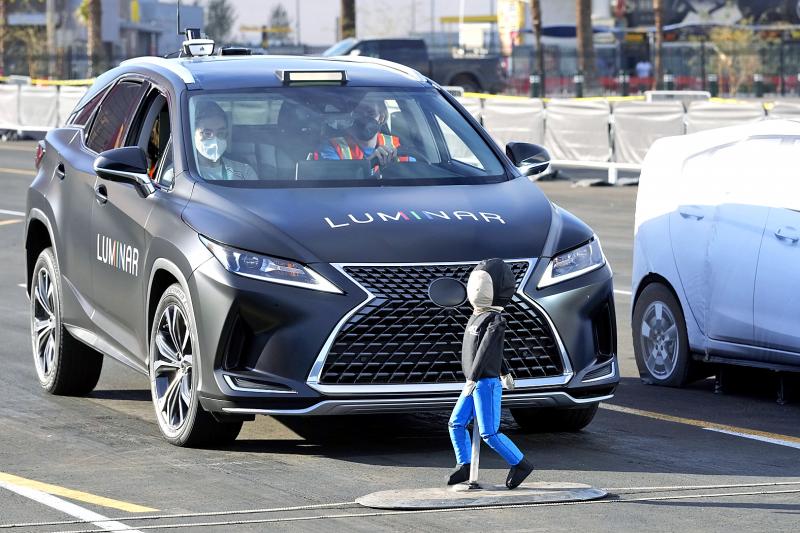
Photo: AP
The French vehicle supplier’s wares at CES include devices to monitor drivers’ attention, air filters and systems that allow personalized climate controls for passengers.
The company’s filtration system for vehicles and buses clears out more than 95 percent of viruses, including COVID-19, it said.
CabinAir Sweden AB and Marelli Corp also showcased air purification systems that could be installed inside the cockpit or in a cup holder.
Another offering by Gentex Corp is a sensor composed of nanofibers capable of surveying the air and identifying contaminants.
The latest generation of technologies comes after earlier efforts focused initially on the trucking industry, where lengthy periods behind the wheel marred physical health, Center for Automotive Research president and CEO Carla Bailo said.
After developing more ergonomic seats, auto suppliers have begun focusing on tools to help drivers get ahead of other health problems such as cardiovascular issues and to maintain driver awareness.
Some of the systems follow government requirements.
The Italian start-up Filo Srl developed an alarm system for children’s car seats following a law in its home country intended to prevent children from being left in the vehicle on hot days.
The company was in Las Vegas to launch the technology for the US, where there are dozens of casualties each year due to hyperthermia.
“With the hecticness of life, stress, et cetera, sadly, it happens more than we would like to admit that parents actually have on occasion lapsed ... and they leave their children in the car,” said Rudolf Jantos, who works in marketing for Filo.
The company’s Bluetooth-based system would alert if a child remains in the seat when the driver moves away from the vehicle.
Other child-protection devices employ cameras, radars, vibration detection and weight sensors, said Mike Ramsay, a specialist in auto technology at consultancy Gartner.
Many of these products are not brand new, but are “becoming more practical in terms of costs and capabilities,” thanks to progress in algorithms and processors, Ramsay said.
These new devices have also been boosted by a rise of autonomous driving systems, which employ cameras and radars, Valeo chief executive officer Jacques Aschenbroich said.
“We had been focusing before more on the comfort of the seats and of the heating,” he said. “Now our clients also ask for more visual comfort and safety applications” based on these cameras and radars.
At CES, Bosch GmbH demonstrated its “Virtual Visor,” a transparent screen that detects the position of the driver’s eyes and can darken only the portion of the windshield through which the sun would bother the driver, leaving the rest unobstructed.
“The key point is to use technology to really improve the customer experience, not to seem invasive,” Bailo said. “There’s a fine line between ‘we’re trying to keep you safe, we’re trying to keep you healthy,’ and ‘we’re watching what you’re doing.’”

The domestic unit of the Chinese-owned, Dutch-headquartered chipmaker Nexperia BV will soon be able to produce semiconductors locally within China, according to two company sources. Nexperia is at the center of a global tug-of-war over critical semiconductor technology, with a Dutch court in February ordering a probe into alleged mismanagement at the company. The geopolitical tussle has disrupted supply chains, with some carmakers reportedly forced to cut production due to chip shortages. Local production would allow Nexperia’s domestic arm, Nexperia Semiconductors (China) Ltd (安世半導體中國), to bypass restrictions in place since October on the supply of silicon wafers — etched with tiny components to

Singapore-based ride-hailing and delivery giant Grab Holdings Ltd has applied for regulatory approval to acquire the Taiwan operations of Germany-based Delivery Hero SE's Foodpanda in a deal valued at about US$600 million. Grab submitted the filing to the Fair Trade Commission on Friday last week, with the transaction subject to regulatory review and approval, the company said in a statement yesterday. Its independent governance structure would help foster a healthy and competitive market in Taiwan if the deal is approved, Grab said. Grab, which is listed on the NASDAQ, said in the filing that US-based Uber Technologies Inc holds about 13 percent of

Taiwan is open to joining a global liquefied natural gas (LNG) program if one is created, but on the condition that countries provide delivery even in a scenario where there is a conflict with China, an energy department official said yesterday. While Taiwan’s priority is to have enough LNG at home, the nation is open to exploring potential strategic reserves in other countries such as Japan or South Korea, Energy Administration Deputy Director-General Chen Chung-hsien (陳崇憲) said. While the LNG market does not have a global reserve for emergencies like that of oil, the concept has been raised a few times —

Taiwan Semiconductor Manufacturing Co (TSMC, 台積電) yesterday received government approval to deploy its advanced 3-nanometer (3nm) process at its second fab currently under construction in Japan, the Ministry of Economic Affairs said in a news release. The ministry green-lit the plan for the facility in Kumamoto, which is scheduled to start installing equipment and come online in 2028 with a monthly production capacity of 15,000 12-inch wafers, the ministry said. The Department of Investment Review in June 2024 authorized a US$5.26 billion investment for the facility, slated to manufacture 6- to 12nm chips, significantly less advanced than 3nm process. At a meeting with


 RSS
RSS