


The sea of Bulgarian buses parked outside a market in Turkey’s historic city of Edirne betrays the scale of the currency crisis impeding Turkish President Recep Tayyip Erdogan’s path to a third decade of rule.
The mosque-filled city on Turkey’s western edge was an early capital of the Ottoman Empire when it was expanding across the Middle East and Europe in the 14th and 15th centuries.
It is now the place where shoppers from Bulgaria and the Balkans — themselves some of Europe’s poorest countries — go to stock up on everything from underwear to walnuts at a fraction of their cost back home.
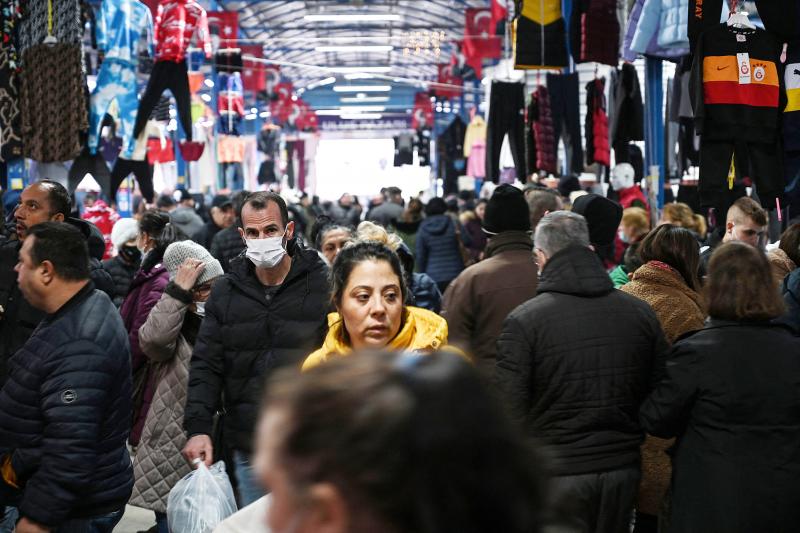
Photo: AFP
“For us, the crisis is good, but it is very bad for the Turkish people,” tour guide Daniela Mircheva said, before boarding a bus back to her Bulgarian hometown Yambol.
“We were in a similar situation maybe 10, 11, 12 years ago,” the 49-year-old said, referring to the 2008 global financial crisis. “It is very difficult.”
Turkey’s beleaguered lira has crashed under the weight of an unusual economic experiment Erdogan is conducting in a bid to boost support before elections due by mid-2023.
Erdogan pushed the central bank to slash interest rates in fervently-held belief that this would finally cure Turkey’s chronic inflation problem.
It has — as economists had universally predicted — done the exact opposite.
Consumer prices are climbing at an annual rate of more than 20 percent. Some economists think this pace could accelerate in the coming months.
The lira has shed one-third of its value since the beginning of last month alone.
It was beginning to lose 5 percent a day until Erdogan on Monday announced new currency support measures that managed to suspend the slide.
This means Mircheva can afford to pile a few extra jugs of sunflower oil on her bus packed with Bulgarian shoppers.
“It is half the price it is in Bulgaria. It is much cheaper for us, much cheaper,” she said.
However, the mood among the market’s Turkish traders is grim.
“It is humiliating,” said Gulsen Kaya from behind her counter filled with sweaters and winter clothes. “Look at what he has done to Turkey.”
Erdogan is betting that a cheap lira would create exports-driven growth that puts Turkey on a path followed by China during an economic transformation that pulled millions out of poverty and created a new middle class.
He championed the poor when bringing his Islamic-rooted party to power against all odds in 2002. Erdogan then surprised many by opening Turkey up to foreign investment and marshaling nearly a decade of vigorous growth.
Economists and diplomats — as well as some Bulgarians — struggle to understand why Erdogan has decided to reverse course so dramatically over the past few years.
“I think that the people who rule Turkey, if they do the things that I think they should do, then the lira will come back to the levels it was in the summer very, very quickly,” Bulgarian shopper Tinko Garev said. “I am very unhappy for the Turkish people because I realize what these cheaper prices mean for them.”
One senior Western official said the drop in Erdogan’s approval ratings in most polls to as low as 30 percent had put the veteran Turkish leader “in political survival mode.”
“You can choose not to believe [individual polls], but the trajectory is clear... He is down to the very bottom of his base of support,” said the official, who spoke on condition of anonymity.
Bulent Reisoglu has been running the Edirne market since it opened after moving from its original location in Istanbul 15 years ago.
He said the number of weekly shoppers filling his hangar-like trading center has ballooned from 50,000 to nearly 150,000 since the full effects of the crisis set in.
“The number of foreign shoppers has gone up four or five-fold,” he said.
Yet the merchants are making less money, because the extra sales are more than offset by the depth of the lira’s collapse.
“Our suppliers are sending us new price lists every week,” market trader Utku Bitmez said.
“All the raw materials come from abroad, from Europe, China and Italy,” he said. “The price of these products has doubled since last year.”
Reisoglu said merchants often nervously eye the latest lira exchange rates on their phones.
“We are in shock,” he said. “No one expected this big of a devaluation.”
The Bulgarian shoppers also seemed to have mixed feelings about getting such great deals.
“Local people cannot buy all these things,” said Ilyana Todorova while shopping for clothes with her teenage daughter. “For ordinary people, it is no good.”
Turkey’s lira posted a major recovery on Friday, with the support of billions of US dollars of state-backed market interventions and a promise that the government would cover foreign exchange losses on certain deposits.
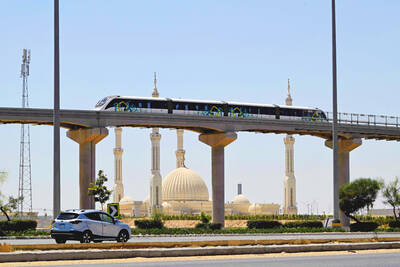
Cairo’s new monorail slices across the city skyline, running above the familiar chaos of blaring horns and aging buses’ exhaust fumes that mark rush hour below. The US$4.5 billion monorail, opened this month, is among Egypt’s most prominent new transport projects, part of a debt-funded infrastructure drive criticized for sapping state finances while bringing limited benefits to most of the country’s 109 million people. “It feels like you’re in a different country,” said Ramy Sayed, a restaurant manager, aboard a driverless Innovia 300 train. “No noise, no traffic, we’re not used to this.” The eastern line runs 56km from the bustling middle-class
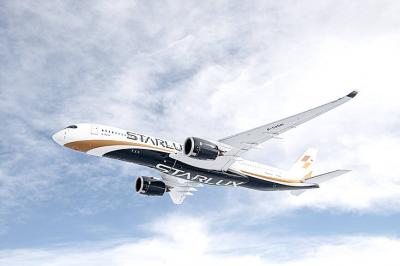
Starlux Airlines Co (星宇航空) today unveiled a long-haul network expansion plan at a shareholders’ meeting in Taipei, including direct flights to Barcelona, Spain, and Zurich, Switzerland, as well as a service connecting Taipei, Sydney and New Zealand. Starlux is to become the first Taiwanese carrier to offer non-stop services to the two European cities, while the inaugural oceanic route is expected to expand transit opportunities within the Australia-New Zealand market, Starlux said. Flight services to Chicago, Dallas, Washington and New York are under evaluation, the airline added. Prior to the shareholders’ meeting, the airline earlier this year announced that it would be

Netherlands-based semiconductor equipment supplier ASML Holding NV yesterday said that it is planning to hire an additional 1,000 people in Taiwan this year in response to growing demand from clients. ASML had previously planned to recruit 600 people this year, but that the plan has been adjusted upward, ASML vice president and ASML Taiwan general manager Grace Wang (汪佳慧) told reporters. ASML has a workforce of more than 4,500 in Taiwan, accounting for about 10 percent of its global total, Wang said. This year’s recruitment campaign would focus on adding people in the customer support, manufacturing and supply chain domains to assist ASML

Nvidia Corp yesterday announced that CEO Jensen Huang (黃仁勳) would attend an employee meeting in Taipei tomorrow to celebrate the launch of the company’s Taiwan headquarters project. Huang would attend a gathering at the site of Nvidia’s planned headquarters in Beitou Shilin Technology Park (北投士林科技園區), the company said in a statement. After arriving in Taiwan on Saturday last week, Huang told reporters that he plans to meet with Quanta Computer Inc (廣達) chairman Barry Lam (林百里) and Taiwan Semiconductor Manufacturing Co (TSMC, 台積電) chairman C.C. Wei (魏哲家), and would attend the groundbreaking ceremony for Nvidia’s Taiwan headquarters tomorrow. Nvidia has not yet applied


 RSS
RSS