


Turkish President Recep Tayyip Erdogan’s government on Monday announced extraordinary measures to bolster the Turkish lira, including the introduction of a new program to protect savings from fluctuations in the local currency.
The government would make up for losses incurred by holders of lira deposits should its declines against hard currencies exceed interest rates promised by banks, Erdogan said after chairing a Cabinet meeting in Ankara.
The lira trimmed its drop — which had extended to as much as 10.6 percent — after Erdogan’s announcement and was trading down 5.3 percent at 12.6269 per US dollar at 1:28pm in Istanbul yesterday.
“From now on, none of our citizens will need to switch their deposits from the Turkish lira to foreign currencies because of their concerns that the exchange rate” fluctuations might wipe out gains from interest payments, Erdogan said.
The measures are intended to mitigate retail investors’ demand for dollars and bring to an end three months of turmoil for the nation’s currency.
The lira has lost more than half of its value against the dollar since September, with declines gaining pace after Erdogan last month unveiled an economic model that relies on lower borrowing costs and a cheaper currency.
However, his announcements show that the subsequent chaos in Turkish markets has been sobering for policymakers, who are now introducing new measures to shore up some of the lost confidence in the lira.
In other steps announced by Erdogan, authorities are to offer non-deliverable forwards to help exporters mitigate foreign-exchange risks emanating from the elevated levels of volatility.
“Turkey has neither the intention nor the need to take the slightest step back from the free-market economy and the foreign-exchange regime,” he said.
Withholding tax for investments in lira notes issued by the government would be reduced to 0 percent from 10 percent currently.
The government would match 30 percent of all contributions made by private-sector workers to the optional pension system, up from the current level of 25 percent.
Turkey can free itself from a reliance on foreign capital flows by abandoning old policies that prioritized higher interest rates and strong inflows, Erdogan said.
Since September, the central bank has cut interest rates in the face of soaring consumer prices.
The ensuing monetary stance eventually left the lira unanchored, with the currency sinking to fresh record lows almost every day.
The currency’s collapse fed into consumer prices almost overnight, resulting in inflation so rampant that supermarket employees were barely able to keep up with changing labels.
Working-class Turks and pensioners have been lining up in front of municipality stalls to get subsidized bread in the past few weeks while the country’s top business associations have accused the government of destabilizing the economy.

The domestic unit of the Chinese-owned, Dutch-headquartered chipmaker Nexperia BV will soon be able to produce semiconductors locally within China, according to two company sources. Nexperia is at the center of a global tug-of-war over critical semiconductor technology, with a Dutch court in February ordering a probe into alleged mismanagement at the company. The geopolitical tussle has disrupted supply chains, with some carmakers reportedly forced to cut production due to chip shortages. Local production would allow Nexperia’s domestic arm, Nexperia Semiconductors (China) Ltd (安世半導體中國), to bypass restrictions in place since October on the supply of silicon wafers — etched with tiny components to

Singapore-based ride-hailing and delivery giant Grab Holdings Ltd has applied for regulatory approval to acquire the Taiwan operations of Germany-based Delivery Hero SE's Foodpanda in a deal valued at about US$600 million. Grab submitted the filing to the Fair Trade Commission on Friday last week, with the transaction subject to regulatory review and approval, the company said in a statement yesterday. Its independent governance structure would help foster a healthy and competitive market in Taiwan if the deal is approved, Grab said. Grab, which is listed on the NASDAQ, said in the filing that US-based Uber Technologies Inc holds about 13 percent of
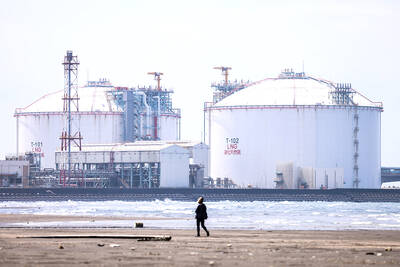
Taiwan is open to joining a global liquefied natural gas (LNG) program if one is created, but on the condition that countries provide delivery even in a scenario where there is a conflict with China, an energy department official said yesterday. While Taiwan’s priority is to have enough LNG at home, the nation is open to exploring potential strategic reserves in other countries such as Japan or South Korea, Energy Administration Deputy Director-General Chen Chung-hsien (陳崇憲) said. While the LNG market does not have a global reserve for emergencies like that of oil, the concept has been raised a few times —

Taiwan Semiconductor Manufacturing Co (TSMC, 台積電) yesterday received government approval to deploy its advanced 3-nanometer (3nm) process at its second fab currently under construction in Japan, the Ministry of Economic Affairs said in a news release. The ministry green-lit the plan for the facility in Kumamoto, which is scheduled to start installing equipment and come online in 2028 with a monthly production capacity of 15,000 12-inch wafers, the ministry said. The Department of Investment Review in June 2024 authorized a US$5.26 billion investment for the facility, slated to manufacture 6- to 12nm chips, significantly less advanced than 3nm process. At a meeting with


 RSS
RSS