


Metals vital for making rechargeable batteries in electric vehicles (EVs) are set to extend their stunning rally into next year, potentially increasing costs for automakers and blunting a key weapon in the race to slow climate change.
Battery metals are in the throes of an unprecedented boom as the global push toward a greener future fires up demand for materials such as lithium, cobalt and nickel, at a time of constrained supply exacerbated by the COVID-19 pandemic. That is likely to boost battery costs and could delay the widespread adoption of electric vehicles.
Now the Omicron variant of SARS-CoV-2 is complicating matters even more.
“The new COVID-19 variant has thrown a cog in the wheel of the global recovery,” said Kwasi Ampofo, head of metals and mining at BloombergNEF. “We expect the supply-chain constraints that impacted the movement of materials this year to remain well into 2022.”
Prices of lithium, graphite and cobalt are likely to stay elevated, potentially easing only in 2023, although nickel could report a decline in prices by the second half of next year, he added.
LITHIUM RECORD
An index of lithium prices has more than tripled this year to a record. Chinese producer Chengxin Lithium Group (盛新鋰能) expects prices to “stay at relatively high levels for a while,” bolstered by buoyant downstream consumption and constraints in brine production capacity and spodumene supply.
“It’s hard to see any material changes in global market tightness in the short term,” the company said in a written response to Bloomberg News.
Green exuberance has tightened the lithium market this year after years of underinvestment when prices were sluggish. As miners scurry to expand capacity, long-term electric vehicle demand bodes well for the material that is used in virtually all electric vehicle batteries.
Passenger electric car sales are projected to soar from 3 million last year to 66 million in 2040, according to BloombergNEF’s Economic Transition Scenario.
“We expect global average lithium prices to continue increasing over the next couple of years as contract prices start catching up to spot and as supply continues to be unable to reach demand,” Benchmark Mineral Intelligence analyst Cameron Perks said. “A balanced market is not projected until 2025 or 2026 at which point prices may start to subside.”
COBALT AND NICKEL
Cobalt has doubled in price this year. The metal has been grappling with supply chain disruptions in South Africa, which exports the majority of global cobalt supply out of the Democratic Republic of the Congo, S&P Global Market Intelligence analyst Alice Yu said.
Omicron risks worsening logistical challenges, and could delay the timing of a price correction, she said.
Still, the outlook is not all bullish.
“The supply side has ramped up cobalt production capacity and that could come online next year,” said Wang Wentao (王文濤), general manager of trader Shanghai Qin Cobalt Industrial Co (上海千鈷實業有限公司).
The commodity market could also be engulfed by a risk-off mood among investors as central banks begin to raise interest rates, he added.
Nickel has jumped about 17 percent this year, but aggressive supply expansion from Indonesia could swing the market into a surplus next year, S&P Global Market Intelligence has said.
Prices took a hit early this month after Tsingshan Holding Group Co (青山控股) said it is operating its first production line for nickel matte, an intermediate product that can be processed into battery-grade chemicals.
Graphite prices have climbed sharply since September amid power curbs in China, the world’s biggest producer of the anode material.
“With the expected increase in power demand this winter, power supply may be tight, and production of flake graphite therefore may not fully recover until the first half of 2022,” a BloombergNEF report said.
HIGHER COSTS
A large chunk of the cost of a battery — the most expensive part of an electric vehicle — is tied to commodities that have rallied this year. In China, the world’s biggest electric vehicle market, battery manufacturers have already started to feel the pinch from the escalating cost of raw materials.
SVolt Energy Technology Co (蜂巢能源科技), which has an agreement to supply Jeep-maker Stellantis NV, has already flagged issues with materials including copper foil, while Gotion High-tech Co (國軒高科股份有限公司), a partner of Volkswagen AG, told customers in mid-October it needed to raise battery prices.
Battery costs are on course for the first jump since BloombergNEF began tracking them in 2012, which is set to deal a blow to the automotive industry.
Electric vehicles are expected to reach price parity with petrol and diesel vehicles when a battery pack drops below US$100 per kilowatt hour, but higher raw-material costs could delay that by two years to 2026, Bloomberg has said.
Other commodities:
‧Gold for February delivery rose US$6.70 to US$1,804.90 an ounce, gaining 1.13 percent on the week.
‧Silver for March delivery rose US$0.04 to US$22.53 an ounce, posting an increase of 1.49 percent, while March copper was unchanged at US$4.30 a pound, up 0.23 percent from a week earlier.
Additional reporting by AP

The domestic unit of the Chinese-owned, Dutch-headquartered chipmaker Nexperia BV will soon be able to produce semiconductors locally within China, according to two company sources. Nexperia is at the center of a global tug-of-war over critical semiconductor technology, with a Dutch court in February ordering a probe into alleged mismanagement at the company. The geopolitical tussle has disrupted supply chains, with some carmakers reportedly forced to cut production due to chip shortages. Local production would allow Nexperia’s domestic arm, Nexperia Semiconductors (China) Ltd (安世半導體中國), to bypass restrictions in place since October on the supply of silicon wafers — etched with tiny components to

Singapore-based ride-hailing and delivery giant Grab Holdings Ltd has applied for regulatory approval to acquire the Taiwan operations of Germany-based Delivery Hero SE's Foodpanda in a deal valued at about US$600 million. Grab submitted the filing to the Fair Trade Commission on Friday last week, with the transaction subject to regulatory review and approval, the company said in a statement yesterday. Its independent governance structure would help foster a healthy and competitive market in Taiwan if the deal is approved, Grab said. Grab, which is listed on the NASDAQ, said in the filing that US-based Uber Technologies Inc holds about 13 percent of
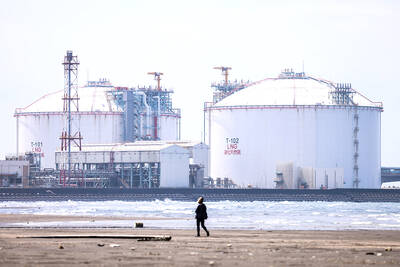
Taiwan is open to joining a global liquefied natural gas (LNG) program if one is created, but on the condition that countries provide delivery even in a scenario where there is a conflict with China, an energy department official said yesterday. While Taiwan’s priority is to have enough LNG at home, the nation is open to exploring potential strategic reserves in other countries such as Japan or South Korea, Energy Administration Deputy Director-General Chen Chung-hsien (陳崇憲) said. While the LNG market does not have a global reserve for emergencies like that of oil, the concept has been raised a few times —

Taiwan Semiconductor Manufacturing Co (TSMC, 台積電) yesterday received government approval to deploy its advanced 3-nanometer (3nm) process at its second fab currently under construction in Japan, the Ministry of Economic Affairs said in a news release. The ministry green-lit the plan for the facility in Kumamoto, which is scheduled to start installing equipment and come online in 2028 with a monthly production capacity of 15,000 12-inch wafers, the ministry said. The Department of Investment Review in June 2024 authorized a US$5.26 billion investment for the facility, slated to manufacture 6- to 12nm chips, significantly less advanced than 3nm process. At a meeting with


 RSS
RSS