


In a rural office on Bengkalis Island, off the northeast coast of Sumatra, 30-year-old Mayasari runs a mask dyed with tree sap through an antique sewing machine.
The day before, Mayasari, who goes by one name, and a dozen other women in Pedekik village learned to make hand sanitizer with an extract from the mangrove trees that fringe the coast.
“Alhamdulillah [praise be to god] — if this comes from nature in Bengkalis, then it’s great,” Mayasari said.
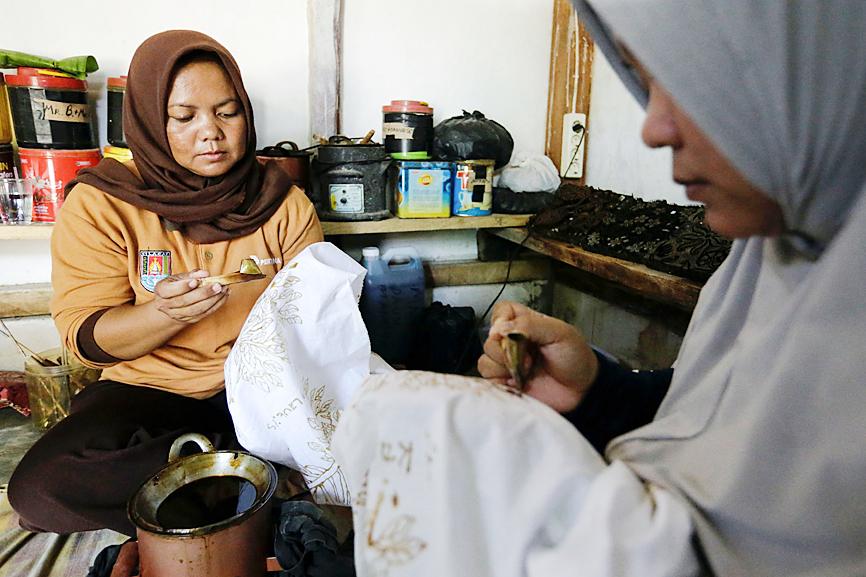
Photo: Reuters
The Bengkalis training is the first government program aimed at addressing the double hit from COVID-19 and climate change among mangrove-dwelling communities in Indonesia.
The masks made by the Pedekik women’s group are sold for 2,000 rupiah (US$0.14) each, offering a new source of income for members.
Besides this scheme in Riau province, others are also under way in South Sumatra and South Kalimantan, to demonstrate to communities the practical value of keeping their mangroves standing.
Indonesia — the world’s largest archipelagic country and its biggest home of wetland forests — counts about 3.3 million hectares of mangroves across its rivers, basins and shorelines, an area larger than Belgium.
These mangrove ecosystems provide vital services to local communities, from food to protection against storm surges.
Mangroves also have an outsize role in sequestering planet-heating carbon dioxide emissions, storing one-third of the world’s coastal carbon stock and about five times as much per hectare as Indonesia’s upland forests.
However, a 2015 study from the Center for International Forestry Research (CIFOR) found that about 40 percent of Indonesia’s mangroves were lost in the previous three decades.
They are often ripped out to make way for shrimp ponds and other small businesses, such as charcoal production, that provide economic security for millions but account for most mangrove loss.
Last year, Indonesian President Joko Widodo expanded the remit of Indonesia’s peatland restoration agency to include ambitious plans to restore 600,000 hectares of damaged mangrove forests by 2024.
“A target of this magnitude has not been attempted anywhere else in the world,” said Daniel Friess, a mangrove researcher and associate professor at the National University of Singapore.
Earlier government efforts had rehabilitated only about 10,000 hectares per year, said Muhammad Ilman, director of the oceans program at Yayasan Konservasi Alam Nusantara, a Jakarta-based conservation group.
About 90 percent of the budget allocated this year to Indonesia’s Peatland and Mangrove Restoration Agency (BRGM) was for planting seedlings, but a small amount was earmarked to foster change in how communities view mangrove forests.
NATURAL PRODUCTS
Mayasari first learned to weave local batik and tenun textiles at the age of nine. Today, she makes 4m of traditional fabric every few weeks, earning about US$150 a month.
Yet the single parent, with two children to put through school, makes only a small profit because she must buy expensive and unhealthy chemical dyes.
This year, the mangrove agency began working with Achmad Nur Hasim, an Indonesian designer who has supplied tenun fabric to French fashion brand Christian Dior.
Achmad said that 90 percent of traditional textiles in Sumatra are dyed using synthetic products.
He hopes textile weavers in Pedekik and elsewhere will instead adopt natural dyes derived from the sap and fruit of local trees, supporting broader efforts to conserve mangroves.
Mayasari said she can find the jengkol tree used for darker shades, pinang for orange and bixa for red just outside her home.
The Bengkalis women’s group this month won a public vote for the best collection of handwoven clothes at the Tenun Fashion Week in Malaysia, which showcased work by 45 women’s weaving communities across Southeast Asia.
Oil extracted from the mangroves is also used to make a hand sanitizer patented by a university in Semarang city, on Java island, and accredited by the Indonesian Ministry of Industry.
MONEY WORRIES
Extending the peat agency’s mandate to include mangrove restoration involves expanding field work from seven to 13 of the archipelago’s 34 provinces.
Matching mangrove species to the landscape depends on complex local factors, such as tides, salinity and sediment levels, forestry scientists said.
“The key distinction is between planting and restoration,” Friess said. “It is not restoration if [the planting] fails.”
In February, the BRGM estimated that restoring 600,000 hectares of mangroves by 2024 could cost 18.4 trillion rupiah.
Only about 1.5 trillion rupiah was initially allocated for that purpose this year — still seven times higher than the agency’s budget for peat restoration.
However, the government later slashed its mangrove restoration target for this year from 150,000 hectares to 33,000, as spending was squeezed by the COVID-19 pandemic, although it plans to open new funding schemes for mangroves.
The Indonesian Ministry of Finance did not respond to questions about the program.
Government expenditure to curb climate change was only one-third of the 266 trillion rupiah required annually, the Indonesian minister of finance said this year.
“The challenge is to make a better program with very limited finance,” said Dermawati Sihite, an environmental lawyer who leads community work for the BRGM.
FOREST FLOODING
One key reason to stop further destruction of Indonesia’s mangroves is to ensure the climate-heating carbon they store remains in their biomass and the soil they grow in.
Research shows global warming also hikes risks to mangrove ecosystems. A 2016 study published in the journal Wetlands Ecology and Management said that coastal mangroves in Indonesia and elsewhere could face inundation from rising sea levels within 35 years without stronger action to curb climate change.
That would threaten food security for people in Bengkalis such as Hidayati, a mother of three who earns 100,000 rupiah per day picking clams from mangroves a short drive from Pedekik.
Hidayati said mangrove loss would deplete the fish and crustaceans that meet local household protein needs, owing to prohibitively high meat prices.
“If the mangroves are gone, then the fish will have nowhere to feed,” one fisherman said, after untangling a barramundi from a net in the strait bisecting Bengkalis from Sumatra’s mainland.
Mangrove loss in Indonesia also reflects regional economic drivers, from tin mining in Bangka island to aquaculture in coastal Java, fieldworkers said.
Erosion and subsidence are already damaging the coastline in Bengkalis.
Here, as in other peatland regions, hundreds of mangrove trunks, each costing 3,000 rupiah, are stacked in a lattice underneath homes to prevent buildings on peat from subsiding.
One local contractor said he knew of no other way to affordably shore up foundations.
“Mangrove restoration or rehabilitation needs careful planning,” said Daniel Murdiyarso, principal scientist at CIFOR. “There is no one-size-fits-all.”

The domestic unit of the Chinese-owned, Dutch-headquartered chipmaker Nexperia BV will soon be able to produce semiconductors locally within China, according to two company sources. Nexperia is at the center of a global tug-of-war over critical semiconductor technology, with a Dutch court in February ordering a probe into alleged mismanagement at the company. The geopolitical tussle has disrupted supply chains, with some carmakers reportedly forced to cut production due to chip shortages. Local production would allow Nexperia’s domestic arm, Nexperia Semiconductors (China) Ltd (安世半導體中國), to bypass restrictions in place since October on the supply of silicon wafers — etched with tiny components to

Singapore-based ride-hailing and delivery giant Grab Holdings Ltd has applied for regulatory approval to acquire the Taiwan operations of Germany-based Delivery Hero SE's Foodpanda in a deal valued at about US$600 million. Grab submitted the filing to the Fair Trade Commission on Friday last week, with the transaction subject to regulatory review and approval, the company said in a statement yesterday. Its independent governance structure would help foster a healthy and competitive market in Taiwan if the deal is approved, Grab said. Grab, which is listed on the NASDAQ, said in the filing that US-based Uber Technologies Inc holds about 13 percent of
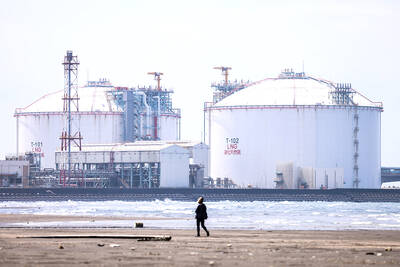
Taiwan is open to joining a global liquefied natural gas (LNG) program if one is created, but on the condition that countries provide delivery even in a scenario where there is a conflict with China, an energy department official said yesterday. While Taiwan’s priority is to have enough LNG at home, the nation is open to exploring potential strategic reserves in other countries such as Japan or South Korea, Energy Administration Deputy Director-General Chen Chung-hsien (陳崇憲) said. While the LNG market does not have a global reserve for emergencies like that of oil, the concept has been raised a few times —

Taiwan Semiconductor Manufacturing Co (TSMC, 台積電) yesterday received government approval to deploy its advanced 3-nanometer (3nm) process at its second fab currently under construction in Japan, the Ministry of Economic Affairs said in a news release. The ministry green-lit the plan for the facility in Kumamoto, which is scheduled to start installing equipment and come online in 2028 with a monthly production capacity of 15,000 12-inch wafers, the ministry said. The Department of Investment Review in June 2024 authorized a US$5.26 billion investment for the facility, slated to manufacture 6- to 12nm chips, significantly less advanced than 3nm process. At a meeting with


 RSS
RSS