


AIRLINES
EasyJet narrows losses
British airline EasyJet PLC yesterday posted narrowing annual losses as air travel reopened, but said that it was “too soon” to assess the effects of the fallout of the Omicron variant of SARS-CoV-2 on the sector. “However, we have prepared ourselves for periods of uncertainty such as this,” EasyJet said in a results statement. The airline posted a pretax loss of £1.14 billion (US$1.52 billion) for the year through September. There had been “some softening of trading” in the current quarter, but next year would see “a return to near pre-pandemic” capacity levels as people take long-awaited summer holidays, it said.
UNITED KINGDOM
Costs to trigger price hikes
Half of businesses expect to increase their prices in response to rising wage costs and supply-chain difficulties, a survey conducted by Lloyds Bank found. Acute labor shortages persisted into last month, the results showed. One-quarter of companies expect to increase wages by 3 percent or more in the next year in an effort to retain and attract workers, it showed. The findings are likely to fuel expectations that the Bank of England would raise interest rates as early as this month. Inflation is running at double the 2 percent target, largely due to surging energy prices.
CRYPTOCURRENCY
Huobi picks city-state base
Huobi Group (火幣), the operator of China’s largest cryptocurrency exchange, has picked Singapore as its regional headquarters, while choosing to have another location for Europe, company cofounder Du Jun (杜均) said. Singapore became the company’s new base after it shifted focus outside its original home of Beijing, Du said. He has been based in the city-state since he returned to Huobi at the end of last year. The firm is planning to set up another regional headquarters in either France or the UK in 2023, he said.
CHINA
Plan urges safer data flow
The Ministry of Industry and Information Technology called for improved cross-border security management of big data, in a five-year plan published yesterday. The plan comes as the country has pushed forward its regulatory framework for data and technology. It contains six key tasks, including improving the “marketization” of data, improving computing power and playing a leading role in developing global technology standards. It also called for enhanced management of cross-border data flows and more support for open-source initiatives. By the end of 2025, the scale of China’s big data industry is to exceed 3 trillion yuan (US$470.9 billion), the ministry said.
INSURERS
Syn Mun Kong stake for sale
The controlling shareholders of Thai insurer Syn Mun Kong Insurance PCL are exploring the sale of a majority stake in the firm and have picked several strategic players to advance into the next round of bidding, people familiar with the matter said. Assicurazioni Generali SpA and Liberty Mutual Group are among those selected to advance, they said. Syn Mun Kong is working with an adviser on the deal, which could be valued at about US$200 million, they said. The sale could include a fresh investment of about US$100 million, they added. Founded in 1951, the Bangkok-based insurer offers auto, health, accident and travel insurance, among others.

KEEPING UP: The acquisition of a cleanroom in Taiwan would enable Micron to increase production in a market where demand continues to outpace supply, a Micron official said Micron Technology Inc has signed a letter of intent to buy a fabrication site in Taiwan from Powerchip Semiconductor Manufacturing Corp (力積電) for US$1.8 billion to expand its production of memory chips. Micron would take control of the P5 site in Miaoli County’s Tongluo Township (銅鑼) and plans to ramp up DRAM production in phases after the transaction closes in the second quarter, the company said in a statement on Saturday. The acquisition includes an existing 12 inch fab cleanroom of 27,871m2 and would further position Micron to address growing global demand for memory solutions, the company said. Micron expects the transaction to
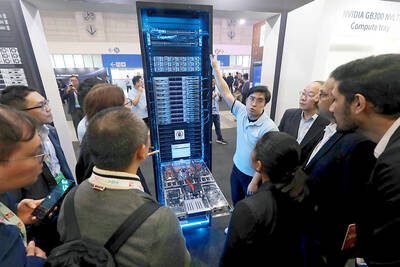
Nvidia Corp’s GB300 platform is expected to account for 70 to 80 percent of global artificial intelligence (AI) server rack shipments this year, while adoption of its next-generation Vera Rubin 200 platform is to gradually gain momentum after the third quarter of the year, TrendForce Corp (集邦科技) said. Servers based on Nvidia’s GB300 chips entered mass production last quarter and they are expected to become the mainstay models for Taiwanese server manufacturers this year, Trendforce analyst Frank Kung (龔明德) said in an interview. This year is expected to be a breakout year for AI servers based on a variety of chips, as

Global semiconductor stocks advanced yesterday, as comments by Nvidia Corp chief executive officer Jensen Huang (黃仁勳) at Davos, Switzerland, helped reinforce investor enthusiasm for artificial intelligence (AI). Samsung Electronics Co gained as much as 5 percent to an all-time high, helping drive South Korea’s benchmark KOSPI above 5,000 for the first time. That came after the Philadelphia Semiconductor Index rose more than 3 percent to a fresh record on Wednesday, with a boost from Nvidia. The gains came amid broad risk-on trade after US President Donald Trump withdrew his threat of tariffs on some European nations over backing for Greenland. Huang further

Sweeping policy changes under US Secretary of Health and Human Services Robert F. Kennedy Jr are having a chilling effect on vaccine makers as anti-vaccine rhetoric has turned into concrete changes in inoculation schedules and recommendations, investors and executives said. The administration of US President Donald Trump has in the past year upended vaccine recommendations, with the country last month ending its longstanding guidance that all children receive inoculations against flu, hepatitis A and other diseases. The unprecedented changes have led to diminished vaccine usage, hurt the investment case for some biotechs, and created a drag that would likely dent revenues and


 RSS
RSS