


European stocks posted their worst session in more than year on Friday, as reports of a newly identified and possibly vaccine-resistant SARS-CoV-2 variant stoked fears of a fresh hit to global economy and drove investors out of riskier assets.
The benchmark STOXX 600 fell 3.7 percent. It had slid as much as 3.6 percent in early trading, while the volatility gauge for the main stock market hit its highest in nearly 10 months. For the week, it plunged 4.53 percent.
Little is known of the variant detected in South Africa, Botswana and Hong Kong, but scientists said it has an unusual combination of mutations and might evade immune responses or make it more transmissible.
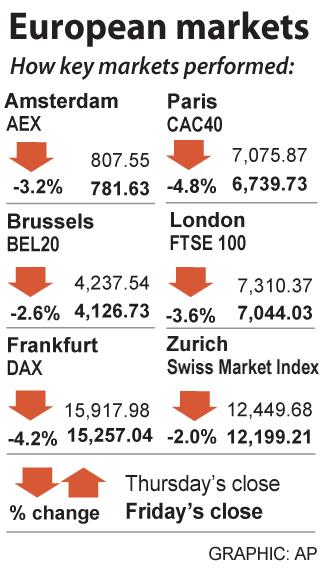
France’s CAC 40 shed 4.75 percent, leading regional markets lower as shares in plane maker Airbus SE, shopping center operator Unibail SE and Safran SA fell 10 to 11 percent each.
UK’s FTSE 100 dropped 3.64 percent, while Germany’s DAX fell 4.15 percent and Spain’s IBEX lost 4.96 percent.
Cyclical-heavy European stock markets have already been under stress this week as a resurgence in COVID-19 cases prompted new restrictions in several countries.
“While COVID still has an impact on market sentiment, it is not the dominant driver it was a year ago. Political and economic agendas have more breadth,” Hargreaves Lansdown head of investment analysis Emma Wall said. “That said, should we have a difficult winter with returned restrictions expect to see those stock sectors which were most vulnerable before wobble — retail, leisure, entertainment and travel.”
Travel and leisure stocks were down 3.9 percent after falling as much as 7 percent after the UK announced a temporary ban on flights from South Africa and several neighboring countries from Friday. The EU is also planning similar moves.
Shares in British Airways owner IAG and EasyJet Holdings PLC, cruise operator Carnival Corp PLC and travel company TUI Group fell 9 to 10 percent.
Oil and gas producers dropped 4.3 percent, while miners tumbled 3.5 percent as oil and metal prices lost ground as reports of the new virus variant fueled economic slowdown worries.
Tracking falls in bond yields, the banking index dropped 4.4 percent, while some stay-at-home stocks, including Delivery Hero SE and Just Eat Takeaway.com NV rose about 3 percent.
The virus scare prompted eurozone money markets to scale back bets of a rate hike from the European Central Bank next year. Odds of a 10 basis point rate hike in December next year almost halved from a full 100 percent earlier this week.

The domestic unit of the Chinese-owned, Dutch-headquartered chipmaker Nexperia BV will soon be able to produce semiconductors locally within China, according to two company sources. Nexperia is at the center of a global tug-of-war over critical semiconductor technology, with a Dutch court in February ordering a probe into alleged mismanagement at the company. The geopolitical tussle has disrupted supply chains, with some carmakers reportedly forced to cut production due to chip shortages. Local production would allow Nexperia’s domestic arm, Nexperia Semiconductors (China) Ltd (安世半導體中國), to bypass restrictions in place since October on the supply of silicon wafers — etched with tiny components to

Singapore-based ride-hailing and delivery giant Grab Holdings Ltd has applied for regulatory approval to acquire the Taiwan operations of Germany-based Delivery Hero SE's Foodpanda in a deal valued at about US$600 million. Grab submitted the filing to the Fair Trade Commission on Friday last week, with the transaction subject to regulatory review and approval, the company said in a statement yesterday. Its independent governance structure would help foster a healthy and competitive market in Taiwan if the deal is approved, Grab said. Grab, which is listed on the NASDAQ, said in the filing that US-based Uber Technologies Inc holds about 13 percent of

Taiwan is open to joining a global liquefied natural gas (LNG) program if one is created, but on the condition that countries provide delivery even in a scenario where there is a conflict with China, an energy department official said yesterday. While Taiwan’s priority is to have enough LNG at home, the nation is open to exploring potential strategic reserves in other countries such as Japan or South Korea, Energy Administration Deputy Director-General Chen Chung-hsien (陳崇憲) said. While the LNG market does not have a global reserve for emergencies like that of oil, the concept has been raised a few times —

Taiwan Semiconductor Manufacturing Co (TSMC, 台積電) yesterday received government approval to deploy its advanced 3-nanometer (3nm) process at its second fab currently under construction in Japan, the Ministry of Economic Affairs said in a news release. The ministry green-lit the plan for the facility in Kumamoto, which is scheduled to start installing equipment and come online in 2028 with a monthly production capacity of 15,000 12-inch wafers, the ministry said. The Department of Investment Review in June 2024 authorized a US$5.26 billion investment for the facility, slated to manufacture 6- to 12nm chips, significantly less advanced than 3nm process. At a meeting with


 RSS
RSS