


Taiwanese have reduced their plans to depend on pension funds as their main source of retirement income, and assign more importance to savings and wealth management tools, a survey by the Chung-Hua Institution for Economic Research (CIER, 中華經濟研究院) said.
The Taipei-based think tank arrived at the findings after surveying people aged 25 and older regarding their financial income, retirement readiness, wealth management preference and return expectations.
A total of 69.4 percent of the respondents cite savings as their planned main source of income for retirement, followed by investment gains at 52.9 percent and government pension funds at 51.7 percent, the survey said.
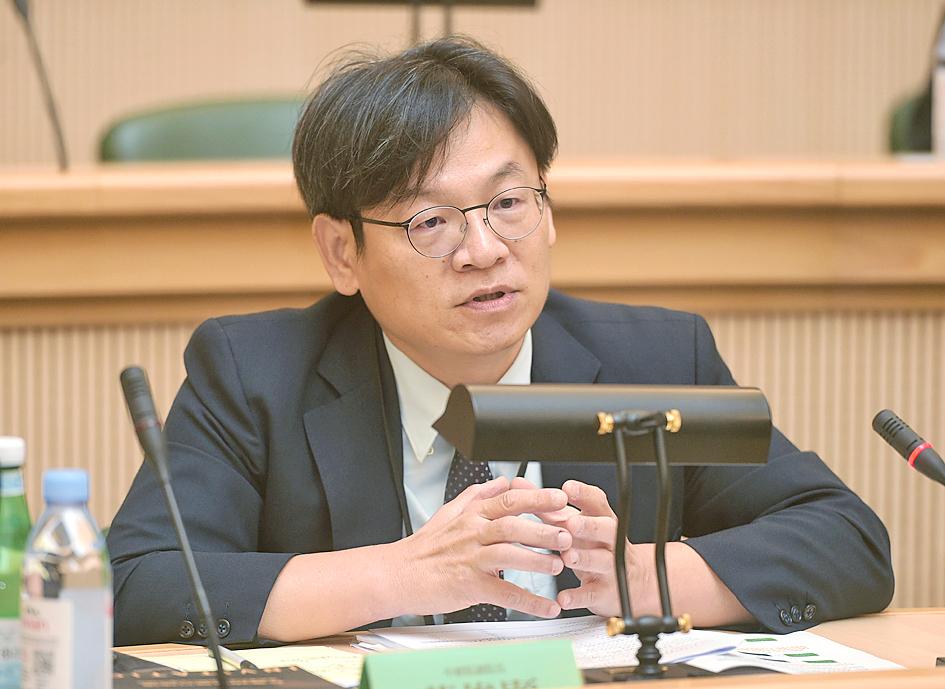
Photo: Chang Chia-ming, Taipei Times
The findings ran counter past surveys in which pension funds played the most important role for both retirees and employed people, it said.
CIER attributed the attitude change to lingering concern over potential pension reforms, uncertainty arising from the COVID-19 pandemic and the rally in the TAIEX.
The local bourse has seen the daily turnover spiking for the past two years, reflecting a large increase in investment interest and the number of participants, the institute said.
Data from the central bank lend support to the observation as the number of securities accounts have been break records as individual players comprise the bulk of daily trading.
Excessive liquidity and extremely low interest rates around the world are encouraging securities investment and boosting financial asset prices, analysts said.
Stocks have gained popularity as wealth management tool, while unit-linked insurance policies have lost appeal, especially among young people, the survey said, adding that the shift has much to do with the retirement timing.
Wealth management experts have said that young people can afford to explore risky investment strategies in the pursuit of wealth, whereas retirees should look to safer strategies to avoid irreparable capital losses.
Additionally, exchange traded funds (ETF) have picked up weight as investment options, from 1.96 percent in 2017 to 37.6 percent this year among employed people, and from 1.44 percent to 29.3 percent among retirees, the survey said.
The finding suggests more room of growth for ETF products, it said.
CIER advised policymakers to introduce an open platform that allows people to select wealth management products on their own to meet their expectations for retirement.
People should be given more discretion in planning their portfolios, as some are expecting higher returns and are willing to shoulder larger risks, the institute said, adding that existing pension funds are insufficient to support a decent living or defend inflation and longevity.
The government could help reduce risks by sponsoring classes on wealth management and asset allocations, it said.

The domestic unit of the Chinese-owned, Dutch-headquartered chipmaker Nexperia BV will soon be able to produce semiconductors locally within China, according to two company sources. Nexperia is at the center of a global tug-of-war over critical semiconductor technology, with a Dutch court in February ordering a probe into alleged mismanagement at the company. The geopolitical tussle has disrupted supply chains, with some carmakers reportedly forced to cut production due to chip shortages. Local production would allow Nexperia’s domestic arm, Nexperia Semiconductors (China) Ltd (安世半導體中國), to bypass restrictions in place since October on the supply of silicon wafers — etched with tiny components to

Singapore-based ride-hailing and delivery giant Grab Holdings Ltd has applied for regulatory approval to acquire the Taiwan operations of Germany-based Delivery Hero SE's Foodpanda in a deal valued at about US$600 million. Grab submitted the filing to the Fair Trade Commission on Friday last week, with the transaction subject to regulatory review and approval, the company said in a statement yesterday. Its independent governance structure would help foster a healthy and competitive market in Taiwan if the deal is approved, Grab said. Grab, which is listed on the NASDAQ, said in the filing that US-based Uber Technologies Inc holds about 13 percent of

Taiwan is open to joining a global liquefied natural gas (LNG) program if one is created, but on the condition that countries provide delivery even in a scenario where there is a conflict with China, an energy department official said yesterday. While Taiwan’s priority is to have enough LNG at home, the nation is open to exploring potential strategic reserves in other countries such as Japan or South Korea, Energy Administration Deputy Director-General Chen Chung-hsien (陳崇憲) said. While the LNG market does not have a global reserve for emergencies like that of oil, the concept has been raised a few times —

Taiwan Semiconductor Manufacturing Co (TSMC, 台積電) yesterday received government approval to deploy its advanced 3-nanometer (3nm) process at its second fab currently under construction in Japan, the Ministry of Economic Affairs said in a news release. The ministry green-lit the plan for the facility in Kumamoto, which is scheduled to start installing equipment and come online in 2028 with a monthly production capacity of 15,000 12-inch wafers, the ministry said. The Department of Investment Review in June 2024 authorized a US$5.26 billion investment for the facility, slated to manufacture 6- to 12nm chips, significantly less advanced than 3nm process. At a meeting with


 RSS
RSS