


The UN yesterday warned that a surge in container freight rates could mean higher prices for consumers next year unless COVID-19 pandemic-fueled problems are untangled.
The UN Conference on Trade and Development (UNCTAD) said that global import price levels could increase by 11 percent and consumer price levels by 1.5 percent between now and 2023.
“Global consumer prices will rise significantly in the year ahead until shipping supply chain disruptions are unblocked and port constraints and terminal inefficiencies are tackled,” UNCTAD said in its Review of Maritime Transport 2021 report.
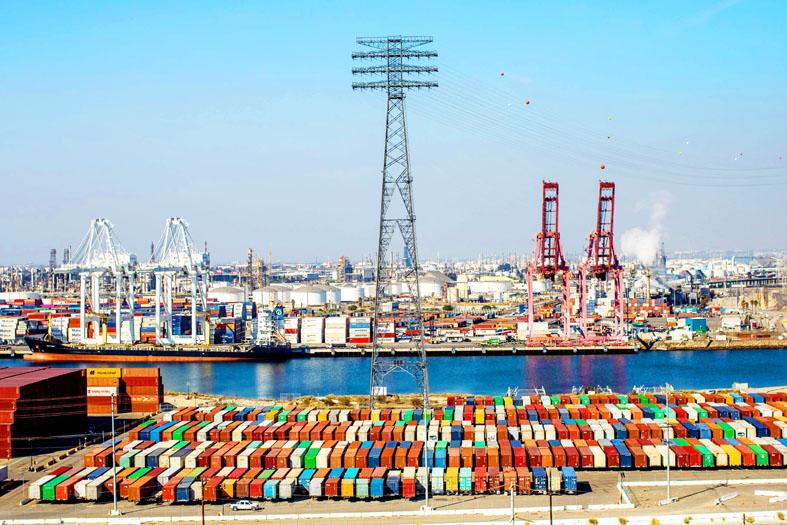
Photo: AFP
Global supply chains faced unprecedented demand from the second half of last year onwards, as consumers spent on goods rather than services during COVID-19 lockdowns.
However, the upswing in demand hit several practical constraints, including container ship carrying capacity, container shortages, labor shortages, congestion at ports and COVID-19 restrictions.
The mismatch led to record container freight rates “on practically all container trade routes,” the report said.
“The current surge in freight rates will have a profound impact on trade and undermine socioeconomic recovery, especially in developing countries, until maritime shipping operations return to normal,” UNCTAD Secretary-General Rebeca Grynspan said.
“Returning to normal would entail investing in new solutions, including infrastructure, freight technology and digitalization and trade facilitation measures,” she said.
UNCTAD said the pandemic had magnified pre-existing industry challenges, particularly labor shortages and infrastructure gaps.
It also exposed vulnerabilities, such as when China’s Yantian Port shut in May due to a COVID-19 outbreak, causing significant delays, or when the giant container ship Ever Given blocked the Suez Canal in March, snarling global trade.
Still, the pandemic’s impact on maritime trade volumes last year was less severe than initially expected, UNCTAD said.
Maritime trade contracted 3.8 percent to 10.65 billion tonnes last year, and is projected to increase 4.3 percent this year.
UNCTAD said the medium-term outlook remained positive, but was subject to “mounting risks and uncertainties.”
The agency predicted that annual growth would slow to 2.4 percent between next year and 2026, compared with 2.9 percent over the past two decades.
“A lasting recovery ... largely hinges on being able to mitigate the headwinds and on a worldwide vaccine roll-out,” Grynspan said.
“The impacts of the COVID-19 crisis will hit small island developing states (SIDS) and least developed countries (LDCs) the hardest,” it said.
The rise in consumer prices is expected to be 7.5 percent in SIDS and 2.2 percent in LDCs.
Contending with lockdowns, border closures and a lack of international flights, hundreds of thousands of seafarers have been stranded at sea, unable to be repatriated or replaced, UNCTAD said.
The UN agency urged governments and industry to work together to end the crew change crisis in the sector, which employs more than 1.9 million people worldwide.
UNCTAD also said the vaccination rate of seafarers was about 41 percent and called for them to be jabbed as a priority.
“This is not acceptable if we want to see the supply chains moving again,” UNCTAD technology and logistics director Shamika Sirimanne said.
While bottlenecks have hindered the economic recovery, the pandemic could trigger far-reaching transformations in maritime transport, UNCTAD predicted.
The crisis has activated digitalization and automation, which should, in turn, deliver efficiency and cost savings.
E-commerce — accelerated by the pandemic — has changed consumer shopping habits and spending patterns, the report said.
“This could generate new business opportunities for shipping and ports,” it said.

The domestic unit of the Chinese-owned, Dutch-headquartered chipmaker Nexperia BV will soon be able to produce semiconductors locally within China, according to two company sources. Nexperia is at the center of a global tug-of-war over critical semiconductor technology, with a Dutch court in February ordering a probe into alleged mismanagement at the company. The geopolitical tussle has disrupted supply chains, with some carmakers reportedly forced to cut production due to chip shortages. Local production would allow Nexperia’s domestic arm, Nexperia Semiconductors (China) Ltd (安世半導體中國), to bypass restrictions in place since October on the supply of silicon wafers — etched with tiny components to

Singapore-based ride-hailing and delivery giant Grab Holdings Ltd has applied for regulatory approval to acquire the Taiwan operations of Germany-based Delivery Hero SE's Foodpanda in a deal valued at about US$600 million. Grab submitted the filing to the Fair Trade Commission on Friday last week, with the transaction subject to regulatory review and approval, the company said in a statement yesterday. Its independent governance structure would help foster a healthy and competitive market in Taiwan if the deal is approved, Grab said. Grab, which is listed on the NASDAQ, said in the filing that US-based Uber Technologies Inc holds about 13 percent of

Taiwan is open to joining a global liquefied natural gas (LNG) program if one is created, but on the condition that countries provide delivery even in a scenario where there is a conflict with China, an energy department official said yesterday. While Taiwan’s priority is to have enough LNG at home, the nation is open to exploring potential strategic reserves in other countries such as Japan or South Korea, Energy Administration Deputy Director-General Chen Chung-hsien (陳崇憲) said. While the LNG market does not have a global reserve for emergencies like that of oil, the concept has been raised a few times —

Taiwan Semiconductor Manufacturing Co (TSMC, 台積電) yesterday received government approval to deploy its advanced 3-nanometer (3nm) process at its second fab currently under construction in Japan, the Ministry of Economic Affairs said in a news release. The ministry green-lit the plan for the facility in Kumamoto, which is scheduled to start installing equipment and come online in 2028 with a monthly production capacity of 15,000 12-inch wafers, the ministry said. The Department of Investment Review in June 2024 authorized a US$5.26 billion investment for the facility, slated to manufacture 6- to 12nm chips, significantly less advanced than 3nm process. At a meeting with


 RSS
RSS