


Tesla Inc on Monday became the latest US tech giant to hit US$1 trillion in market value as investors cheered a large order from Hertz Global Holdings Inc and shrugged off criticism from a US auto safety official.
Shares of Elon Musk’s company closed at US$1,024.86, up 12.7 percent and topping US$1 trillion for the first time.
“Wild $T1mes!” Musk write on Twitter.
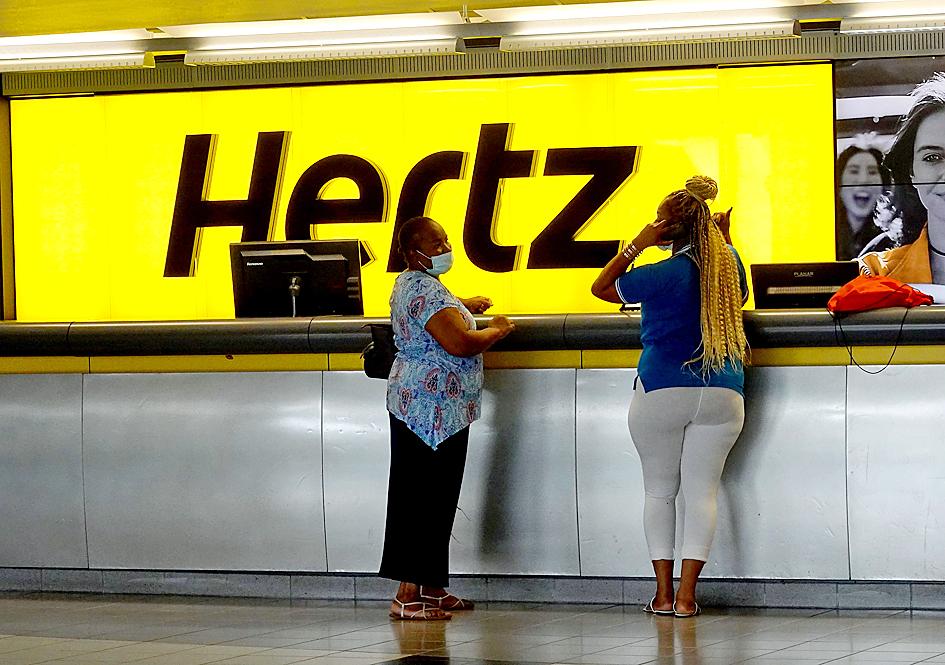
Photo: AFP
The surge followed an announcement from rental car giant Hertz of an order to buy 100,000 vehicles from Tesla by the end of next year in the latest embrace of electric vehicle (EV) technology by a mainstream auto player.
The Hertz announcement came on the heels of strong Tesla earnings last week that illustrated the company’s resilience in spite of a semiconductor shortage that has weighed more heavily on other automakers.
Leading analysts at Morgan Stanley raised their target on Tesla to US$1,200 from US$894, pointing to the company’s “extraordinary” revenue in the past quarter, despite supply chain problems.
The Morgan Stanley note predicted that Tesla over the next 12 to 18 months would “demonstrate the capabilities of the trillion dollar Tesla” as it ramps up production and expands its capacity, model offerings and service offerings.
Monday’s rally overlooked a letter from the US National Transportation Safety Board castigating Musk for not implementing key recommendations to safeguard the automaker’s driver assistance programs.
In a September 2017 report on a fatal incident a year earlier in Florida, the board said that Tesla’s driver assistance system was prone to being employed on roads for which it was not designed.
Tesla’s program also failed to detect signs that the driver was disengaged, it said.
The agency urged Tesla to incorporate safeguards to limit the system to areas for which it was intended and to alert the driver when they become disengaged.
The other five automakers that received the board’s recommendations responded and outlined the steps they were taking, it said.
“Tesla is the only manufacturer that did not officially respond to us about the recommendations,” board chairwoman Jennifer Homendy wrote.
Homendy described a second fatal crash in California in 2018 that also took place in a roadway not meant for the driver assistance system and with an operator who was disengaged.
“Our crash investigations involving your company’s vehicles have clearly shown the potential for misuse requires a system design change to ensure safety,” Homendy said.
However, investors gave more weight to the announcement from Hertz.
The vehicle rental giant, which emerged from a bankruptcy reorganization earlier this year, said in a press release that the EVs would be available “in US major markets and select cities in Europe” beginning early next month.
“Electric vehicles are now mainstream, and we’ve only just begun to see rising global demand and interest,” interim Hertz chief executive officer Mark Fields said.
The deal with Hertz is “a huge win” for Tesla, Briefing.com said on its Web site.
“Beyond the windfall from the order itself, the availability of 100,000 new Model 3s on Hertz’ lots is like a direct marketing campaign for Tesla,” Briefing said.
“After being introduced to Tesla for the first time, some of those Hertz customers may ultimately turn into Tesla customers,” it said. “Additionally, the deal represents another milestone in the broader adoption of EVs, while also opening up an entirely new market for Tesla.”

The domestic unit of the Chinese-owned, Dutch-headquartered chipmaker Nexperia BV will soon be able to produce semiconductors locally within China, according to two company sources. Nexperia is at the center of a global tug-of-war over critical semiconductor technology, with a Dutch court in February ordering a probe into alleged mismanagement at the company. The geopolitical tussle has disrupted supply chains, with some carmakers reportedly forced to cut production due to chip shortages. Local production would allow Nexperia’s domestic arm, Nexperia Semiconductors (China) Ltd (安世半導體中國), to bypass restrictions in place since October on the supply of silicon wafers — etched with tiny components to

Singapore-based ride-hailing and delivery giant Grab Holdings Ltd has applied for regulatory approval to acquire the Taiwan operations of Germany-based Delivery Hero SE's Foodpanda in a deal valued at about US$600 million. Grab submitted the filing to the Fair Trade Commission on Friday last week, with the transaction subject to regulatory review and approval, the company said in a statement yesterday. Its independent governance structure would help foster a healthy and competitive market in Taiwan if the deal is approved, Grab said. Grab, which is listed on the NASDAQ, said in the filing that US-based Uber Technologies Inc holds about 13 percent of

Taiwan Semiconductor Manufacturing Co (TSMC, 台積電) yesterday received government approval to deploy its advanced 3-nanometer (3nm) process at its second fab currently under construction in Japan, the Ministry of Economic Affairs said in a news release. The ministry green-lit the plan for the facility in Kumamoto, which is scheduled to start installing equipment and come online in 2028 with a monthly production capacity of 15,000 12-inch wafers, the ministry said. The Department of Investment Review in June 2024 authorized a US$5.26 billion investment for the facility, slated to manufacture 6- to 12nm chips, significantly less advanced than 3nm process. At a meeting with
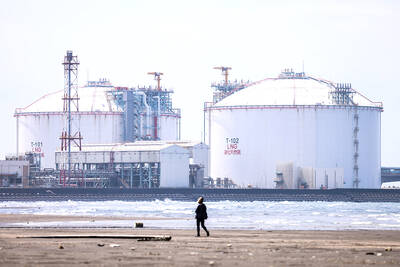
Taiwan is open to joining a global liquefied natural gas (LNG) program if one is created, but on the condition that countries provide delivery even in a scenario where there is a conflict with China, an energy department official said yesterday. While Taiwan’s priority is to have enough LNG at home, the nation is open to exploring potential strategic reserves in other countries such as Japan or South Korea, Energy Administration Deputy Director-General Chen Chung-hsien (陳崇憲) said. While the LNG market does not have a global reserve for emergencies like that of oil, the concept has been raised a few times —


 RSS
RSS