


Intel Corp’s plans for a multibillion-dollar investment in a new US semiconductor plant hang in part on the US Congress moving on a stalled plan to bolster the domestic chip industry, Intel CEO Pat Gelsinger said.
“The capital plans that we’ve laid out do not presume anything heroic on the part of the government, but we’d like to go bigger and faster as a result of the investments from the US government,” Gelsinger said on Bloomberg Television.
Intel’s earnings report on Thursday underscored the costs of returning the world’s largest chipmaker to global industry leadership.

Photo: Reuters
A bipartisan push to make the US more competitive with China and bolster domestic chip production risks falling by the wayside as Congress grapples with a packed year-end agenda in an ever-more divided Capital.
The US Senate passed a bill in June with almost US$250 billion in funding for research and development programs, including US$52 billion in emergency funding to provide grants and incentives to the semiconductor industry in the Creating Helpful Incentives to Produce Semiconductors (CHIPS) for America Act.
Action has stalled in the US House of Representatives over differences in other parts of the bill.
“Our strong plea to the House is get the CHIPS act done, get it funded, because I know we and others are looking forward to the opportunity to go even faster to rebuild our supply chains, to get more of that back on US soil as a result of this funding,” Gelsinger said.
Tech companies and policymakers argue that without government subsidies, the US would not keep pace with countries such as China, whose chip industry is heavily supported by the government.
Intel vice president of government relations Al Thompson cited plans by the EU and South Korea to offer incentives to their homegrown semiconductor manufacturers as a reason for the US to get involved in boosting the industry.
“If you want to start to reverse the continued decline of manufacturing share, CHIPS is necessary,” he said in a separate interview.
The company’s plan to develop a fabrication facility at a yet-to-be named US location “would be very difficult” without the incentives in the legislation, he said.
“We aren’t going to be able to do that without CHIPS funding,” Thompson said.
Fabrication plants cost billions of dollars to build and equip and take several years to complete. Thompson said that every year Congress delays support could mean an additional three-year delay to bringing a plant online.
Separately, Taiwan Semiconductor Manufacturing Co (TSMC, 台積電) on Friday said it would submit its comments to the US in response to Washington’s request for chipmakers to provide information on the semiconductor supply chain by Nov. 8.
TSMC will provide the information requested by the US Department of Commerce, it said, adding that it “has been actively supporting and working with all stakeholders to overcome the global semiconductor supply challenge.”
“Looking forward, to increase the demand visibility in this complex supply chain should be the path to avoid such shortage from happening in the future. We have been a strong partner in this effort and will continue taking actions to address this challenge,” the chipmaker said.
TSMC’s comments came after a US Department of Commerce spokesperson told Reuters on Thursday that it had received indications from several companies that they would supply information.
The companies mentioned include both US and foreign firms, including Intel, General Motors Co, Infineon Technologies AG of Germany and SK Hynix Inc of South Korea. TSMC was not mentioned.
Additional reporting by CNA

DAMAGE REPORT: Global central banks are assessing war-driven inflation risks as the law of unintended consequences careens around the world, spiking oil prices Central banks from Washington to London and from Jakarta to Taipei are about to make their first assessments of economic damage after more than two weeks of conflict between the US and Iran. Decisions this week encompassing every member of the G7 and eight of the world’s 10 most-traded currency jurisdictions are likely to confirm to investors that the specter of a new inflation shock is already worrying enough to prompt heightened caution. The US Federal Reserve is widely expected to do exactly what everyone anticipated weeks ahead of its March 17-18 policy gathering: hold rates steady. The narrative surrounding that

Taiwan Semiconductor Manufacturing Co’s (TSMC, 台積電) share of the global foundry market rose to almost 70 percent last year amid booming demand for artificial intelligence (AI), market information advisory firm TrendForce Corp (集邦科技) said on Thursday. The contract chipmaker posted US$122.54 billion in revenue, up 36.1 percent from a year earlier, accounting for 69.9 percent of the global market, TrendForce said. Its share was up from 64.4 percent in 2024, it said. TSMC’s closest rival, Samsung Electronics, was a distant second, posting US$12.63 billion in sales, down 3.9 percent from a year earlier, for a 7.2 percent share of the global market. In the

HEADWINDS: The company said it expects its computer business, as well as consumer electronics and communications segments to see revenue declines due to seasonality Pegatron Corp (和碩) yesterday said it aims to grow its artificial intelligence (AI) server revenue more than 10-fold this year from last year, driven by orders from neocloud solutions clients and large cloud service providers. The electronics manufacturing service provider said AI server revenue growth would be driven primarily by the Nvidia Corp GB300 server platform. Server shipments are expected to increase each quarter this year, with the second half likely to outperform the first half, it said. The AI server market is expected to broaden this year as more inference applications emerge, which would drive demand for system-on-chip, application-specific integrated circuits
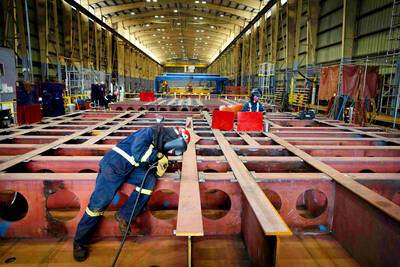
At a massive shipyard in North Vancouver, Canadian workers grind metal beams for a powerful new icebreaker crucial to cementing the country’s presence in the increasingly contested arctic. Icebreakers are specialized, expensive vessels able to navigate in the frozen far north. And “this is the crown jewel,” said Eddie Schehr, vice president of production at the Seaspan shipyard. For Canadian Prime Minister Mark Carney, who heads to Norway next Friday to observe arctic defense drills involving troops from 14 NATO states, Canada’s extreme north has emerged as a strategic priority. “Canada is and forever will be an Arctic nation,” he said ahead of


 RSS
RSS