


Equity investors are advised to choose stocks that are poised to benefit from growth potential in the medium to long term, such as those related to high-performance computing, artificial intelligence and electric vehicle sectors, as market corrections continue to weigh on the local bourse, Allianz Global Investors Taiwan Ltd (安聯投信) said on Friday.
“The main bourse has shown mixed performances since the end of September, with financial and electronic stocks outperforming the broader market, while shipping, chip packaging and testing, optical, steel, printed circuit board and passive component sectors have underperformed the market on the back of worries about softening demand ahead and China’s power rationing,” Allianz Global Investors Taiwan Technology Fund manager Peter Liao (廖哲宏) said in a note.
However, Taiwan’s economic fundamentals remain sound as the IMF last week upgraded the nation’s GDP growth forecast to 5.9 percent for this year and 3.3 percent for next year, Liao said, adding that the TAIEX has a relatively low price-earnings ratio of 12.9 compared with the benchmark index’s historic pattern.
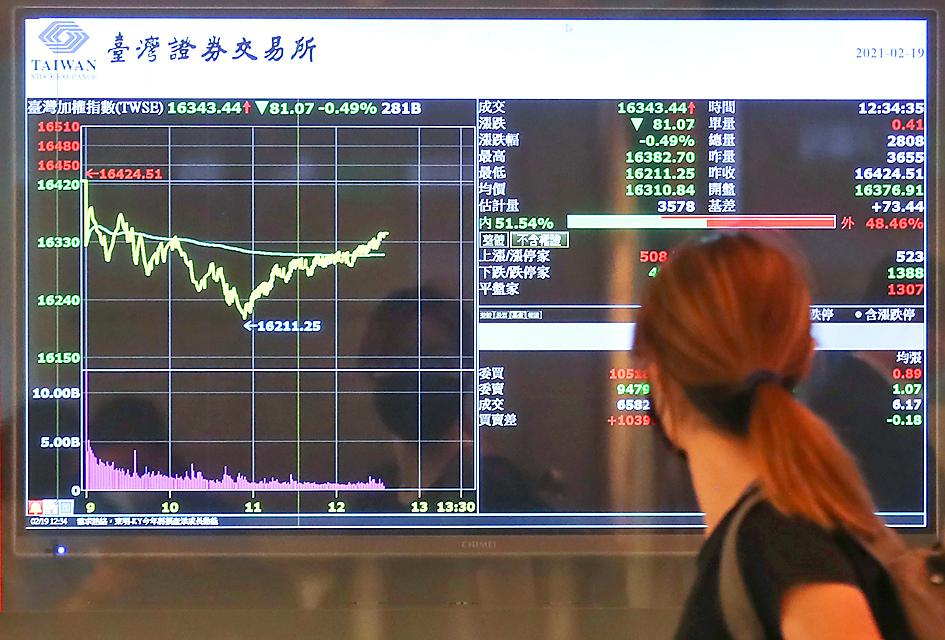
Photo: CNA
Therefore investors for the time being could take cues from listed companies’ earnings reports for the third quarter, along with the outlook major players provide for the fourth quarter, to choose their stocks, he said.
The advice came after the TAIEX on Friday closed 2.4 percent up at the day’s high of 16,781.19 points on the back of strong technology stocks, Taiwan Semiconductor Manufacturing Co (TSMC, 台積電) in particular.
The TAIEX rose 0.85 percent for the entirety of last week, and year to date it has increased by 13.91 percent, Taiwan Stock Exchange data showed.
However, performance of local equities has been volatile in recent sessions, affected by concerns over the US Federal Reserve’s tapering plans for its asset purchases, China’s power shortage crisis and potentially declining demand in the electronics sector next year.
Analysts said that upward resistance remains heavy for the local bourse in the short term, and the best strategy for investors is to avoid chasing prices blindly whenever the market rebounds.
The near-term challenges for TAIEX include the 20-day moving average of 16,831 and the 60-day moving average of 17,112 points, they said.
“At present, it seems that electronics stocks are leading the rebound, followed by financial stocks and some old-economy stocks that had fallen deep earlier,” Franklin Templeton SinoAm High-tech Fund manager Kuo Hsiu-shen (郭修伸) said in an investment note on Friday.
As the rotation buying remains active in the market amid ample liquidity, Kuo said he favored semiconductor, IC design, new energy and electric vehicle-related stocks.
Foreign institutional investors bought a net NT$27.88 billion (US$994.8 million) of local shares on Friday, the largest net purchase by foreign institutional investors since Sept. 3.
For the entirety of last week, foreign institutional investors bought a net NT$5.96 billion of local shares, but sold a net NT$67.76 billion this month as of Friday.
The TAIEX’s continued gains depend on sustained foreign institutional buying in tech stocks, Capital Investment Management Corp (群益投顧) analyst Liao Chien-yu (廖健佑) said on Saturday.

The domestic unit of the Chinese-owned, Dutch-headquartered chipmaker Nexperia BV will soon be able to produce semiconductors locally within China, according to two company sources. Nexperia is at the center of a global tug-of-war over critical semiconductor technology, with a Dutch court in February ordering a probe into alleged mismanagement at the company. The geopolitical tussle has disrupted supply chains, with some carmakers reportedly forced to cut production due to chip shortages. Local production would allow Nexperia’s domestic arm, Nexperia Semiconductors (China) Ltd (安世半導體中國), to bypass restrictions in place since October on the supply of silicon wafers — etched with tiny components to

Singapore-based ride-hailing and delivery giant Grab Holdings Ltd has applied for regulatory approval to acquire the Taiwan operations of Germany-based Delivery Hero SE's Foodpanda in a deal valued at about US$600 million. Grab submitted the filing to the Fair Trade Commission on Friday last week, with the transaction subject to regulatory review and approval, the company said in a statement yesterday. Its independent governance structure would help foster a healthy and competitive market in Taiwan if the deal is approved, Grab said. Grab, which is listed on the NASDAQ, said in the filing that US-based Uber Technologies Inc holds about 13 percent of

Taiwan Semiconductor Manufacturing Co (TSMC, 台積電) yesterday received government approval to deploy its advanced 3-nanometer (3nm) process at its second fab currently under construction in Japan, the Ministry of Economic Affairs said in a news release. The ministry green-lit the plan for the facility in Kumamoto, which is scheduled to start installing equipment and come online in 2028 with a monthly production capacity of 15,000 12-inch wafers, the ministry said. The Department of Investment Review in June 2024 authorized a US$5.26 billion investment for the facility, slated to manufacture 6- to 12nm chips, significantly less advanced than 3nm process. At a meeting with

Taiwan is open to joining a global liquefied natural gas (LNG) program if one is created, but on the condition that countries provide delivery even in a scenario where there is a conflict with China, an energy department official said yesterday. While Taiwan’s priority is to have enough LNG at home, the nation is open to exploring potential strategic reserves in other countries such as Japan or South Korea, Energy Administration Deputy Director-General Chen Chung-hsien (陳崇憲) said. While the LNG market does not have a global reserve for emergencies like that of oil, the concept has been raised a few times —


 RSS
RSS