


Japanese Prime Minister Fumio Kishida yesterday said that he would not seek to change the country’s taxes on capital gains and dividends, as he intends to pursue other steps for better wealth distribution, such as raising wages of medical workers.
Kishida, who has vowed to rectify wealth disparities, previously said that reviewing those taxes would be an option in addressing income gaps.
Kishida’s new stance indicates his concern about jitters in the stock market caused by the prospects of higher tax levies.
Kishida took the top job in the world’s third-largest economy on Monday last week, replacing Yoshihide Suga, who had seen his support undermined by surging COVID-19 infections.
“I have no plan to touch the financial income tax for the time being... There are many other things to tackle first,” Kishida told a news program on commercial broadcaster Fuji Television Network. “Misunderstanding is spreading that I may do it soon. That will give unnecessary worry to people concerned, if not dispelled firmly.”
Investors have voiced concern that the new prime minister might press ahead with capital-gains tax increases, signaling a turnaround from investor-friendly economic policies pursued by Japan’s longest-serving prime minister, Shinzo Abe, from 2013 to last year.
Some analysts had called for raising Japan’s tax levied on investment income from the current 20 percent to raise more from the rich and fund steps to support low-income households.
Others were skeptical about the effects such tax increases might have on correcting wealth disparities.
Kishida’s Liberal Democratic Party makes no mention of reviewing taxes on capital gains and dividends in a draft campaign platform for the Oct. 31 general elections obtained by Reuters.
Investors had been concerned about any negative effect the higher tax rates could have on stock markets, which could cool local investment and drive away foreign investors.

The domestic unit of the Chinese-owned, Dutch-headquartered chipmaker Nexperia BV will soon be able to produce semiconductors locally within China, according to two company sources. Nexperia is at the center of a global tug-of-war over critical semiconductor technology, with a Dutch court in February ordering a probe into alleged mismanagement at the company. The geopolitical tussle has disrupted supply chains, with some carmakers reportedly forced to cut production due to chip shortages. Local production would allow Nexperia’s domestic arm, Nexperia Semiconductors (China) Ltd (安世半導體中國), to bypass restrictions in place since October on the supply of silicon wafers — etched with tiny components to

Singapore-based ride-hailing and delivery giant Grab Holdings Ltd has applied for regulatory approval to acquire the Taiwan operations of Germany-based Delivery Hero SE's Foodpanda in a deal valued at about US$600 million. Grab submitted the filing to the Fair Trade Commission on Friday last week, with the transaction subject to regulatory review and approval, the company said in a statement yesterday. Its independent governance structure would help foster a healthy and competitive market in Taiwan if the deal is approved, Grab said. Grab, which is listed on the NASDAQ, said in the filing that US-based Uber Technologies Inc holds about 13 percent of
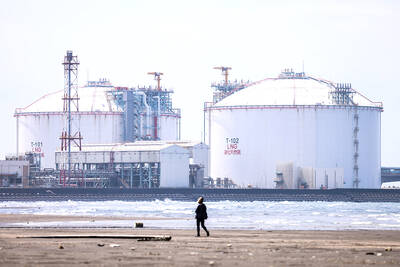
Taiwan is open to joining a global liquefied natural gas (LNG) program if one is created, but on the condition that countries provide delivery even in a scenario where there is a conflict with China, an energy department official said yesterday. While Taiwan’s priority is to have enough LNG at home, the nation is open to exploring potential strategic reserves in other countries such as Japan or South Korea, Energy Administration Deputy Director-General Chen Chung-hsien (陳崇憲) said. While the LNG market does not have a global reserve for emergencies like that of oil, the concept has been raised a few times —
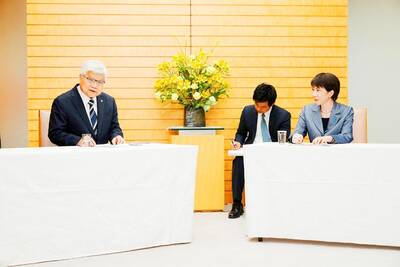
Taiwan Semiconductor Manufacturing Co (TSMC, 台積電) yesterday received government approval to deploy its advanced 3-nanometer (3nm) process at its second fab currently under construction in Japan, the Ministry of Economic Affairs said in a news release. The ministry green-lit the plan for the facility in Kumamoto, which is scheduled to start installing equipment and come online in 2028 with a monthly production capacity of 15,000 12-inch wafers, the ministry said. The Department of Investment Review in June 2024 authorized a US$5.26 billion investment for the facility, slated to manufacture 6- to 12nm chips, significantly less advanced than 3nm process. At a meeting with


 RSS
RSS