


Tesla Inc CEO Elon Musk plans for the electric automaker’s plant near Berlin to start producing vehicles as early as next month, even as the US company still awaits final approval for the project, which has been delayed by legal challenges.
The factory is to begin making Model Y vehicles next month or in December, Musk said on Saturday during a visit to the site in Gruenheide, where Tesla hosted thousands of local residents at an Oktoberfest-style county fair.
The plant would probably source batteries from Tesla’s facilities in China until a cell factory in Germany is completed, he said.
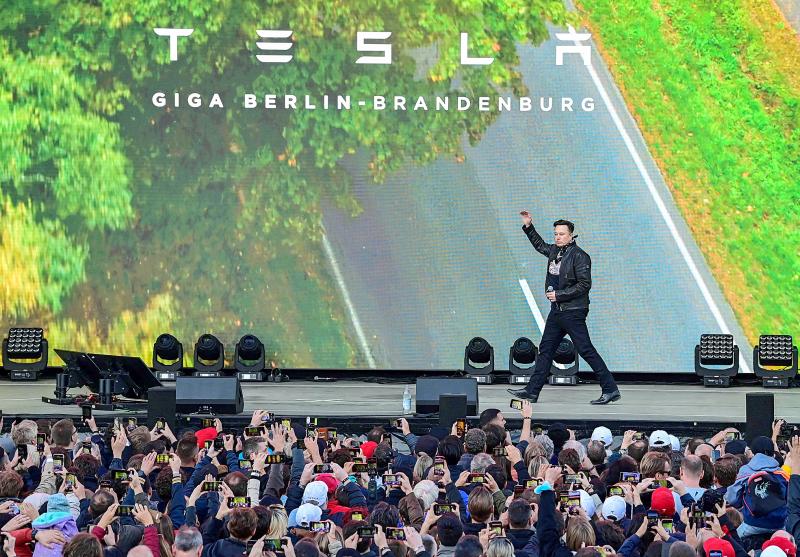
Photo: AFP
“The start of production is nice, but volume production is the hard part,” Musk said, adding that Tesla targets making 5,000 to 10,000 vehicles a week at Gruenheide by the end of next year.
“We are going to need a lot of talented, hardworking people to get there,” he said.
While his visit marks the factory’s final stretch of construction, Tesla is still awaiting final approval for the project that underpins its European expansion plans just as Volkswagen AG, Daimler AG and BMW AG broaden their electric vehicle lineups. For Germany, the plant promises new jobs in a region that lost most of its heavy industry during World War II.
Progress at Gruenheide has been less smooth than hoped, with Tesla facing lawsuits from environmental groups concerned about water use and wildlife, and the plant has been delayed by several months.
Tesla eventually plans to make as many as 500,000 vehicles at the factory, alongside production of battery cells.
Locals have filed more than 800 complaints, which are discussed via an online consultation process until Thursday.
Environmental authorities have vowed to make a decision on final approval only after that process ends.
However, the mood was festive on Saturday, with photographs posted on social media showing visitors lining up for Model Y test rides, a Ferris wheel and tours of the factory’s interior.
In a nod to some of the environmental opposition, Musk said Tesla would plant more trees than it has cut down and make sure the factory uses as little water as possible.
Musk said that he aims to introduce more Tesla products in Europe next year, including its solar roof and its so-called Full Self-Driving system.
“It’s looking highly likely to be in Europe next year,” he said of the system.
Tesla has said that while the system is designed to someday handle trips without driver intervention, it is not yet capable of rendering Tesla vehicles autonomous.
Separately, Indian Minister of Road Transport and Highways Nitin Gadkari said he had asked Tesla to avoid selling China-made vehicles in India ahead of the automaker’s expected entry into the South Asian nation.
Tesla should “make cars in India, sell in India and export from India,” and rely on local suppliers, Gadkari said at an India Today Conclave event on Friday.
Tesla models in India would cost 3.5 million rupees (US$46,671) each and the government would provide whatever help the company needs to make a foray into the nation, he said.
Tesla in August received approval to make or import four models in India, the ministry said on its Web site.
Tesla currently produces vehicles in the US and China.

The domestic unit of the Chinese-owned, Dutch-headquartered chipmaker Nexperia BV will soon be able to produce semiconductors locally within China, according to two company sources. Nexperia is at the center of a global tug-of-war over critical semiconductor technology, with a Dutch court in February ordering a probe into alleged mismanagement at the company. The geopolitical tussle has disrupted supply chains, with some carmakers reportedly forced to cut production due to chip shortages. Local production would allow Nexperia’s domestic arm, Nexperia Semiconductors (China) Ltd (安世半導體中國), to bypass restrictions in place since October on the supply of silicon wafers — etched with tiny components to

Singapore-based ride-hailing and delivery giant Grab Holdings Ltd has applied for regulatory approval to acquire the Taiwan operations of Germany-based Delivery Hero SE's Foodpanda in a deal valued at about US$600 million. Grab submitted the filing to the Fair Trade Commission on Friday last week, with the transaction subject to regulatory review and approval, the company said in a statement yesterday. Its independent governance structure would help foster a healthy and competitive market in Taiwan if the deal is approved, Grab said. Grab, which is listed on the NASDAQ, said in the filing that US-based Uber Technologies Inc holds about 13 percent of
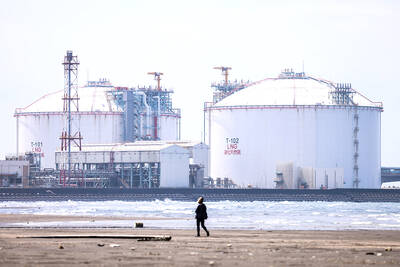
Taiwan is open to joining a global liquefied natural gas (LNG) program if one is created, but on the condition that countries provide delivery even in a scenario where there is a conflict with China, an energy department official said yesterday. While Taiwan’s priority is to have enough LNG at home, the nation is open to exploring potential strategic reserves in other countries such as Japan or South Korea, Energy Administration Deputy Director-General Chen Chung-hsien (陳崇憲) said. While the LNG market does not have a global reserve for emergencies like that of oil, the concept has been raised a few times —

Taiwan Semiconductor Manufacturing Co (TSMC, 台積電) yesterday received government approval to deploy its advanced 3-nanometer (3nm) process at its second fab currently under construction in Japan, the Ministry of Economic Affairs said in a news release. The ministry green-lit the plan for the facility in Kumamoto, which is scheduled to start installing equipment and come online in 2028 with a monthly production capacity of 15,000 12-inch wafers, the ministry said. The Department of Investment Review in June 2024 authorized a US$5.26 billion investment for the facility, slated to manufacture 6- to 12nm chips, significantly less advanced than 3nm process. At a meeting with


 RSS
RSS