


Indonesia is set to become Asia’s fourth country to introduce a carbon tax, but analysts expect opposition from industries that have warned of implementation problems and higher power costs that could undermine manufacturing competitiveness.
The introduction of the tax is part of an ambitious tax overhaul, approved by parliament on Thursday, that includes raising value-added taxes next year and canceling a planned corporate tax cut.
The carbon tax will be introduced at a minimum rate of 30 rupiah (US$0.0021) per kilogram of carbon dioxide equivalent, less than half of the originally proposed rate of 75 rupiah.
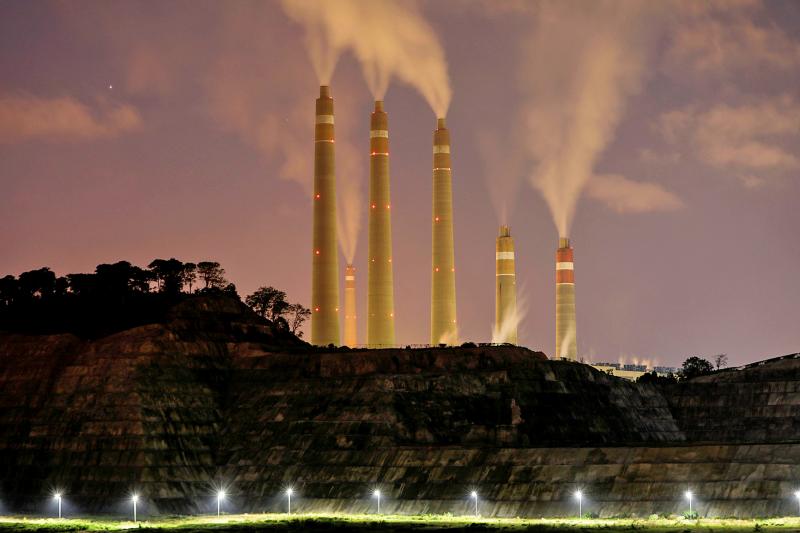
Photo: Reuters
It will be imposed at the floor rate on coal-fired power plants from April next year while a carbon trade mechanism is established. A carbon market is expected to be in operation by 2025.
Indonesia is the world’s top exporter of thermal coal and the eighth-largest carbon emitter.
The new tax is part of a plan to slash carbon output that has included bringing forward a goal of net zero emissions from 2070 to 2060 or sooner.
The carbon tax has been generally welcomed, although some industry analysts have questioned the logic of the government taxing carbon emitted by utilities while subsidizing the electricity they produce.
“It sure is a step in the right direction,” said Elrika Hamdi, an analyst at the Institute for Energy Economics and Financial Analysis. “Although ... how will the carbon tax be felt by coal-power producers if electricity is still being subsidized?”
Southeast Asia’s largest economy is set to spend 61.5 trillion rupiah on electricity subsidies this year, and 56.5 trillion next year.
Coal producers and electricity providers say that higher electricity prices would likely be passed on to consumers as higher prices for goods.
“Power prices will obviously rise because 87 percent of our power generation is from non-renewable energy,” said Bob Saril, a director at Indonesia’s state utility PLN. “If the tariff is not increased, of course subsidies and compensation will increase.”
Indonesia Coal Miners Association executive director Hendra Sinadia said he hoped implementation of the tax could be postponed for more discussions with the coal industry.
“Imposing a carbon tax on coal-fired power plants will affect electricity prices and the competitiveness of Indonesia’s manufacturing,” Sinadia said.
Despite the complaints, the lower 30 rupiah initial rate should soften the blow and encourage industries to make the transition to cleaner energy before a market-driven tax rate comes into effect along with the establishment of the carbon trade mechanism, an analyst said.
“The recently announced rate, albeit lower, will incentivize a smoother transition to lower emissions, while avoiding shocks to the economy amid recovery from the coronavirus,” consultancy group Wood Mackenzie analyst Nuomin Han said.

The domestic unit of the Chinese-owned, Dutch-headquartered chipmaker Nexperia BV will soon be able to produce semiconductors locally within China, according to two company sources. Nexperia is at the center of a global tug-of-war over critical semiconductor technology, with a Dutch court in February ordering a probe into alleged mismanagement at the company. The geopolitical tussle has disrupted supply chains, with some carmakers reportedly forced to cut production due to chip shortages. Local production would allow Nexperia’s domestic arm, Nexperia Semiconductors (China) Ltd (安世半導體中國), to bypass restrictions in place since October on the supply of silicon wafers — etched with tiny components to

Singapore-based ride-hailing and delivery giant Grab Holdings Ltd has applied for regulatory approval to acquire the Taiwan operations of Germany-based Delivery Hero SE's Foodpanda in a deal valued at about US$600 million. Grab submitted the filing to the Fair Trade Commission on Friday last week, with the transaction subject to regulatory review and approval, the company said in a statement yesterday. Its independent governance structure would help foster a healthy and competitive market in Taiwan if the deal is approved, Grab said. Grab, which is listed on the NASDAQ, said in the filing that US-based Uber Technologies Inc holds about 13 percent of
Taiwan is open to joining a global liquefied natural gas (LNG) program if one is created, but on the condition that countries provide delivery even in a scenario where there is a conflict with China, an energy department official said yesterday. While Taiwan’s priority is to have enough LNG at home, the nation is open to exploring potential strategic reserves in other countries such as Japan or South Korea, Energy Administration Deputy Director-General Chen Chung-hsien (陳崇憲) said. While the LNG market does not have a global reserve for emergencies like that of oil, the concept has been raised a few times —

Taiwan Semiconductor Manufacturing Co (TSMC, 台積電) yesterday received government approval to deploy its advanced 3-nanometer (3nm) process at its second fab currently under construction in Japan, the Ministry of Economic Affairs said in a news release. The ministry green-lit the plan for the facility in Kumamoto, which is scheduled to start installing equipment and come online in 2028 with a monthly production capacity of 15,000 12-inch wafers, the ministry said. The Department of Investment Review in June 2024 authorized a US$5.26 billion investment for the facility, slated to manufacture 6- to 12nm chips, significantly less advanced than 3nm process. At a meeting with


 RSS
RSS