


Stablecoins would have to comply with the same safeguards as their more traditional competitors in payments, regulators said yesterday, as authorities get to grips with a rapidly evolving sector.
Stablecoins are cryptocurrencies designed to have a stable value relative to traditional currencies, or to a commodity such as gold, to avoid the volatility that makes bitcoin and other digital tokens impractical for most commerce.
Facebook Inc’s move in 2019 to introduce its own stablecoin — diem, then known as libra — raised concerns among governments and central banks that a major payments competitor could emerge overnight with little regulation.
Since then, diem has radically scaled back its ambitions and plans to launch a US dollar stablecoin.
The IOSCO group of securities regulators and the Bank for International Settlements (BIS), a global forum for central banks, set out yesterday how current rules for major clearing, settlement and payments services should also be applied to “systemic” or heavily used stablecoins.
The proposals, put out to public consultation before being finalized early next year, put into practice what regulators have long called for: the same rules for the same type of business and accompanying risks.
The rules mean a stablecoin operator must set up a legal entity that spells out how it is governed and manages operational risks like cyberattacks.
Although still little-used for commerce, the use of stablecoins in crypto trading has grown rapidly as retail and larger investors warmed to the emerging asset class during the COVID-19 pandemic.
Tether, the largest stablecoin, has a market capitalization of about US$68 billion versus just US$15 billion a year ago.
The value of circulating USD coin, another major stablecoin, has also jumped dramatically to more than US$30 billion from just US$2.7 billion a year ago, CoinMarketCap data showed.
Countries that allow stablecoins to operate would be required to apply the principles as part of their affiliation to IOSCO and the BIS.
“This report marks significant progress in understanding the implications of stablecoin arrangements for the financial system and providing clear and practical guidance on the standards they need to meet to maintain its integrity,” IOSCO chair Ashley Alder said in a statement.
The proposals do not cover issues specific to stablecoins pegged to a basket of fiat currencies, which would be considered separately.

The domestic unit of the Chinese-owned, Dutch-headquartered chipmaker Nexperia BV will soon be able to produce semiconductors locally within China, according to two company sources. Nexperia is at the center of a global tug-of-war over critical semiconductor technology, with a Dutch court in February ordering a probe into alleged mismanagement at the company. The geopolitical tussle has disrupted supply chains, with some carmakers reportedly forced to cut production due to chip shortages. Local production would allow Nexperia’s domestic arm, Nexperia Semiconductors (China) Ltd (安世半導體中國), to bypass restrictions in place since October on the supply of silicon wafers — etched with tiny components to

Singapore-based ride-hailing and delivery giant Grab Holdings Ltd has applied for regulatory approval to acquire the Taiwan operations of Germany-based Delivery Hero SE's Foodpanda in a deal valued at about US$600 million. Grab submitted the filing to the Fair Trade Commission on Friday last week, with the transaction subject to regulatory review and approval, the company said in a statement yesterday. Its independent governance structure would help foster a healthy and competitive market in Taiwan if the deal is approved, Grab said. Grab, which is listed on the NASDAQ, said in the filing that US-based Uber Technologies Inc holds about 13 percent of
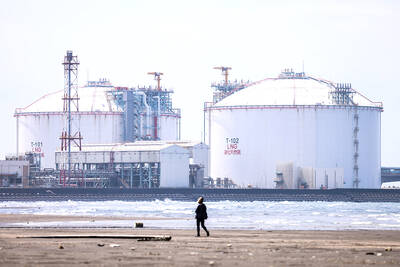
Taiwan is open to joining a global liquefied natural gas (LNG) program if one is created, but on the condition that countries provide delivery even in a scenario where there is a conflict with China, an energy department official said yesterday. While Taiwan’s priority is to have enough LNG at home, the nation is open to exploring potential strategic reserves in other countries such as Japan or South Korea, Energy Administration Deputy Director-General Chen Chung-hsien (陳崇憲) said. While the LNG market does not have a global reserve for emergencies like that of oil, the concept has been raised a few times —

Taiwan Semiconductor Manufacturing Co (TSMC, 台積電) yesterday received government approval to deploy its advanced 3-nanometer (3nm) process at its second fab currently under construction in Japan, the Ministry of Economic Affairs said in a news release. The ministry green-lit the plan for the facility in Kumamoto, which is scheduled to start installing equipment and come online in 2028 with a monthly production capacity of 15,000 12-inch wafers, the ministry said. The Department of Investment Review in June 2024 authorized a US$5.26 billion investment for the facility, slated to manufacture 6- to 12nm chips, significantly less advanced than 3nm process. At a meeting with


 RSS
RSS