


It is “still too soon to tell” whether power shortages in China would lead to a wave of reshoring by Taiwanese manufacturers, Minister of Economic Affairs Wang Mei-hua (王美花) said yesterday.
Wang’s remarks came in response to Democratic Progressive Party (DPP) Legislator Cheng Yun-peng (鄭運鵬), who during a meeting of the legislature’s Economics Committee inquired whether any Taiwanese firms have yet made the announcement to “come home” amid power rationing in China.
“All this just happened and manufacturers are dealing with it by switching production to existing manufacturing facilities outside of China,” Wang said. “However, most firms have a wait-and-see attitude toward long-term investment decisions.”
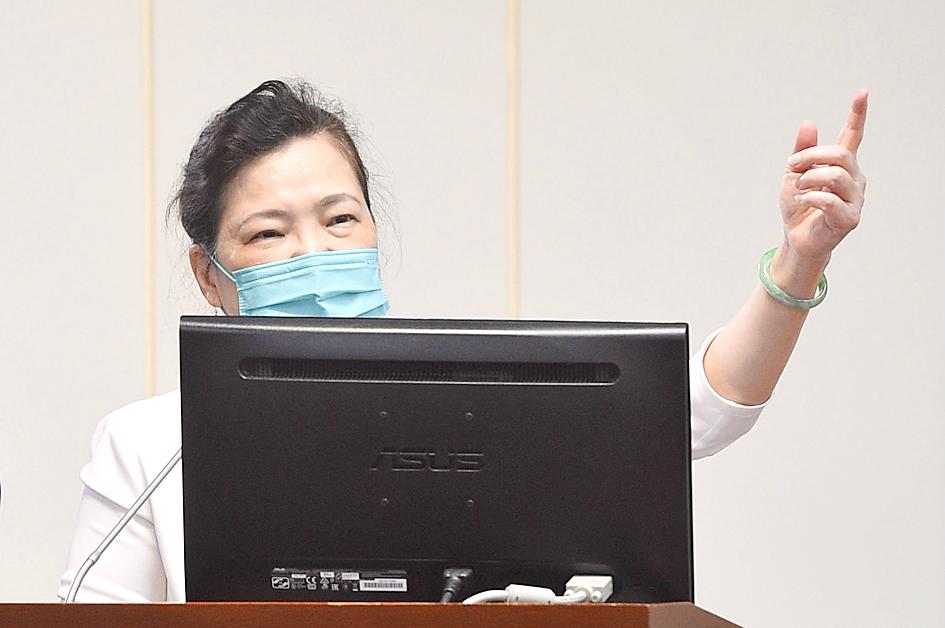
Photo: George Tsorng, Taipei Times
Taiwanese manufacturers that have retained domestic production facilities are better able to weather the unexpected shortages, while firms that exclusively produce in China would inevitably be affected, she said.
“It is inevitable that firms that only manufacture in China will take longer to deliver their orders, leading ultimately to lower volumes,” she added.
DPP Legislator Chiu Yi-ying (邱議瑩) asked whether Taiwan has enough electricity generation capacity to supply industrial users, especially if more manufacturers return.
Wang said that Taiwan has mainly secured its energy needs through long-term contracts and is therefore less exposed to an ongoing global energy crunch.
About 70 percent of Taiwan’s liquefied natural gas and 75 percent of its coal come from long-term supply agreements, she said.
“We are prepared,” Wang said, adding that Taiwan has a 30-day supply of coal, as opposed to about 10 days in India or China.
Separately, Minister Without Portfolio John Deng (鄧振中) said that Taiwan’s bid to join the Comprehensive and Progressive Agreement for Trans-Pacific Partnership (CPTPP) has been “well-received” by Japan, Canada, New Zealand and Australia.
“You can describe the responses to Taiwan’s application as encouraging,” Deng told political commentator Frances Huang (黃光芹) in an interview.
After China’s surprise bid to join the regional trade pact on Sept. 16, Taiwan swiftly followed suit and sent its membership application a week later, worried that China’s membership might derail its long-planned attempt to join the bloc.
“A lot of countries were taken by surprise by China’s bid,” Deng said. “As long as more than half of China’s GDP is generated by state-owned enterprises, it will be hard for the country to meet the CPTPP’s tough requirements.”
Describing China’s bid as a “sneak attack,” Deng said that Taiwan, which “pre-paved” its bid, is more “welcomed internationally.”
“No one is throwing cold water on our bid,” he said, describing Taiwan’s chances as “good.”

SECOND-RATE: Models distilled from US products do not perform the same as the original and undo measures that ensure the systems are neutral, the US’ cable said The US Department of State has ordered a global push to bring attention to what it said are widespread efforts by Chinese companies, including artificial intelligence (AI) start-up DeepSeek (深度求索), to steal intellectual property from US AI labs, according to a diplomatic cable. The cable, dated Friday and sent to diplomatic and consular posts around the world, instructs diplomatic staff to speak to their foreign counterparts about “concerns over adversaries’ extraction and distillation of US AI models.” Distillation is the process of training smaller AI models using output from larger, more expensive ones to lower the costs of training a powerful new
Shares of Taiwan Semiconductor Manufacturing Co (TSMC, 台積電) have repeatedly hit new highs, but an equity analyst said the stock’s valuation remains within a reasonable range and any pullback would likely be technical. The contract chipmaker’s historical price-to-earnings (P/E) ratio has ranged between 20 and 30, Cathay Futures Consultant Co (國泰證期) analyst Tsai Ming-han (蔡明翰) told Central News Agency. With market consensus projecting that TSMC would post earnings per share of about NT$100 (US$3.17) this year, supported by strong global demand for artificial intelligence (AI) applications, and the stock currently trading at a P/E ratio of below 25, Tsai said the valuation
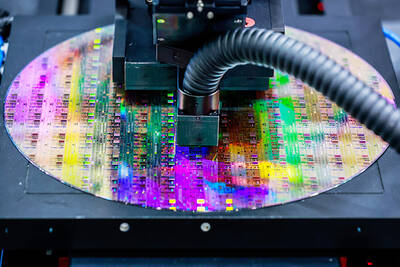
The artificial intelligence (AI) boom has triggered a seismic reshuffling of global equity markets, with Taiwan and South Korea muscling past European nations one by one. With its stock market now valued at nearly US$4.3 trillion, Taiwan surpassed the UK, Europe’s biggest market, earlier this month, data compiled by Bloomberg showed. South Korea is about US$140 billion away from doing the same. The tech-heavy Asian markets have shot past Germany and France in the past seven months. The shift is largely down to massive gains in shares of three companies that provide essential hardware for AI: Taiwan Semiconductor Manufacturing Co (TSMC, 台積電),
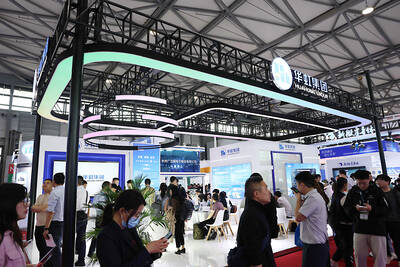
The US Department of Commerce last week ordered multiple chip equipment companies to halt shipments of certain tools to China’s second-largest chipmaker, Hua Hong Semiconductor Ltd (華虹半導體), its latest action to slow the country’s development of advanced chips, two people familiar with the matter said. The department sent letters to at least a handful of companies informing them of restrictions on tools and other materials destined for two Hua Hong facilities US officials believe make China’s most sophisticated chips, the people said. Top US chip equipment companies Lam Research Corp, Applied Materials Inc and KLA Corp, each of which has significant


 RSS
RSS