


Fantasia Holdings Group (花樣年控股集團), a Chinese homebuilder, on Monday missed payments on debt obligations, adding to worries over the country’s property sector as embattled giant China Evergrande Group (恆大集團) teeters on the brink of collapse.
Fears of contagion through the Chinese economy have grown as Evergrande, the most indebted of the country’s private homebuilders, struggles with more than US$300 billion in liabilities and heads toward a massive restructuring.
Fantasia Holdings failed to repay a US$205.7 million note, the Shenzhen-based company said in a statement.
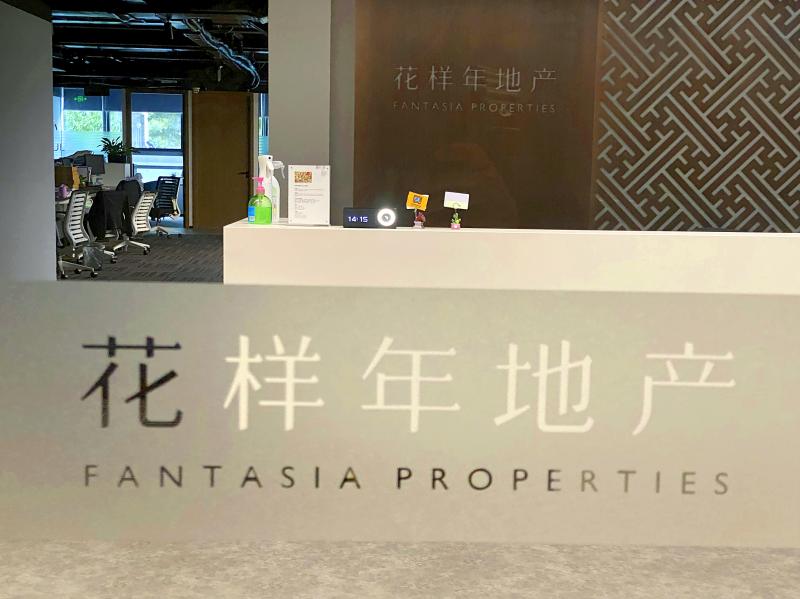
Photo: AP
This came as property management firm Country Garden Services Holdings Co (碧桂園) added that a unit of Fantasia had missed repayment on a 700 million yuan (US$108 million) loan, saying it was likely that Fantasia would default.
The news comes as investors await news from Evergrande after it suspended trading of its shares on Monday pending an announcement on a “major transaction,” with reports saying Hong Kong real-estate firm Hopson Development Holdings Ltd (合生創展集團) planned to buy a 51 percent stake in its property services arm.
While Fantasia is a smaller player in the market than Evergrande, its struggles highlight investor concerns over companies’ financial disclosures.
Fitch Ratings on Monday downgraded Fantasia to “CCC-,” which indicates default is a possibility.
The ratings agency said in a statement that although media reports said Fantasia missed an earlier payment to bondholders, the bond “does not appear to have been disclosed in the company’s financial reports.”
“We believe the existence of these bonds means that the company’s liquidity situation could be tighter than we previously expected,” it said.
“Furthermore, this incident casts doubt on the transparency of the company’s financial disclosures,” it said.
Separately, S&P Global Ratings has downgraded another Chinese property firm — Sinic Holdings Group Co (新力控股集團) — saying that its “debt-servicing ability has almost been depleted.”
Sinic has been unable to service interest repayments, which could result in “accelerating repayments on Sinic’s other debt obligations,” S&P said on Monday.
Fitch yesterday downgraded Shanghai-based Sinic from “CCC” to “C,” reflecting its view that “a default-like process has begun” for the company.
Sinic chairman Zhang Yuanlin (張園林) last month lost more than US$1 billion in a market meltdown linked to fears about Evergrande.
Forbes reported that Zhang’s net worth dropped from US$1.3 billion to US$250.7 million on Sept. 20, when his firm was forced to halt trading in Hong Kong following an 87 percent slump in its share price.
China’s real-estate sector has been under tightened scrutiny in the past few months, with regulators last year announcing caps for three different debt ratios in a scheme dubbed the “three red lines.”
Beijing has stayed silent on the travails of Evergrande, but state media has trailed responses in a nod to the mood toward a private company that grew on a debt binge in the boom years of Chinese real estate.

The domestic unit of the Chinese-owned, Dutch-headquartered chipmaker Nexperia BV will soon be able to produce semiconductors locally within China, according to two company sources. Nexperia is at the center of a global tug-of-war over critical semiconductor technology, with a Dutch court in February ordering a probe into alleged mismanagement at the company. The geopolitical tussle has disrupted supply chains, with some carmakers reportedly forced to cut production due to chip shortages. Local production would allow Nexperia’s domestic arm, Nexperia Semiconductors (China) Ltd (安世半導體中國), to bypass restrictions in place since October on the supply of silicon wafers — etched with tiny components to

Singapore-based ride-hailing and delivery giant Grab Holdings Ltd has applied for regulatory approval to acquire the Taiwan operations of Germany-based Delivery Hero SE's Foodpanda in a deal valued at about US$600 million. Grab submitted the filing to the Fair Trade Commission on Friday last week, with the transaction subject to regulatory review and approval, the company said in a statement yesterday. Its independent governance structure would help foster a healthy and competitive market in Taiwan if the deal is approved, Grab said. Grab, which is listed on the NASDAQ, said in the filing that US-based Uber Technologies Inc holds about 13 percent of
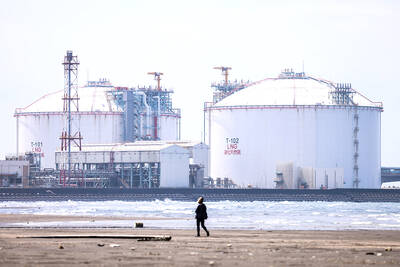
Taiwan is open to joining a global liquefied natural gas (LNG) program if one is created, but on the condition that countries provide delivery even in a scenario where there is a conflict with China, an energy department official said yesterday. While Taiwan’s priority is to have enough LNG at home, the nation is open to exploring potential strategic reserves in other countries such as Japan or South Korea, Energy Administration Deputy Director-General Chen Chung-hsien (陳崇憲) said. While the LNG market does not have a global reserve for emergencies like that of oil, the concept has been raised a few times —

Taiwan Semiconductor Manufacturing Co (TSMC, 台積電) yesterday received government approval to deploy its advanced 3-nanometer (3nm) process at its second fab currently under construction in Japan, the Ministry of Economic Affairs said in a news release. The ministry green-lit the plan for the facility in Kumamoto, which is scheduled to start installing equipment and come online in 2028 with a monthly production capacity of 15,000 12-inch wafers, the ministry said. The Department of Investment Review in June 2024 authorized a US$5.26 billion investment for the facility, slated to manufacture 6- to 12nm chips, significantly less advanced than 3nm process. At a meeting with


 RSS
RSS