


Commercial property transactions last quarter gained 14.3 percent from three months earlier to NT$31.32 billion (US$1.12 billion), while land deals jumped 15.8 percent to NT$77.5 billion, propelled by demand for commercial and industrial office spaces, as well as factories, Cushman & Wakefield Taiwan (戴德梁行) said yesterday.
In the first three quarters of the year, commercial property deals totaled NT$105.07 billion, already surpassing the figure for the whole of last year, the local branch of the US property consultancy said.
Cash-loaded life insurance companies contributed NT$6.95 billion, or 22 percent, in the July-to-September period, the broker said.
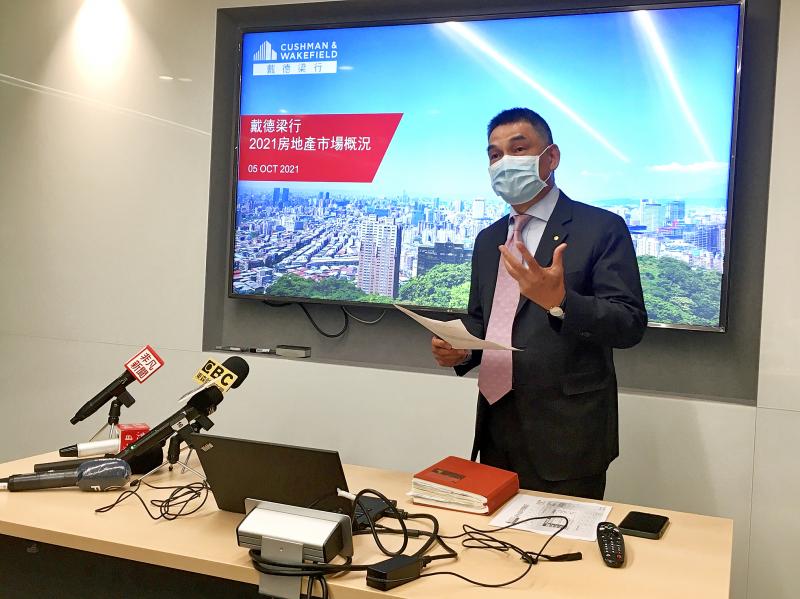
Photo: Hsu Yi-ping, Taipei Times
China Life Insurance Co (中國人壽) spent NT$2.33 billion on an office building in Hsinchu City, Mercuries Life Insurance Co (三商美邦人壽) acquired an office building in Taipei’s Neihu District (內湖) for NT$3.4 billion and CTBC Asset Management Co (中信資產) won an auction for an office building in Taipei’s Neihu District for NT$2.21 billion, Cushman & Wakefield Taiwan said.
Also last quarter, Holiday Garden Hotel’s (華園大飯店) property near Liuhe Tourist Night Market (六合夜市) in Kaohsiung and Fushin Hotel’s (富信大飯店) outlet in New Taipei City’s Sijhih District (汐止) changed hands for NT$2.7 billion and NT$1.85 billion respectively, it said.
Hotels have been hit hard by COVID-19 restrictions and more are seeking buyers, it said.
Cushman & Wakefield Taiwan managing director Billy Yen (顏炳立) said that the commercial market this year might match last year’s record of NT$130 billion, driven by robust self-occupancy needs amid a supply glut.
Land deals have been hot, with an average quarterly volume of NT$73.8 billion for the past two-and-a-half years, the consultancy said.
Taoyuan outperformed other counties and cities last quarter with NT$28.3 billion of land transactions, thanks to the release of public land by the local government to better utilize assets, it said.
Commercial land accounted for 48.5 percent of overall deals as major developers vied for plots in emerging business districts such as Taipei’s Nangang District (南港), Taoyuan’s Chingpu District (青埔) and Taichung’s Shuinan Economic and Trade Park (水湳經貿園區), it said.
All are benefiting from improving transportation convenience and other infrastructure projects, it said.
It is unlikely that property prices would fall, given increasingly expensive building materials and land costs, Yen said.
The housing market, especially in second-tier locations, has recovered after a COVID-19 outbreak, which began in May, while luxury apartments remain affected by virus concerns and credit tightening measures, he said, adding that low interest rates and sufficient liquidity have supported the real-estate market.

The domestic unit of the Chinese-owned, Dutch-headquartered chipmaker Nexperia BV will soon be able to produce semiconductors locally within China, according to two company sources. Nexperia is at the center of a global tug-of-war over critical semiconductor technology, with a Dutch court in February ordering a probe into alleged mismanagement at the company. The geopolitical tussle has disrupted supply chains, with some carmakers reportedly forced to cut production due to chip shortages. Local production would allow Nexperia’s domestic arm, Nexperia Semiconductors (China) Ltd (安世半導體中國), to bypass restrictions in place since October on the supply of silicon wafers — etched with tiny components to

Singapore-based ride-hailing and delivery giant Grab Holdings Ltd has applied for regulatory approval to acquire the Taiwan operations of Germany-based Delivery Hero SE's Foodpanda in a deal valued at about US$600 million. Grab submitted the filing to the Fair Trade Commission on Friday last week, with the transaction subject to regulatory review and approval, the company said in a statement yesterday. Its independent governance structure would help foster a healthy and competitive market in Taiwan if the deal is approved, Grab said. Grab, which is listed on the NASDAQ, said in the filing that US-based Uber Technologies Inc holds about 13 percent of
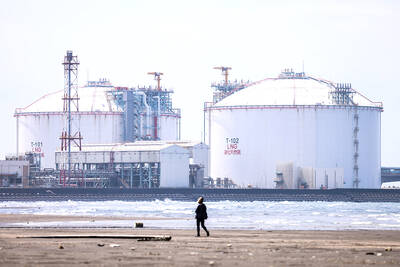
Taiwan is open to joining a global liquefied natural gas (LNG) program if one is created, but on the condition that countries provide delivery even in a scenario where there is a conflict with China, an energy department official said yesterday. While Taiwan’s priority is to have enough LNG at home, the nation is open to exploring potential strategic reserves in other countries such as Japan or South Korea, Energy Administration Deputy Director-General Chen Chung-hsien (陳崇憲) said. While the LNG market does not have a global reserve for emergencies like that of oil, the concept has been raised a few times —

Taiwan Semiconductor Manufacturing Co (TSMC, 台積電) yesterday received government approval to deploy its advanced 3-nanometer (3nm) process at its second fab currently under construction in Japan, the Ministry of Economic Affairs said in a news release. The ministry green-lit the plan for the facility in Kumamoto, which is scheduled to start installing equipment and come online in 2028 with a monthly production capacity of 15,000 12-inch wafers, the ministry said. The Department of Investment Review in June 2024 authorized a US$5.26 billion investment for the facility, slated to manufacture 6- to 12nm chips, significantly less advanced than 3nm process. At a meeting with


 RSS
RSS