


European gas yesterday surged to a record 100 euros before retreating, as the energy crunch deepened after China set the stage for a global fight for supplies — a move that threatens to derail the economic recovery.
Benchmark futures traded in the Netherlands gained as much 2.3 percent, and then fell 3.1 percent in volatile trading. China ordered its state-owned energy companies to secure supplies for this winter at all costs, people familiar with the matter said.
That would intensify a battle for liquefied natural gas and coal cargoes just as Russian pipeline flows into Germany’s Mallnow compressor station tumbled.
Energy prices are rising from the US to Europe and Asia as the economy recovers from the COVID-19 pandemic and people return to offices. Europe is struggling to secure enough gas and coal ahead of the winter, with rising prices forcing some of industrial giants from fertilizer producers CF Industries to Yara International ASA and chemicals giant BASF SE to shut plants or curtail output.
“The volatile trading already shows that no one really knows how high gas can go,” said Niek van Kouteren, a senior trader at PZEM, a Dutch energy company. “But we’re definitely in for a wild ride. The question will be where there will be demand destruction.”
Dutch gas futures surged to 100 euros per megawatt-hour, before plunging 3.1 percent to 94.7 euros by 9:21am in Amsterdam. Prices were swinging between gains and loss this morning as traders weighed the potential for demand curbs as more factories shut or reduce production.
European storage sites are just under 75 percent full, the lowest level for this time of year in more than a decade. Inventory withdrawals typically start by the end of the month, depending on the weather. So far, temperatures in northwest Europe are forecast to be largely within seasonal norms in October.
“Gas can go now as high as it needs to knock demand out,” said Andreas Gandolfo, leader of the European power team at BloombergNEF. “For some European industries gas has become too expensive. For some, including us, who have gas heating at home, it can probably go a lot higher before there is a decision to switch off.”
Flows from top supplier Russia into Germany’s Mallnow through the key Yamal-Europe pipeline also dropped just as the heating season begins. At an auction on Thursday, no extra pipeline capacity was booked to deliver fuel to Mallnow the following day.
The threat of more industrial closures in Europe also risks stalling than rally in European carbon futures. Some of the companies curtailing production or closing factories are energy-intensive users and need to use carbon permits to cover their emissions.
The slowdown could lead them to sell their allowances, said Trevor Sikorski, head of natural gas and energy transition at the London-based consultants Energy Aspects.
Carbon futures fell 0.6 percent to 61.40 euros per tonne, while German power gained 1.3 percent to 131 euros per megawatt-hour.
In Asia, the price of liquefied natural gas surged to a record US$34.47 per million British thermal units on Thursday. The cost in Asia and in Europe are about US$190 per barrel of crude oil equivalent.

The domestic unit of the Chinese-owned, Dutch-headquartered chipmaker Nexperia BV will soon be able to produce semiconductors locally within China, according to two company sources. Nexperia is at the center of a global tug-of-war over critical semiconductor technology, with a Dutch court in February ordering a probe into alleged mismanagement at the company. The geopolitical tussle has disrupted supply chains, with some carmakers reportedly forced to cut production due to chip shortages. Local production would allow Nexperia’s domestic arm, Nexperia Semiconductors (China) Ltd (安世半導體中國), to bypass restrictions in place since October on the supply of silicon wafers — etched with tiny components to

Singapore-based ride-hailing and delivery giant Grab Holdings Ltd has applied for regulatory approval to acquire the Taiwan operations of Germany-based Delivery Hero SE's Foodpanda in a deal valued at about US$600 million. Grab submitted the filing to the Fair Trade Commission on Friday last week, with the transaction subject to regulatory review and approval, the company said in a statement yesterday. Its independent governance structure would help foster a healthy and competitive market in Taiwan if the deal is approved, Grab said. Grab, which is listed on the NASDAQ, said in the filing that US-based Uber Technologies Inc holds about 13 percent of
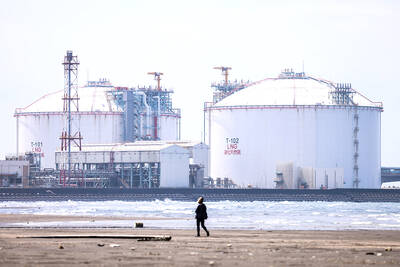
Taiwan is open to joining a global liquefied natural gas (LNG) program if one is created, but on the condition that countries provide delivery even in a scenario where there is a conflict with China, an energy department official said yesterday. While Taiwan’s priority is to have enough LNG at home, the nation is open to exploring potential strategic reserves in other countries such as Japan or South Korea, Energy Administration Deputy Director-General Chen Chung-hsien (陳崇憲) said. While the LNG market does not have a global reserve for emergencies like that of oil, the concept has been raised a few times —

Taiwan Semiconductor Manufacturing Co (TSMC, 台積電) yesterday received government approval to deploy its advanced 3-nanometer (3nm) process at its second fab currently under construction in Japan, the Ministry of Economic Affairs said in a news release. The ministry green-lit the plan for the facility in Kumamoto, which is scheduled to start installing equipment and come online in 2028 with a monthly production capacity of 15,000 12-inch wafers, the ministry said. The Department of Investment Review in June 2024 authorized a US$5.26 billion investment for the facility, slated to manufacture 6- to 12nm chips, significantly less advanced than 3nm process. At a meeting with


 RSS
RSS