


US automaker Ford Motor Co on Monday said it plans to invest US$11.4 billion in electric vehicle (EV) production, in a bid to position itself to lead the US’ shift away from fossil fuels.
The company said that it is to build four new plants to produce EVs and batteries that will create 11,000 new jobs by 2025.
Together with its South Korean partner SK Innovation Co, it is to build the factories in Kentucky and Tennessee, Ford said in a statement.
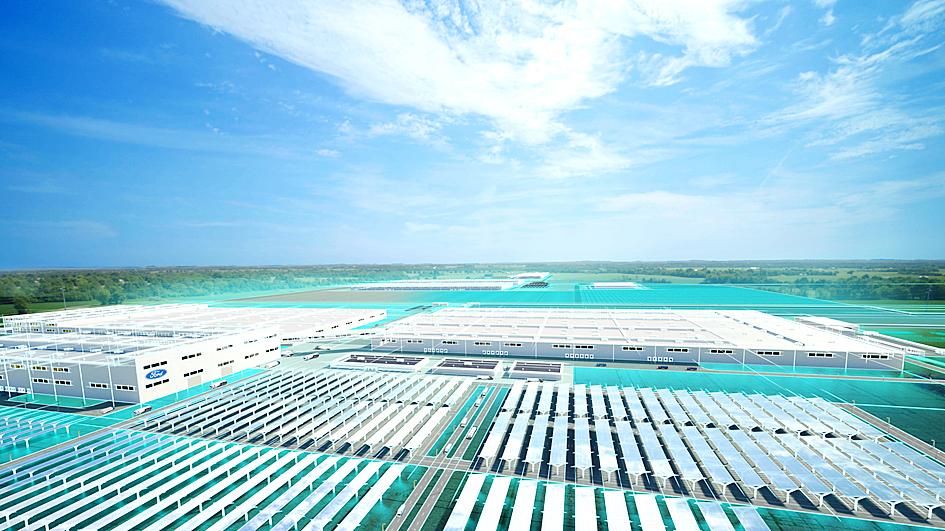
Photo: Reuters
It is to invest US$7 billion, part of a US$30 billion investment already announced last spring, and SK Innovation will put up the remainder, the statement said.
It would be the “largest, most advanced, most efficient auto production complex in its 118-year history” and would place the company at the forefront of the country’s shift to electric vehicles, Ford said.
“This investment supports the company’s longer-term goal to create a sustainable American manufacturing ecosystem, and to accelerate its progress towards achieving carbon neutrality, backed by science-based targets in line with the Paris Climate Agreement,” it said.
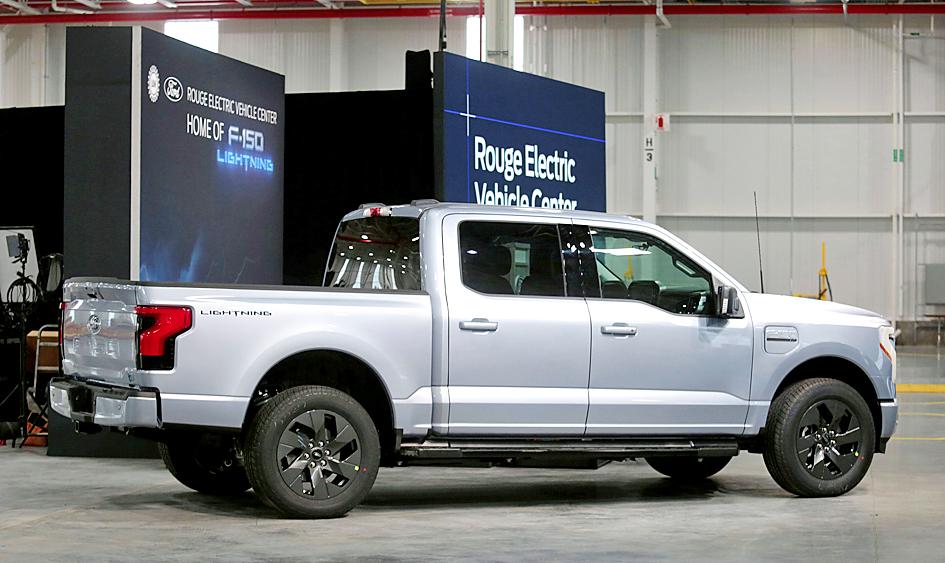
Photo: Reuters
The company expects between 40 and 50 percent of its global vehicles to be fully electric by 2030, the statement said.
The announcement came amid strong demand for the company’s new F-150 Lightning pickup and other electric models such as the E-Transit and the Mustang Mach-E.
Like its competitor General Motors Co, Ford is striving to catch up with Tesla Inc, the main pioneer of electric vehicles.
Ford, which revolutionized automated car production a century ago, said its rollout would be “the largest ever US investment in electric vehicles at one time by any automotive manufacturer.”
Echoing a theme close to US President Joe Biden’s economic plans, Ford chief executive officer Jim Farley said that the investment was “about creating good jobs that support American families.”
Ford’s announcement will give a boost to Biden’s Democratic Party, which is to put a massive infrastructure investment plan of about US$1 trillion to a vote in the US Congress this week.
The Democrats say that a switch to a greener economy could create millions of jobs.
In its original form, the infrastructure plan provided for the construction of a national network of 500,000 charging stations by 2030 and a switch to electricity for 20 percent of the country’s yellow school buses.

The domestic unit of the Chinese-owned, Dutch-headquartered chipmaker Nexperia BV will soon be able to produce semiconductors locally within China, according to two company sources. Nexperia is at the center of a global tug-of-war over critical semiconductor technology, with a Dutch court in February ordering a probe into alleged mismanagement at the company. The geopolitical tussle has disrupted supply chains, with some carmakers reportedly forced to cut production due to chip shortages. Local production would allow Nexperia’s domestic arm, Nexperia Semiconductors (China) Ltd (安世半導體中國), to bypass restrictions in place since October on the supply of silicon wafers — etched with tiny components to

Singapore-based ride-hailing and delivery giant Grab Holdings Ltd has applied for regulatory approval to acquire the Taiwan operations of Germany-based Delivery Hero SE's Foodpanda in a deal valued at about US$600 million. Grab submitted the filing to the Fair Trade Commission on Friday last week, with the transaction subject to regulatory review and approval, the company said in a statement yesterday. Its independent governance structure would help foster a healthy and competitive market in Taiwan if the deal is approved, Grab said. Grab, which is listed on the NASDAQ, said in the filing that US-based Uber Technologies Inc holds about 13 percent of
Taiwan is open to joining a global liquefied natural gas (LNG) program if one is created, but on the condition that countries provide delivery even in a scenario where there is a conflict with China, an energy department official said yesterday. While Taiwan’s priority is to have enough LNG at home, the nation is open to exploring potential strategic reserves in other countries such as Japan or South Korea, Energy Administration Deputy Director-General Chen Chung-hsien (陳崇憲) said. While the LNG market does not have a global reserve for emergencies like that of oil, the concept has been raised a few times —

Taiwan Semiconductor Manufacturing Co (TSMC, 台積電) yesterday received government approval to deploy its advanced 3-nanometer (3nm) process at its second fab currently under construction in Japan, the Ministry of Economic Affairs said in a news release. The ministry green-lit the plan for the facility in Kumamoto, which is scheduled to start installing equipment and come online in 2028 with a monthly production capacity of 15,000 12-inch wafers, the ministry said. The Department of Investment Review in June 2024 authorized a US$5.26 billion investment for the facility, slated to manufacture 6- to 12nm chips, significantly less advanced than 3nm process. At a meeting with


 RSS
RSS