


Brent oil roared above US$80 a barrel on signs that demand is running ahead of supply, depleting inventories amid a global energy crunch.
The leading crude benchmark rose for a sixth day to hit the highest since October 2018, while West Texas Intermediate extended gains.
Oil’s latest upswing has come with a flurry of bullish price predictions from banks and traders, further gains in natural gas and speculation that the energy industry is not investing enough in fossil fuels to keep supplies at current levels.
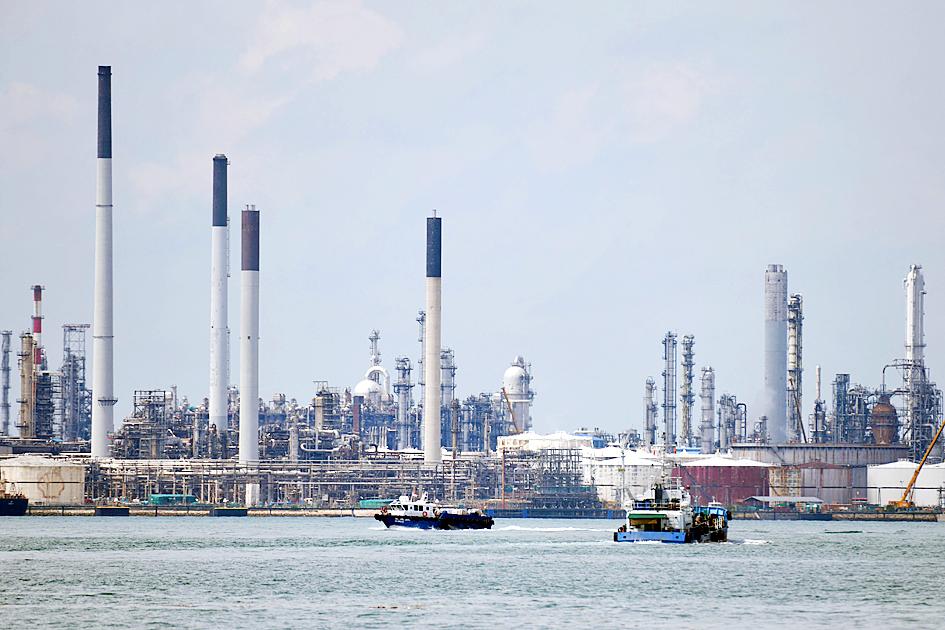
Photo: AFP
Oil has rallied this year as the rollout of vaccines to combat the COVID-19 pandemic aids energy demand, spurring a drop in US inventories.
A dramatic surge in natural gas has stoked bets that crude will benefit from spillover demand as users seek alternatives.
Trafigura Group, one of the world’s largest commodity trading houses, is among those that are forecasting higher oil prices.
“It looks like the oil rally has still got some legs,” JTD Energy Services Pte lead strategist John Driscoll said. “Fundamentals are still pretty convincing, demand is recovering, backwardation is increasing. I just don’t see any evidence yet that the rally has topped out.”
While worldwide demand has increased, the OPEC and its allies, including Russia, have been easing supply curbs with great caution.
Crude demand could rise 500,000 barrels a day as high gas prices force a switch, Commonwealth Bank of Australia analyst Vivek Dhar said in a note.
That would tighten markets further, especially with OPEC+ making only conservative additions to supply, Dhar said.
US natural gas rallied again yesterday.
Inventory draws are the “largest on record” and OPEC+ cannot restore the market’s balance, Goldman Sachs Group Inc said in a note this week.
The deficit “will not be reversed in coming months, in our view, as its scale will overwhelm both the willingness and ability of OPEC+ to ramp up,” Goldman Sachs said.
Global oil consumption is expected to return to pre-pandemic levels in the third quarter of next year, BP PLC said.
Demand is expected to see an average gain of 3.8 million barrels per day from the same period last year, BP Singapore president Eugene Leong said in an interview.
Oil’s time spreads have widened, signaling that traders are more positive. Brent’s prompt spread was US$0.80 a barrel in backwardation, from US$0.63 two weeks ago. That is bullish, with near-dated prices above those further out.

The domestic unit of the Chinese-owned, Dutch-headquartered chipmaker Nexperia BV will soon be able to produce semiconductors locally within China, according to two company sources. Nexperia is at the center of a global tug-of-war over critical semiconductor technology, with a Dutch court in February ordering a probe into alleged mismanagement at the company. The geopolitical tussle has disrupted supply chains, with some carmakers reportedly forced to cut production due to chip shortages. Local production would allow Nexperia’s domestic arm, Nexperia Semiconductors (China) Ltd (安世半導體中國), to bypass restrictions in place since October on the supply of silicon wafers — etched with tiny components to

Singapore-based ride-hailing and delivery giant Grab Holdings Ltd has applied for regulatory approval to acquire the Taiwan operations of Germany-based Delivery Hero SE's Foodpanda in a deal valued at about US$600 million. Grab submitted the filing to the Fair Trade Commission on Friday last week, with the transaction subject to regulatory review and approval, the company said in a statement yesterday. Its independent governance structure would help foster a healthy and competitive market in Taiwan if the deal is approved, Grab said. Grab, which is listed on the NASDAQ, said in the filing that US-based Uber Technologies Inc holds about 13 percent of
Taiwan is open to joining a global liquefied natural gas (LNG) program if one is created, but on the condition that countries provide delivery even in a scenario where there is a conflict with China, an energy department official said yesterday. While Taiwan’s priority is to have enough LNG at home, the nation is open to exploring potential strategic reserves in other countries such as Japan or South Korea, Energy Administration Deputy Director-General Chen Chung-hsien (陳崇憲) said. While the LNG market does not have a global reserve for emergencies like that of oil, the concept has been raised a few times —

Taiwan Semiconductor Manufacturing Co (TSMC, 台積電) yesterday received government approval to deploy its advanced 3-nanometer (3nm) process at its second fab currently under construction in Japan, the Ministry of Economic Affairs said in a news release. The ministry green-lit the plan for the facility in Kumamoto, which is scheduled to start installing equipment and come online in 2028 with a monthly production capacity of 15,000 12-inch wafers, the ministry said. The Department of Investment Review in June 2024 authorized a US$5.26 billion investment for the facility, slated to manufacture 6- to 12nm chips, significantly less advanced than 3nm process. At a meeting with


 RSS
RSS