


Tesla Inc chief executive officer Elon Musk yesterday spoke at the opening of China’s World Internet Conference, reassuring Beijing about his company’s commitment to invest and expand in the country against a backdrop of unprecedented economic turbulence.
The summit was opened by Chinese President Xi Jinping’s (習近平) promise that China would work with all countries to create a vibrant digital economy and improve supervision effectiveness, in remarks delivered by Chinese Vice Premier Liu He (劉鶴).
Also participating in the event remotely were Pat Gelsinger, the recently appointed CEO of Intel Corp, and Qualcomm Inc CEO Cristiano Amon, who stepped into the top role this summer.
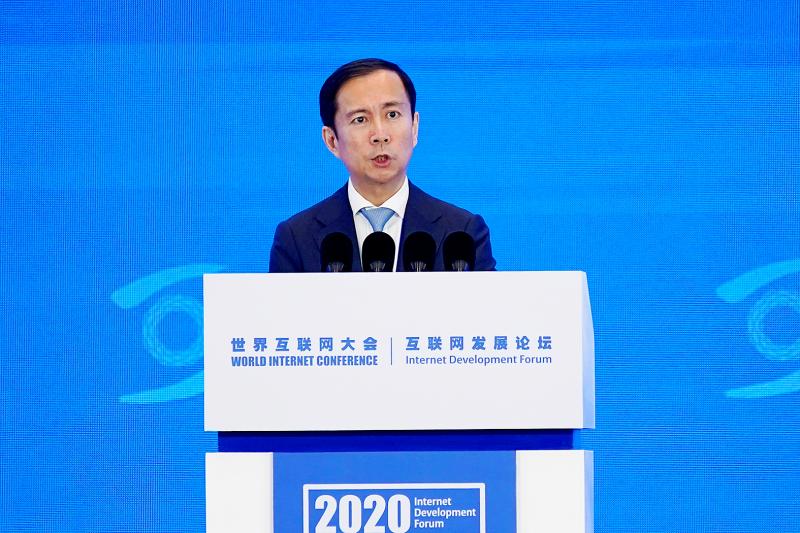
Photo: Reuters
The inclusion of the US business leaders alongside domestic firms such as Alibaba Group Holding Ltd (阿里巴巴) and Xiaomi Corp (小米) might restore some sense of normalcy in the midst of an 11-month campaign to rein in the power of big tech.
“At Tesla, we are glad to see a number of laws and regulations that have been released to strengthen data management,” Musk said by videoconference.
“Tesla has set up a data center in China to localize all data generated from our business here, including production, sales, service and charging,” he said, adding that for the first time these kinds of information would be stored locally. “Data protection is not only an issue of one single company, but should be a mutual effort for all industry players.”
It marks the second time in 10 days that Musk has lauded China’s credentials as “a global leader in digitalization,” adding yesterday that Tesla would continue to expand its investment into the country and “hopes to contribute to build a digitized future of shared benefits, responsibilities and governance.”
Qualcomm’s Amon commended the speed of China’s 5G rollout and the many relationships his company has cultivated with local device makers, urging US and Chinese companies to work together more.
Cisco Systems Inc CEO Chuck Robbins also joined to speak about aligning with Xi’s vision of a shared cyberspace community for the benefit of all.
This collaborative international tone was in contrast to the great domestic upheaval for China’s Internet firms. From Jack Ma’s (馬雲) Alibaba and Ant Group Co (螞蟻集團) to Tencent Holdings Ltd (騰訊) and Didi Global Inc (滴滴), the biggest tech companies have weathered a series of crackdowns that expanded from online commerce to gaming, entertainment and online finance.
All are dealing with heightened uncertainty, as Beijing takes steps to rein in unruly Internet spheres and nudge its young people toward more productive pastimes.
“Platform companies should stand up to help solve top concerns from the public and the government regarding corporate management, user privacy protection and data security,” Alibaba CEO Daniel Zhang (張勇) said in a video message.
He and Xiaomi cofounder Lei Jun (雷軍) addressed the importance of big companies helping smaller ones prosper.
“Platform economies can only sustainably develop if they are more inclusive, more fair, more standardized and allow more people and more SMEs [small and medium-sized enterprises] to participate,” Zhang said.
Tesla, Intel and Qualcomm are among a handful of US companies with ambitions to expand their business in China. The country is the world’s biggest market for electric vehicles as well as smartphones, making it a crucial battleground for acquiring new customers.
Qualcomm processors dominate the Chinese smartphone arena, while Intel stands to benefit from the country’s expanding investment in data centers and Internet infrastructure to support cloud services.

The domestic unit of the Chinese-owned, Dutch-headquartered chipmaker Nexperia BV will soon be able to produce semiconductors locally within China, according to two company sources. Nexperia is at the center of a global tug-of-war over critical semiconductor technology, with a Dutch court in February ordering a probe into alleged mismanagement at the company. The geopolitical tussle has disrupted supply chains, with some carmakers reportedly forced to cut production due to chip shortages. Local production would allow Nexperia’s domestic arm, Nexperia Semiconductors (China) Ltd (安世半導體中國), to bypass restrictions in place since October on the supply of silicon wafers — etched with tiny components to

Singapore-based ride-hailing and delivery giant Grab Holdings Ltd has applied for regulatory approval to acquire the Taiwan operations of Germany-based Delivery Hero SE's Foodpanda in a deal valued at about US$600 million. Grab submitted the filing to the Fair Trade Commission on Friday last week, with the transaction subject to regulatory review and approval, the company said in a statement yesterday. Its independent governance structure would help foster a healthy and competitive market in Taiwan if the deal is approved, Grab said. Grab, which is listed on the NASDAQ, said in the filing that US-based Uber Technologies Inc holds about 13 percent of

Taiwan is open to joining a global liquefied natural gas (LNG) program if one is created, but on the condition that countries provide delivery even in a scenario where there is a conflict with China, an energy department official said yesterday. While Taiwan’s priority is to have enough LNG at home, the nation is open to exploring potential strategic reserves in other countries such as Japan or South Korea, Energy Administration Deputy Director-General Chen Chung-hsien (陳崇憲) said. While the LNG market does not have a global reserve for emergencies like that of oil, the concept has been raised a few times —

Taiwan Semiconductor Manufacturing Co (TSMC, 台積電) yesterday received government approval to deploy its advanced 3-nanometer (3nm) process at its second fab currently under construction in Japan, the Ministry of Economic Affairs said in a news release. The ministry green-lit the plan for the facility in Kumamoto, which is scheduled to start installing equipment and come online in 2028 with a monthly production capacity of 15,000 12-inch wafers, the ministry said. The Department of Investment Review in June 2024 authorized a US$5.26 billion investment for the facility, slated to manufacture 6- to 12nm chips, significantly less advanced than 3nm process. At a meeting with


 RSS
RSS