


China Evergrande Group (恆大集團) inched closer yesterday to the potential default that investors fear, missing a payment deadline in one of the clearest indications yet that the developer whose debt struggles have spooked markets is in dire trouble.
The company owes US$305 billion, has run short of cash, and investors are worried that a collapse could pose systemic risks to China’s financial system and reverberate around the world.
A deadline for paying US$83.5 million in bond interest passed without remark from Evergrande, and bondholders had not been paid nor heard from the company, two people familiar with the situation told Reuters.
The firm is now in uncharted waters and enters a 30-day grace period. It would default if that passes without payment.
“These are periods of eerie silence as no one wants to take massive risks at this stage,” said Howe Chung Wan, head of Asia fixed income at Principal Global Investors in Singapore.
“There’s no precedent to this at the size of Evergrande ... we have to see in the next 10 days or so, before China goes into holiday, how this is going to play out,” he said.
China’s central bank again injected cash into the banking system yesterday, seen as a signal of support for markets. However, authorities have been silent on Evergrande’s predicament, and China’s state media has offered no clues on a rescue package.
Evergrande appointed financial advisers and warned of default last week, and world markets fell heavily on Monday amid fears of contagion, though they have since stabilized.
The conundrum for policymakers is how fiercely they can impose financial discipline without fueling social unrest, since an ugly collapse at Evergrande could crush a property market that accounts for 40 percent of Chinese household wealth.
Protests by disgruntled suppliers, home buyers and investors last week illustrated discontent that could spiral in the event a default sparks crises at other developers.
Evergrande has promised to prioritize such investors and resolved one coupon payment on a domestic bond this week.
However, it has said nothing about the offshore interest payment that was due on Thursday or a US$47.5 million payment due next week.
Bondholders are starting to think that it might be about a month before the situation becomes clearer, and markets have already assumed they could likely take a large haircut.
“Current market pricing estimates that investors in Evergrande’s dollar bonds are likely to recover very little,” said Jennifer James, a portfolio manager and lead emerging markets analyst at Janus Henderson Investors.
“The likeliest outcome is that the company will engage with creditors to come up with a restructuring agreement,” she said, warning that if such a deal is mismanaged “the loss of confidence could have contagion effects.”
Global markets have begun to recover after Evergrande’s plight sparked a sharp selloff, trading on the basis that the crisis can be contained.
Only about US$20 billion of Evergrande’s debts are owed offshore, yet the risks at home are considerable because of the risks to China’s property sector, a vast store of wealth.
“Housing sales and investments could inevitably slow further. This would knock nearly 1 percentage point off GDP growth,” analysts at Societe Generale said in a note.
“The longer policymakers wait before acting, the higher the hard-landing risk,” the note said.
There have been few signs of official intervention. The People’s Bank of China’s 270 billion yuan (US$42 billion) cash injection this week is the largest weekly sum since January, and has helped put a floor under stocks.
Bloomberg Law also reported that regulators had asked Evergrande to avoid a near-term default, citing unnamed people familiar with the matter.

The domestic unit of the Chinese-owned, Dutch-headquartered chipmaker Nexperia BV will soon be able to produce semiconductors locally within China, according to two company sources. Nexperia is at the center of a global tug-of-war over critical semiconductor technology, with a Dutch court in February ordering a probe into alleged mismanagement at the company. The geopolitical tussle has disrupted supply chains, with some carmakers reportedly forced to cut production due to chip shortages. Local production would allow Nexperia’s domestic arm, Nexperia Semiconductors (China) Ltd (安世半導體中國), to bypass restrictions in place since October on the supply of silicon wafers — etched with tiny components to

Singapore-based ride-hailing and delivery giant Grab Holdings Ltd has applied for regulatory approval to acquire the Taiwan operations of Germany-based Delivery Hero SE's Foodpanda in a deal valued at about US$600 million. Grab submitted the filing to the Fair Trade Commission on Friday last week, with the transaction subject to regulatory review and approval, the company said in a statement yesterday. Its independent governance structure would help foster a healthy and competitive market in Taiwan if the deal is approved, Grab said. Grab, which is listed on the NASDAQ, said in the filing that US-based Uber Technologies Inc holds about 13 percent of
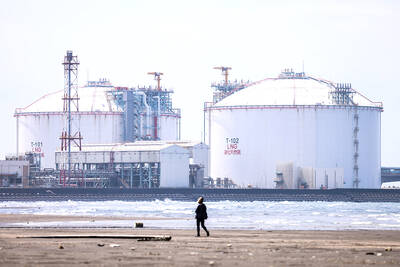
Taiwan is open to joining a global liquefied natural gas (LNG) program if one is created, but on the condition that countries provide delivery even in a scenario where there is a conflict with China, an energy department official said yesterday. While Taiwan’s priority is to have enough LNG at home, the nation is open to exploring potential strategic reserves in other countries such as Japan or South Korea, Energy Administration Deputy Director-General Chen Chung-hsien (陳崇憲) said. While the LNG market does not have a global reserve for emergencies like that of oil, the concept has been raised a few times —

Taiwan Semiconductor Manufacturing Co (TSMC, 台積電) yesterday received government approval to deploy its advanced 3-nanometer (3nm) process at its second fab currently under construction in Japan, the Ministry of Economic Affairs said in a news release. The ministry green-lit the plan for the facility in Kumamoto, which is scheduled to start installing equipment and come online in 2028 with a monthly production capacity of 15,000 12-inch wafers, the ministry said. The Department of Investment Review in June 2024 authorized a US$5.26 billion investment for the facility, slated to manufacture 6- to 12nm chips, significantly less advanced than 3nm process. At a meeting with


 RSS
RSS