


Fitch Ratings yesterday cut its growth forecast for China’s economy this year, citing a slowdown in the country’s colossal property sector, which is facing headwinds over faltering real-estate giant Evergrande Group (恆大集團).
China enjoyed a swift economic rebound from the COVID-19 pandemic, but strict new rules on the country’s developers have caused a deleveraging rush and helped push housing giant Evergrande to a crisis point.
Financial markets have tumbled over fears that the Chinese group could collapse, leading to possible contagion in the world’s second-largest economy and beyond.

Photo: AP
Evergrande shares soared as much as 32 percent yesterday in the biggest daily percentage rise since listing in November 2009, after its unit said on Wednesday it had “resolved” a coupon payment on an onshore bond.
Fitch said it expected China’s economic growth to come in at 8.1 percent this year, compared with a previous 8.4 percent estimate, saying the “main factor weighing on the outlook is the slowdown in the property sector.”
Weakness in the property market comes after a bout of regulatory tightening by authorities looking to rein in surging prices and companies’ excessive borrowing.
Beijing has cracked down on developers in a bid to force them to offload debt, introducing its “three red lines” to curb leverage last year.
“Housing starts are falling and financial pressures are weighing on real-estate investment,” Fitch said in its latest report.
“Residential investment directly accounts for around 10 percent of GDP, and property activity has large spillovers to other industries,” it added.
Chinese Premier Li Keqiang (李克強) on Wednesday called for efforts to keep the economy running steadily, state media reported.
A State Council meeting he chaired underlined measures to promote consumption, stabilize commodity prices, and maintain growth of foreign investment and trade.
Separately, Chinese Estates Holdings Ltd (華人置業集團), the second-largest shareholder of Evergrande, said yesterday it had sold US$32 million of its Evergrande stake and plans to exit the holding completely.
“The directors are cautious and concerned about the recent development of China Evergrande Group, including certain disclosure ... on its liquidity,” Chinese Estates said in a filing to the Hong Kong Stock Exchange.
Chinese Estates, which owned about 6.5 percent of Evergrande’s equity as of Sept. 10, data showed, said it has mandated a sale of all or part of the remaining 5.66 percent Evergrande stake either on the market or through block trades.
The disposal mandate is valid for 12 months from yesterday’s shareholders’ meeting to approve the sale, it said.
Chinese Estates said it had already sold 108.91 million shares, or 0.82 percent, of Evergrande’s issued share capital between Aug. 30 and Tuesday for HK$246.5 million (US$31.67 million).
The company estimated that if the entire stake is sold, it would realize a loss of about HK$9.49 billion for the year ending in December.

The domestic unit of the Chinese-owned, Dutch-headquartered chipmaker Nexperia BV will soon be able to produce semiconductors locally within China, according to two company sources. Nexperia is at the center of a global tug-of-war over critical semiconductor technology, with a Dutch court in February ordering a probe into alleged mismanagement at the company. The geopolitical tussle has disrupted supply chains, with some carmakers reportedly forced to cut production due to chip shortages. Local production would allow Nexperia’s domestic arm, Nexperia Semiconductors (China) Ltd (安世半導體中國), to bypass restrictions in place since October on the supply of silicon wafers — etched with tiny components to

Singapore-based ride-hailing and delivery giant Grab Holdings Ltd has applied for regulatory approval to acquire the Taiwan operations of Germany-based Delivery Hero SE's Foodpanda in a deal valued at about US$600 million. Grab submitted the filing to the Fair Trade Commission on Friday last week, with the transaction subject to regulatory review and approval, the company said in a statement yesterday. Its independent governance structure would help foster a healthy and competitive market in Taiwan if the deal is approved, Grab said. Grab, which is listed on the NASDAQ, said in the filing that US-based Uber Technologies Inc holds about 13 percent of
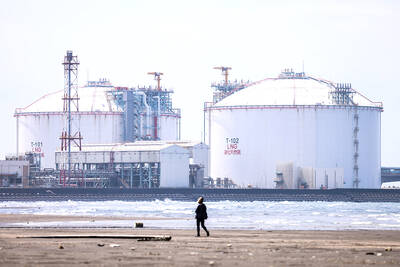
Taiwan is open to joining a global liquefied natural gas (LNG) program if one is created, but on the condition that countries provide delivery even in a scenario where there is a conflict with China, an energy department official said yesterday. While Taiwan’s priority is to have enough LNG at home, the nation is open to exploring potential strategic reserves in other countries such as Japan or South Korea, Energy Administration Deputy Director-General Chen Chung-hsien (陳崇憲) said. While the LNG market does not have a global reserve for emergencies like that of oil, the concept has been raised a few times —

Taiwan Semiconductor Manufacturing Co (TSMC, 台積電) yesterday received government approval to deploy its advanced 3-nanometer (3nm) process at its second fab currently under construction in Japan, the Ministry of Economic Affairs said in a news release. The ministry green-lit the plan for the facility in Kumamoto, which is scheduled to start installing equipment and come online in 2028 with a monthly production capacity of 15,000 12-inch wafers, the ministry said. The Department of Investment Review in June 2024 authorized a US$5.26 billion investment for the facility, slated to manufacture 6- to 12nm chips, significantly less advanced than 3nm process. At a meeting with


 RSS
RSS