


Asian shares steadied on Friday after losses earlier in the week, but China jitters and global growth concerns weighed on investors’ minds, while the US dollar sat near a three-week high.
The MSCI Asia Pacific Index rose 0.25 percent to 203.32, but was down 1.6 percent for the week.
The TAIEX on Friday fell less than 0.1 percent to 17,276.79 points, down 1.13 percent for the week.
“We’re looking at a market that is nervous, though hasn’t seen sentiment turn outright bearish,” IG markets analyst Kyle Rodda said. “If you look for catalysts that could justify the next move to the upside in equities and risk assets, they are nowhere to be seen because global growth concerns are keeping investors on edge.”
Hong Kong’s Hang Seng Index rose 1 percent to 24,920,76, with traders looking for oversold stocks after the benchmark posted its lowest close in 10 months the day before, as the saga around China Evergrande Group (恒大集團) lurched toward a conclusion. The index fell 4.9 percent for the week.
The embattled property developer’s shares dropped a further 11.8 percent on Friday, down 35 percent this week, but there were gains elsewhere, including in technology stocks.
The previously bruised Hang Seng Tech Index rose 2.8 percent on Friday.
Australia’s S&P/ASX 200 fell 0.8 percent to 7,403.70, as a fall in iron ore prices hurt miners. The index was virtually unchanged for the week.
Chinese blue chips edged up 0.58 percent.
Japan’s Nikkei 225 gained 0.6 percent to head back toward a 31-year high hit on Monday. The benchmark index rose 0.4 percent weekly. The TOPIX on Friday added 0.5 percent and rose 0.4 percent for the week.
India’s SENSEX on Friday fell 0.2 percent, tapering its weekly gain to 1.2 percent.
Due next week is a policy meeting of Indonesia’s central bank, but all 25 analysts surveyed by Reuters expected Bank Indonesia to keep its key interest rate steady.
Chinese data earlier this week suggested that growth in the world’s second-largest economy would slow in the second half of this year, while economists polled by Reuters said they expected the US economic rebound to have been dented in the third quarter.
Respondents to that poll also pushed back expectations for the US Federal Reserve to announce a tapering of asset purchases to November.
This means next week’s Fed policy meeting is likely less consequential than would have been expected a few months ago when many investors felt a tapering announcement was an option this month, but traders would still be watching closely for any policy clues from the meeting, especially after the US posted an unexpected increase in retail sales on Thursday.
Additional reporting by staff writer

The domestic unit of the Chinese-owned, Dutch-headquartered chipmaker Nexperia BV will soon be able to produce semiconductors locally within China, according to two company sources. Nexperia is at the center of a global tug-of-war over critical semiconductor technology, with a Dutch court in February ordering a probe into alleged mismanagement at the company. The geopolitical tussle has disrupted supply chains, with some carmakers reportedly forced to cut production due to chip shortages. Local production would allow Nexperia’s domestic arm, Nexperia Semiconductors (China) Ltd (安世半導體中國), to bypass restrictions in place since October on the supply of silicon wafers — etched with tiny components to

Singapore-based ride-hailing and delivery giant Grab Holdings Ltd has applied for regulatory approval to acquire the Taiwan operations of Germany-based Delivery Hero SE's Foodpanda in a deal valued at about US$600 million. Grab submitted the filing to the Fair Trade Commission on Friday last week, with the transaction subject to regulatory review and approval, the company said in a statement yesterday. Its independent governance structure would help foster a healthy and competitive market in Taiwan if the deal is approved, Grab said. Grab, which is listed on the NASDAQ, said in the filing that US-based Uber Technologies Inc holds about 13 percent of
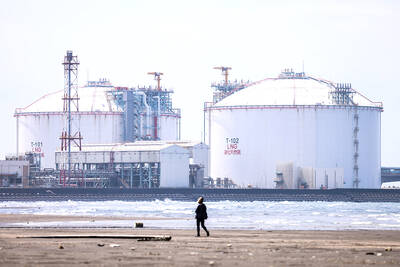
Taiwan is open to joining a global liquefied natural gas (LNG) program if one is created, but on the condition that countries provide delivery even in a scenario where there is a conflict with China, an energy department official said yesterday. While Taiwan’s priority is to have enough LNG at home, the nation is open to exploring potential strategic reserves in other countries such as Japan or South Korea, Energy Administration Deputy Director-General Chen Chung-hsien (陳崇憲) said. While the LNG market does not have a global reserve for emergencies like that of oil, the concept has been raised a few times —

Taiwan Semiconductor Manufacturing Co (TSMC, 台積電) yesterday received government approval to deploy its advanced 3-nanometer (3nm) process at its second fab currently under construction in Japan, the Ministry of Economic Affairs said in a news release. The ministry green-lit the plan for the facility in Kumamoto, which is scheduled to start installing equipment and come online in 2028 with a monthly production capacity of 15,000 12-inch wafers, the ministry said. The Department of Investment Review in June 2024 authorized a US$5.26 billion investment for the facility, slated to manufacture 6- to 12nm chips, significantly less advanced than 3nm process. At a meeting with


 RSS
RSS