


Supply chain snags that have roiled commodity markets and this week helped push aluminum prices to a 13-year high are unlikely to ease any time soon.
That was the message coming from producers, consumers, traders and shippers at North America’s largest aluminum conference, which ended on Friday.
Aluminum has jumped 48 percent this year on surging demand, shipping bottlenecks and production curbs in China, stoking inflation concerns and causing a major headache for consumer-goods producers facing worsening material shortages alongside a sharp rise in costs.
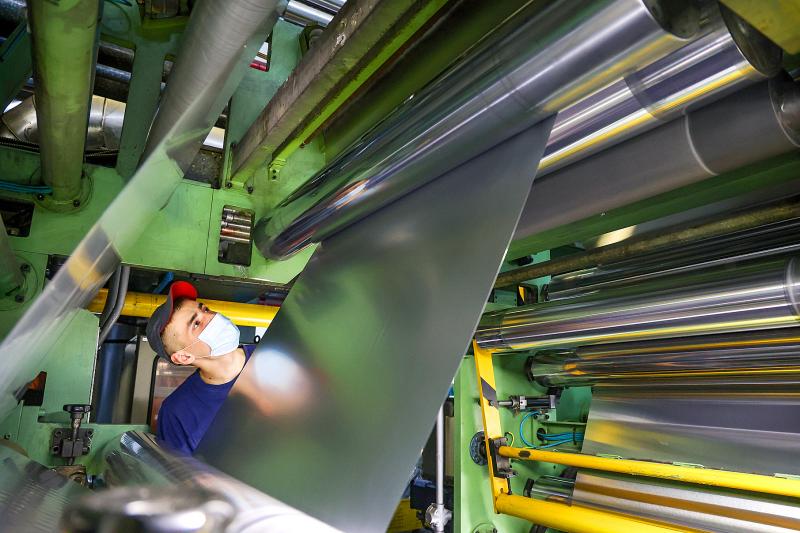
Photo: Bloomberg
Snarled supplies would continue to dog the industry through most of next year, many conference participants said, with some projecting that it could take as long as five years to resolve the issues.
Global supply chains, with container shipping as their backbone, are struggling to keep pace with demand for goods and overcome labor disruptions caused by COVID-19 outbreaks. Compounding matters in the aluminum industry are worker shortages at plants and a lack of truck drivers to deliver what is available.
“For us it’s been a mess, and as we look ahead to 2022 we don’t see this going away any time soon unfortunately,” Commonwealth Rolled Products chief executive officer Mike Keown said at the Harbor Aluminum Summit in Chicago. “For us we think it’s just begun. It’s kept our head on a swivel this entire time.”
Commonwealth makes value-added aluminum products that it sells to the automotive industry, which has faced its own production issues because of a shortage of semiconductors.
Several aluminum conference attendees said that labor shortages are their biggest problem, and they do not have any idea when the situation will improve.
“Consumers are ordering more than 100 percent of their expected needs,” Adam Jackson, director of metals trading at Aegis Hedging, said in an interview. “They don’t expect to receive 100 percent, but if they over-order, maybe they’ll land on the right amount and not forfeit sales. Such a practice has a serious risk if prices fall and you’re carrying extra unhedged inventory.”
The surge in aluminum prices comes as producers and consumers negotiate annual supply contracts.
Buyers are holding off as long as possible from making agreements, because shipping premiums are so high. They are also waiting for indications on whether Russia, the world’s second-largest aluminum producer, will keep an expensive export tax into next year, Harbor Intelligence managing director Jorge Vazquez said.
All of this could signal further price increases.
Harbor Intelligence said its bull case for aluminum next year is an average price of about US$2,570 per tonne.
That is about 9 percent higher than the average so far this year for benchmark aluminum traded in London.
Harbor also estimated that the so-called Midwest premium, the amount added to deliver the metal to the US Midwest, would surge to an all-time-high US$0.40 a pound in the fourth quarter, which would be a 185 percent increase from the end of last year
“Mess is probably a good word,” said Buddy Stemple, chief executive officer of Constellium SE’s rolled-products business in Ravenswood, West Virginia. “I have never been through a period like this in which you had so many factors at once.”
Other commodities:
‧Gold for December delivery fell US$7.90 to US$1,792.10 an ounce, posting a weekly decline of 2.27 percent.
‧Silver for December delivery fell US$0.28 to US$23.90 an ounce, declining 3.63 percent from a week earlier, while December copper increased US$0.16 to US$4.45 a pound, dropping 2.7 percent week-on-week.
Additional reporting by AP

The domestic unit of the Chinese-owned, Dutch-headquartered chipmaker Nexperia BV will soon be able to produce semiconductors locally within China, according to two company sources. Nexperia is at the center of a global tug-of-war over critical semiconductor technology, with a Dutch court in February ordering a probe into alleged mismanagement at the company. The geopolitical tussle has disrupted supply chains, with some carmakers reportedly forced to cut production due to chip shortages. Local production would allow Nexperia’s domestic arm, Nexperia Semiconductors (China) Ltd (安世半導體中國), to bypass restrictions in place since October on the supply of silicon wafers — etched with tiny components to

Singapore-based ride-hailing and delivery giant Grab Holdings Ltd has applied for regulatory approval to acquire the Taiwan operations of Germany-based Delivery Hero SE's Foodpanda in a deal valued at about US$600 million. Grab submitted the filing to the Fair Trade Commission on Friday last week, with the transaction subject to regulatory review and approval, the company said in a statement yesterday. Its independent governance structure would help foster a healthy and competitive market in Taiwan if the deal is approved, Grab said. Grab, which is listed on the NASDAQ, said in the filing that US-based Uber Technologies Inc holds about 13 percent of

Taiwan is open to joining a global liquefied natural gas (LNG) program if one is created, but on the condition that countries provide delivery even in a scenario where there is a conflict with China, an energy department official said yesterday. While Taiwan’s priority is to have enough LNG at home, the nation is open to exploring potential strategic reserves in other countries such as Japan or South Korea, Energy Administration Deputy Director-General Chen Chung-hsien (陳崇憲) said. While the LNG market does not have a global reserve for emergencies like that of oil, the concept has been raised a few times —

Taiwan Semiconductor Manufacturing Co (TSMC, 台積電) yesterday received government approval to deploy its advanced 3-nanometer (3nm) process at its second fab currently under construction in Japan, the Ministry of Economic Affairs said in a news release. The ministry green-lit the plan for the facility in Kumamoto, which is scheduled to start installing equipment and come online in 2028 with a monthly production capacity of 15,000 12-inch wafers, the ministry said. The Department of Investment Review in June 2024 authorized a US$5.26 billion investment for the facility, slated to manufacture 6- to 12nm chips, significantly less advanced than 3nm process. At a meeting with


 RSS
RSS