


US firms in China are hoping for a meeting between US President Joe Biden and Chinese President Xi Jinping (習近平) this year, a survey showed, as they look for relief from trade barriers raised during the administration of former US president Donald Trump.
More than 60 percent of American Chamber of Commerce (AmCham) in China members surveyed cited the need to restore regular visa services for business executives and their families, a survey released by the group yesterday showed.
Another 47 percent wanted the removal of tariffs, with more than three-quarters of companies complaining that measures levied during the trade war were impacting their operations.
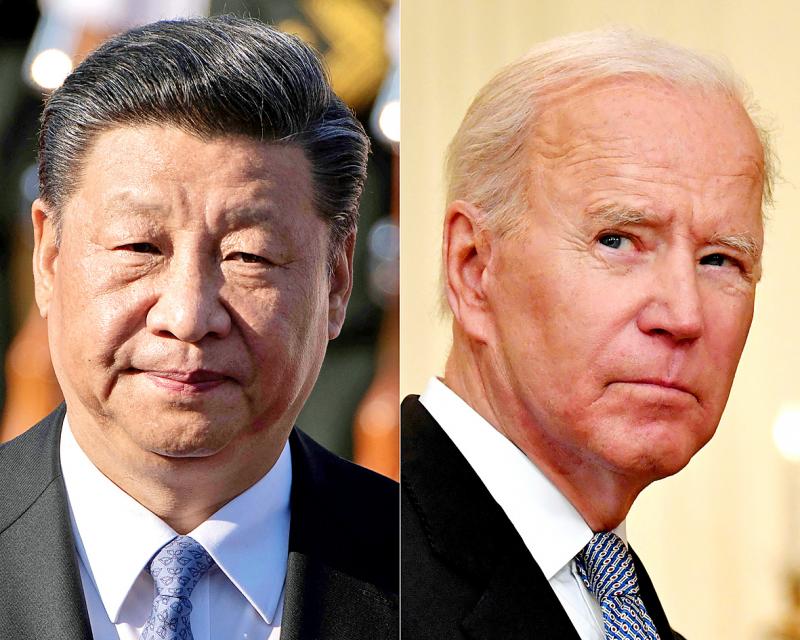
Photo: AFP
Still, the results suggested companies realized that it was necessary to first improve ties that have remained tense, despite Biden’s defeat of Trump in November last year.
About 54 percent of respondents called for “regularized government-to-government communication” to rebuild relations, while 38 percent wanted a Biden-Xi summit this year.
While the chamber did not disclose the names of the 125 companies that participated in the survey last month, its membership includes the Chinese branches of some of the US’ best-known brands, such as Boeing Co, Coca-Cola Co and Walt Disney Co.
Over the past few years, “there’s grown a gap between the two countries and the relevant officials and how much they communicate, which right now is not a lot at all,” AmCham China chairman Greg Gilligan said in an interview with Bloomberg Television yesterday. “If the two countries’ leaders get together and get that process going again, that would be a good thing.”
Gilligan added that Chinese ministries have been asking the chamber if it had questions over recent recently regulatory moves that have shaken up markets.
In response to a question about how companies are reacting, Gilligan said: “I would say there’s kind of a go-slow approach right now to see how things shake out.”
The prospects for a face-to-face meeting between the leaders of the world’s two largest economies look uncertain, although they spoke on the telephone on Thursday night.
Xi has not traveled outside of China in about 600 days as Beijing maintains strict controls against the COVID-19 pandemic, dampening hopes for a meeting with Biden on the sideline of the upcoming UN General Assembly in New York or the G20 summit in Italy.
High-level talks between top US envoys, including US Secretary of State Antony Blinken and US Special Presidential Envoy for Climate John Kerry have so far highlighted disagreements and yielded few results. US Secretary of the Treasury Janet Yellen, who has expressed skepticism on the effectiveness of Trump-era tariffs, is said to be weighing a trip to China.
The survey suggested that companies were feeling more pain from tariffs. Only 22 percent of respondents reported no impact from the measures, compared with 43 percent in the chamber’s Business Climate Survey last year.

The domestic unit of the Chinese-owned, Dutch-headquartered chipmaker Nexperia BV will soon be able to produce semiconductors locally within China, according to two company sources. Nexperia is at the center of a global tug-of-war over critical semiconductor technology, with a Dutch court in February ordering a probe into alleged mismanagement at the company. The geopolitical tussle has disrupted supply chains, with some carmakers reportedly forced to cut production due to chip shortages. Local production would allow Nexperia’s domestic arm, Nexperia Semiconductors (China) Ltd (安世半導體中國), to bypass restrictions in place since October on the supply of silicon wafers — etched with tiny components to

Singapore-based ride-hailing and delivery giant Grab Holdings Ltd has applied for regulatory approval to acquire the Taiwan operations of Germany-based Delivery Hero SE's Foodpanda in a deal valued at about US$600 million. Grab submitted the filing to the Fair Trade Commission on Friday last week, with the transaction subject to regulatory review and approval, the company said in a statement yesterday. Its independent governance structure would help foster a healthy and competitive market in Taiwan if the deal is approved, Grab said. Grab, which is listed on the NASDAQ, said in the filing that US-based Uber Technologies Inc holds about 13 percent of

Taiwan is open to joining a global liquefied natural gas (LNG) program if one is created, but on the condition that countries provide delivery even in a scenario where there is a conflict with China, an energy department official said yesterday. While Taiwan’s priority is to have enough LNG at home, the nation is open to exploring potential strategic reserves in other countries such as Japan or South Korea, Energy Administration Deputy Director-General Chen Chung-hsien (陳崇憲) said. While the LNG market does not have a global reserve for emergencies like that of oil, the concept has been raised a few times —

Taiwan Semiconductor Manufacturing Co (TSMC, 台積電) yesterday received government approval to deploy its advanced 3-nanometer (3nm) process at its second fab currently under construction in Japan, the Ministry of Economic Affairs said in a news release. The ministry green-lit the plan for the facility in Kumamoto, which is scheduled to start installing equipment and come online in 2028 with a monthly production capacity of 15,000 12-inch wafers, the ministry said. The Department of Investment Review in June 2024 authorized a US$5.26 billion investment for the facility, slated to manufacture 6- to 12nm chips, significantly less advanced than 3nm process. At a meeting with


 RSS
RSS