


Hon Hai Precision Industry Co (鴻海) is to produce new-generation silicon carbide (SiC) chips used in electric vehicles (EVs) as it seeks to resolve key choke points in global EV supply chains, company chairman Young Liu (劉揚偉) told a technology forum yesterday.
Long battery charging times, relatively short driving distance and higher sales tags than vehicles powered by gasoline hinder the swift uptake of EVs, Liu told the virtual forum arranged by SEMI, an association that represents the global semiconductor sector.
“We want to help our customers solve those problems. That is why we bought a 6-inch fab in Hsinchu from Macronix International Co (旺宏) in August,” Liu said.
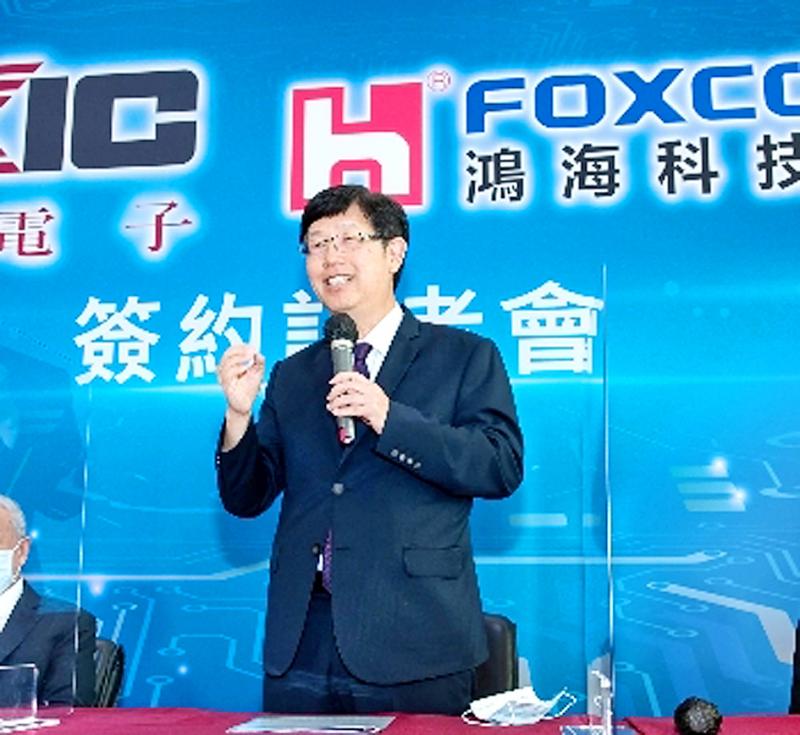
Photo courtesy of Hon Hai Precision Industry Co
Company research showed that SiC technology would solve those problems, Liu said, adding that semiconductors comprise about 30 percent of the manufacturing cost of EVs and power chips are the key semiconductors in EVs.
SiC chips are recognized by EV manufacturers for their thermal conductivity, low thermal expansion, lower power usage and high energy efficiency.
The Hsinchu fab is to be converted into a manufacturing facility for SiC chips, as well as a research and development center for SiC semiconductors, Liu said.
The converted fab would have an installed capacity of 15,000 wafers per month, which obviously lags behind future demand, he said.
Hon Hai has also expanded into different regions, including Japan, with a share in an 8-inch fab in Fukuyama, and Malaysia, with a share in an 8-inch fab owned by Silterra Malaysia Sdn Bhd.
Hon Hai also plans to make power chips, radio frequency chips and complementary metal-oxide semiconductor image sensors at the fabs, he said.
The company is discussing collaborations with some of the top semiconductor firms, Liu said.
SiC semiconductors have the potential to replace silicon, the leading material, on many power fronts, as SEMI’s Power & Compound Fab Report to 2024 shows.
Capital investments of nearly US$7 billion would this year be made in compound semiconductors, such as SiC chips, SEMI Taiwan president Terry Tsao (曹世綸) said yesterday.
The investment total marked a new record, he added.
With demand growing rapidly, investment next year is expected to reach US$8.5 billion, as compound semiconductors are used in EVs, the green energy industry and 5G communications applications, Tsao said.
SEMI and the Hon Hai Research Institute (鴻海研究院) are to jointly hold a forum on compound semiconductors for EVs, called the NExT Forum, on Thursday.
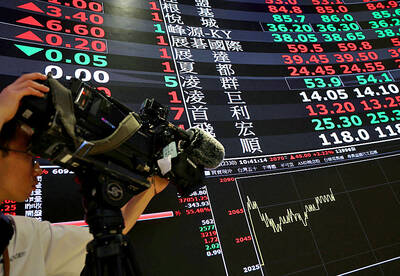
After several years flying high as Asia’s best Nvidia Corp proxy, Taiwan Semiconductor Manufacturing Co (TSMC, 台積電) is increasingly vying with other artificial intelligence (AI) stocks for investor attention. Stock traders are chasing a wider array of beneficiaries as mainstream usage of AI creates demand for hardware beyond the most-advanced chips TSMC makes for Nvidia. Subthemes from the deepening memory crunch to advances in robotics are also luring bids. At the same time, investment caps on single stocks are pushing funds to diversify, while retail investors long familiar with TSMC through its US depositary receipts are being offered a broader set of
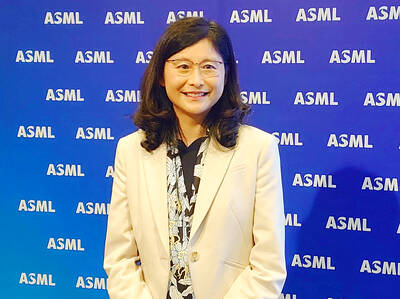
Netherlands-based semiconductor equipment supplier ASML Holding NV yesterday said that it is planning to hire an additional 1,000 people in Taiwan this year in response to growing demand from clients. ASML had previously planned to recruit 600 people this year, but that the plan has been adjusted upward, ASML vice president and ASML Taiwan general manager Grace Wang (汪佳慧) told reporters. ASML has a workforce of more than 4,500 in Taiwan, accounting for about 10 percent of its global total, Wang said. This year’s recruitment campaign would focus on adding people in the customer support, manufacturing and supply chain domains to assist ASML

UNDER MICROSCOPE: Taiwan detained three people who allegedly conspired to buy servers in Taiwan and export them using fraudulent documentation, prosecutors said Nvidia Corp chief executive officer Jensen Huang (黃仁勳) on Saturday urged Super Micro Computer Inc to tighten up on compliance after Taiwan detained three people this week for allegedly making fraudulent declarations about artificial intelligence (AI) servers made by its US partner. The development marked the nation’s first crackdown on semiconductor smuggling, which grew after the US slapped restrictions on exports of high-end chips such as Nvidia AI accelerators to China. Nvidia is “rigorous” in explaining regulations to all of its partners, Huang told reporters after arriving in Taipei. “Ultimately Super Micro has to run their own company,” he said in response to

Nvidia Corp yesterday announced that CEO Jensen Huang (黃仁勳) would attend an employee meeting in Taipei tomorrow to celebrate the launch of the company’s Taiwan headquarters project. Huang would attend a gathering at the site of Nvidia’s planned headquarters in Beitou Shilin Technology Park (北投士林科技園區), the company said in a statement. After arriving in Taiwan on Saturday last week, Huang told reporters that he plans to meet with Quanta Computer Inc (廣達) chairman Barry Lam (林百里) and Taiwan Semiconductor Manufacturing Co (TSMC, 台積電) chairman C.C. Wei (魏哲家), and would attend the groundbreaking ceremony for Nvidia’s Taiwan headquarters tomorrow. Nvidia has not yet applied


 RSS
RSS