


European stocks slipped on Friday as US employment data pointed toward slowing growth in the world’s largest economy, with retail and travel stocks exposed to US markets suffering the most.
The pan-European STOXX 600 slipped 0.6 percent, marking its worst fall in two weeks after data showed that the US economy created the fewest jobs in seven month last month. The index fell 0.03 percent for the week.
Global equities also tumbled after the data.
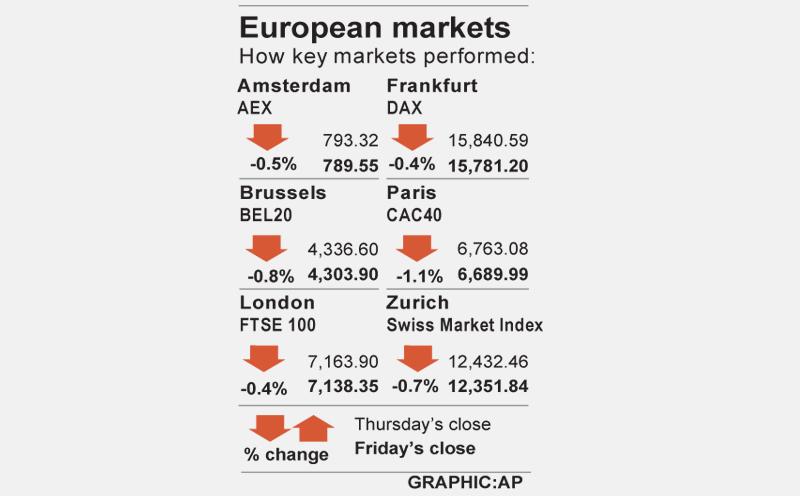
Retail stocks were among the worst performers for the day, dropping 0.9 percent.
Bookseller WH Smith PLC, which makes at least one-quarter of its earnings from US customers, was the worst performer in the sector, down 3.4 percent.
Travel stocks sank 1 percent.
The laggard US data were attributed to a rise in the highly contagious Delta variant of SARS-CoV-2.
However, analysts saw a bright side in the reading, specifically that weakness in the job market would give less impetus to the US Federal Reserve to rein in liquidity measures.
“Friday’s weaker-than-expected jobs puts less pressure on the Fed to taper its stimulus, which is likely to provide a short-term boost for stocks. The stock market loves stimulus and any indication that the Fed will remain fully accommodative is good news for investors,” Zega Financial chief executive officer Jay Pestrichelli said.
European technology stocks were the best performers for the week, up nearly 2 percent as investors fled to sectors most resilient to disruptions caused by the COVID-19 pandemic.
A private survey also showed that activity in China’s services sector contracted sharply last month as restrictions to curb the Delta variant threatened to derail the recovery.
However, eurozone business activity remained strong last month, IHS Markit’s survey showed, suggesting the bloc’s economy could be back to pre-pandemic levels by the end of this year, despite fears about the Delta variant and widespread supply chain issues.
The European Central Bank is to meet next week amid calls from several hawkish members to slow down its pandemic-era purchases program.
A Reuters poll sees the bank announcing a cut to its asset purchases, given a recent spike in inflation.

The domestic unit of the Chinese-owned, Dutch-headquartered chipmaker Nexperia BV will soon be able to produce semiconductors locally within China, according to two company sources. Nexperia is at the center of a global tug-of-war over critical semiconductor technology, with a Dutch court in February ordering a probe into alleged mismanagement at the company. The geopolitical tussle has disrupted supply chains, with some carmakers reportedly forced to cut production due to chip shortages. Local production would allow Nexperia’s domestic arm, Nexperia Semiconductors (China) Ltd (安世半導體中國), to bypass restrictions in place since October on the supply of silicon wafers — etched with tiny components to

Singapore-based ride-hailing and delivery giant Grab Holdings Ltd has applied for regulatory approval to acquire the Taiwan operations of Germany-based Delivery Hero SE's Foodpanda in a deal valued at about US$600 million. Grab submitted the filing to the Fair Trade Commission on Friday last week, with the transaction subject to regulatory review and approval, the company said in a statement yesterday. Its independent governance structure would help foster a healthy and competitive market in Taiwan if the deal is approved, Grab said. Grab, which is listed on the NASDAQ, said in the filing that US-based Uber Technologies Inc holds about 13 percent of

Taiwan is open to joining a global liquefied natural gas (LNG) program if one is created, but on the condition that countries provide delivery even in a scenario where there is a conflict with China, an energy department official said yesterday. While Taiwan’s priority is to have enough LNG at home, the nation is open to exploring potential strategic reserves in other countries such as Japan or South Korea, Energy Administration Deputy Director-General Chen Chung-hsien (陳崇憲) said. While the LNG market does not have a global reserve for emergencies like that of oil, the concept has been raised a few times —

Taiwan Semiconductor Manufacturing Co (TSMC, 台積電) yesterday received government approval to deploy its advanced 3-nanometer (3nm) process at its second fab currently under construction in Japan, the Ministry of Economic Affairs said in a news release. The ministry green-lit the plan for the facility in Kumamoto, which is scheduled to start installing equipment and come online in 2028 with a monthly production capacity of 15,000 12-inch wafers, the ministry said. The Department of Investment Review in June 2024 authorized a US$5.26 billion investment for the facility, slated to manufacture 6- to 12nm chips, significantly less advanced than 3nm process. At a meeting with


 RSS
RSS