


The Ministry of Economic Affairs (MOEA) yesterday promised to help entertainment workers who have been hit hard by COVID-19 restrictions by using funds left over from the “Stimulus 4.0” scheme.
Although indoor dining restrictions have been eased, the Central Epidemic Command Center (CECC) has yet to lift the ban on the so-called “eight major special industries,” which include nightclubs, hostess and karaoke bars, teahouses and saunas.
They would likely be reopened only after the nation’s vaccination rate reaches 60 percent, the CECC has said.
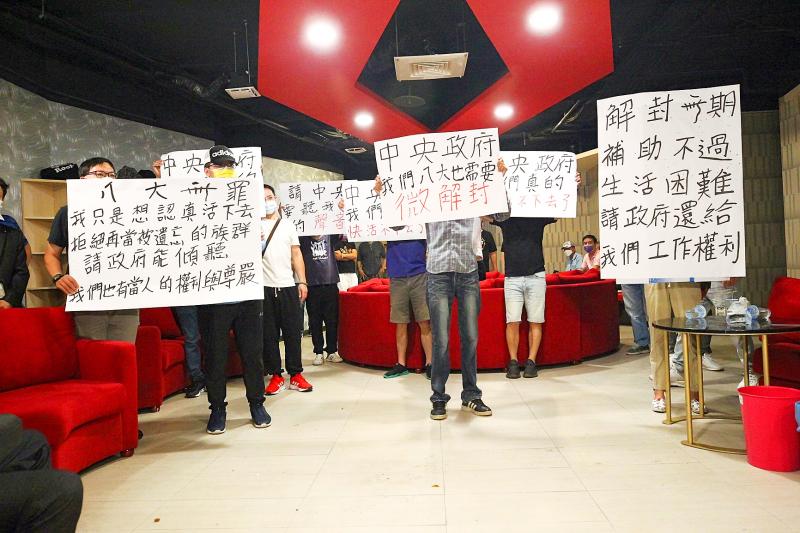
Photo: Taipei Times
Yesterday, more than 300 workers from the eight industries took to the streets to protest, asking for the right to work or for more subsidy from the government.
The protest follows the suicide earlier this week of a 36-year-old single mother, who reports said could not cope with the bills, as the dance hall where she worked has been closed since May.
When asked about the “eight industries” on a Z Media (震傳媒) show hosted by veteran media worker Frances Huang (黃光芹) on Wednesday, Minister of Economic Affairs Wang Mei-hua (王美花) said that the ministry was coordinating with the CECC to offer relief.
Asked about the prospects of a “Stimulus 5.0,” Wang said that was also under consideration.
“We have been meeting internally to help the businesses that can not yet reopen, such as the eight industries, but it is not anything we can officially announce yet,” Wang said.
The ministry yesterday confirmed that help is on the way.
“With the COVID-19 situation worldwide still severe and new developments domestically, we must remain on high alert even as we gradually loosen restrictions,” the ministry said. “Vaccination remains our top priority, and some businesses must remain restricted for now.”
The ministry is inclined to provide relief to affected businesses directly according to the number of employees using funds left over from the Stimulus 4.0 scheme, but it is still figuring out the details.
Although the Stimulus 4.0 program stopped accepting new cases as of the end of last month, some cases are still under review, meaning the amount of funds remaining has yet to be determined.
However, the ministry said there should be “enough” to take care of affected businesses for a period.
As it is still working out the details, the ministry declined to provide concrete figures and a timeline, saying only that it is working “as quickly as possible.”

The domestic unit of the Chinese-owned, Dutch-headquartered chipmaker Nexperia BV will soon be able to produce semiconductors locally within China, according to two company sources. Nexperia is at the center of a global tug-of-war over critical semiconductor technology, with a Dutch court in February ordering a probe into alleged mismanagement at the company. The geopolitical tussle has disrupted supply chains, with some carmakers reportedly forced to cut production due to chip shortages. Local production would allow Nexperia’s domestic arm, Nexperia Semiconductors (China) Ltd (安世半導體中國), to bypass restrictions in place since October on the supply of silicon wafers — etched with tiny components to

Singapore-based ride-hailing and delivery giant Grab Holdings Ltd has applied for regulatory approval to acquire the Taiwan operations of Germany-based Delivery Hero SE's Foodpanda in a deal valued at about US$600 million. Grab submitted the filing to the Fair Trade Commission on Friday last week, with the transaction subject to regulatory review and approval, the company said in a statement yesterday. Its independent governance structure would help foster a healthy and competitive market in Taiwan if the deal is approved, Grab said. Grab, which is listed on the NASDAQ, said in the filing that US-based Uber Technologies Inc holds about 13 percent of
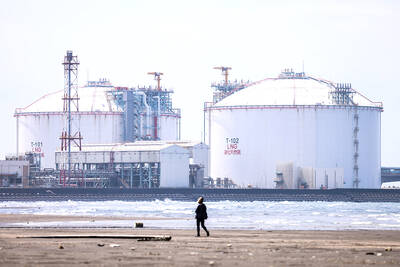
Taiwan is open to joining a global liquefied natural gas (LNG) program if one is created, but on the condition that countries provide delivery even in a scenario where there is a conflict with China, an energy department official said yesterday. While Taiwan’s priority is to have enough LNG at home, the nation is open to exploring potential strategic reserves in other countries such as Japan or South Korea, Energy Administration Deputy Director-General Chen Chung-hsien (陳崇憲) said. While the LNG market does not have a global reserve for emergencies like that of oil, the concept has been raised a few times —

Taiwan Semiconductor Manufacturing Co (TSMC, 台積電) yesterday received government approval to deploy its advanced 3-nanometer (3nm) process at its second fab currently under construction in Japan, the Ministry of Economic Affairs said in a news release. The ministry green-lit the plan for the facility in Kumamoto, which is scheduled to start installing equipment and come online in 2028 with a monthly production capacity of 15,000 12-inch wafers, the ministry said. The Department of Investment Review in June 2024 authorized a US$5.26 billion investment for the facility, slated to manufacture 6- to 12nm chips, significantly less advanced than 3nm process. At a meeting with


 RSS
RSS