


In just two decades from now, half of all domestic ships plying Japan’s coastal waters might be piloting themselves.
That is the ambitious goal of the Nippon Foundation, a public interest organization backing the nation’s development of ocean-traversing autonomous ships. It aims to see crewless ships make up 50 percent of Japan’s local fleet by 2040.
With the foundation’s backing, a group that includes Japan’s largest shipping company, Nippon Yusen KK, plans to have a container ship pilot itself from Tokyo Bay to Ise, a coastal city in central Mie Prefecture, in February next year.
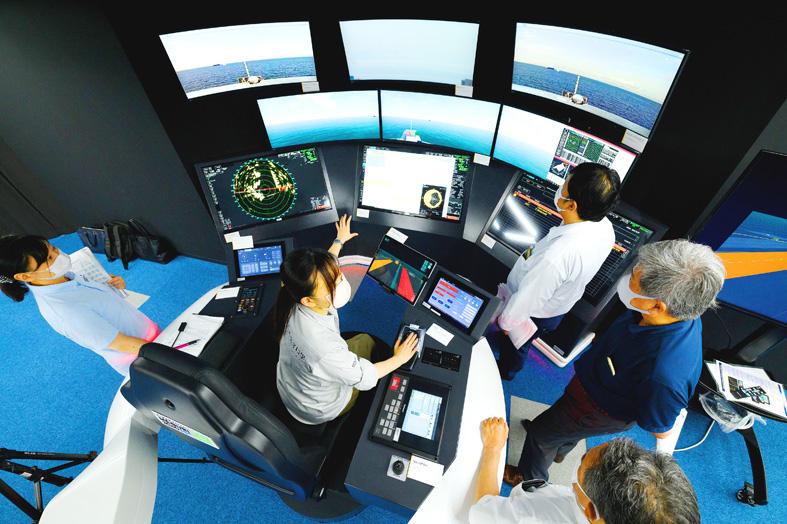
Photo: Bloomberg
According to Nippon Yusen, the 380km voyage would be the world’s first test of an autonomous ship in an area with heavy marine traffic.
The global market for autonomous shipping could grow to be worth about US$166 billion by 2030.
“When it comes to the automation of ships, our mission is to have Japan lead the rest of the world,” Satoru Kuwahara, a general manager at Nippon Yusen subsidiary Japan Marine Science Inc, said in an interview on Thursday.
Kuwahara, a captain himself, said there is a real need for autonomous ships in Japan as the country’s workforce shrinks and rapidly ages. In the nation’s domestic tanker industry, for example, about 40 percent of crew are 55 years or older, according to a recent survey.
The Nippon Foundation estimates that taking into account factors like artificial intelligence, which should improve efficiencies, the development of unmanned ships would have a positive impact of about ¥1 trillion (US$9.1 billion) for Japan’s economy in 2040.
There are other foreseeable benefits too, such as lower insurance premiums and improved safety, Kuwahara said.
Studies on shipping industry safety show that about 70 percent of maritime accidents are caused by human error.
“With the issue of Japan’s shrinking workforce in mind, there’s growing need for these technologies to uphold safety,” he said.
For the February test run, information on everything from weather to radar data points would be collected and crunched at a support center back on land. Directions would then be fed back to the ship. In the case of an upset, the vessel’s steering can be taken over remotely from the center.
Kuwahara said he is confident such technology would be ready to be put into practical use by 2025.
The “immense challenge” would be developing a regulatory environment and industry standards around autonomous shipping by then, he said.
For now, Kuwahara and others are gearing up for next year’s trial run, running simulations at a technology center east of Tokyo.
“We need this technology to be recognized, otherwise actual implementation in society won’t move forward,” Kuwahara said. “As a first demonstration, we can’t fail.”

The domestic unit of the Chinese-owned, Dutch-headquartered chipmaker Nexperia BV will soon be able to produce semiconductors locally within China, according to two company sources. Nexperia is at the center of a global tug-of-war over critical semiconductor technology, with a Dutch court in February ordering a probe into alleged mismanagement at the company. The geopolitical tussle has disrupted supply chains, with some carmakers reportedly forced to cut production due to chip shortages. Local production would allow Nexperia’s domestic arm, Nexperia Semiconductors (China) Ltd (安世半導體中國), to bypass restrictions in place since October on the supply of silicon wafers — etched with tiny components to

Singapore-based ride-hailing and delivery giant Grab Holdings Ltd has applied for regulatory approval to acquire the Taiwan operations of Germany-based Delivery Hero SE's Foodpanda in a deal valued at about US$600 million. Grab submitted the filing to the Fair Trade Commission on Friday last week, with the transaction subject to regulatory review and approval, the company said in a statement yesterday. Its independent governance structure would help foster a healthy and competitive market in Taiwan if the deal is approved, Grab said. Grab, which is listed on the NASDAQ, said in the filing that US-based Uber Technologies Inc holds about 13 percent of

Taiwan is open to joining a global liquefied natural gas (LNG) program if one is created, but on the condition that countries provide delivery even in a scenario where there is a conflict with China, an energy department official said yesterday. While Taiwan’s priority is to have enough LNG at home, the nation is open to exploring potential strategic reserves in other countries such as Japan or South Korea, Energy Administration Deputy Director-General Chen Chung-hsien (陳崇憲) said. While the LNG market does not have a global reserve for emergencies like that of oil, the concept has been raised a few times —

Taiwan Semiconductor Manufacturing Co (TSMC, 台積電) yesterday received government approval to deploy its advanced 3-nanometer (3nm) process at its second fab currently under construction in Japan, the Ministry of Economic Affairs said in a news release. The ministry green-lit the plan for the facility in Kumamoto, which is scheduled to start installing equipment and come online in 2028 with a monthly production capacity of 15,000 12-inch wafers, the ministry said. The Department of Investment Review in June 2024 authorized a US$5.26 billion investment for the facility, slated to manufacture 6- to 12nm chips, significantly less advanced than 3nm process. At a meeting with


 RSS
RSS